
Comprehensive Aquifer Management Planning (CAMP)
The 2008 Legislature approved House Bill 428 and House Bill 644 establishing the Statewide Comprehensive Aquifer Planning and Management Program (Idaho Code § 42-1779) and the Aquifer Planning and Management Fund (Idaho Code § 42-1780). This legislation authorized characterization and planning efforts for ten different basins from 2008 through 2018.
The Comprehensive Aquifer Planning and Management Program was designed to provide IWRB and IDWR with the necessary information to develop plans for managing groundwater and surface water resources into the future. The program had two phases:
- A technical component to characterize the surface water and groundwater resources of each basin
- A planning component to integrate the technical knowledge with an assessment of current and projected future water uses and constraints
At the culmination of this program, the intent was to develop long-range plans for conjunctively managing the water resources of each basin by integrating hydrologic realities with the social needs. These water management plans were designed to address water supply and demand issues looking out 50 years into the future, and investigated strategies which will lead to sustainable water supplies and optimum use of the water resources.

Active CAMP
Eastern Snake Plain Aquifer CAMP
The Eastern Snake Plain Aquifer Comprehensive Aquifer Management Plan
The ESPA is a key element of southern Idaho’s economy and covers approximately 10,800 square miles of Idaho. The ESPA region produces approximately 21% of all goods and services within the State of Idaho—resulting in an estimated annual value of $10 billion. Water is the critical element for this productivity.
For a variety of reasons, groundwater levels in parts of the ESPA declined, leading to a cumulative decrease in aquifer storage, decreased spring flows, and changing Snake River flows that resulted in insufficient water supplies to satisfy existing beneficial uses. IWRB , at the request of the Idaho State Legislature, prepared and submitted a Comprehensive Aquifer Management Plan to address the water supply-and-demand imbalance.
Eastern Snake Plain Aquifer (ESPA) Comprehensive Aquifer Management Plan
Eastern Snake Plain Aquifer (ESPA) Comprehensive Aquifer Management Plan
In 2009, the Eastern Snake Plain Aquifer (ESPA) Comprehensive Aquifer Management Plan was passed into law by the Idaho State Legislature. The plan establishes a long-term program for managing water supply and demand in the ESPA through a phased approach to implementation, together with an adaptive management process to allow for adjustments or changes in management techniques as implementation proceeds. Because of the inherent complexities in the management and responses of the river and aquifer to water budget changes, a very deliberate choice was made to incrementally implement the various mechanisms proposed in the plan.
The Goal of the plan is to: Sustain the economic viability and social and environmental health of the Eastern Snake Plain by adaptively managing a balance between water use and supplies.
The objectives of the plan are to:
- Increase predictability for water users by managing for a reliable supply.
- Create alternatives to administrative water-use curtailment.
- Manage overall demand for water within the Eastern Snake Plain.
- Increase recharge to the aquifer.
- Reduce withdrawals from the aquifer.
ESPA CAMP Process
IWRB was tasked by the Idaho Legislature with developing an Eastern Snake Plain Aquifer (ESPA) Comprehensive Aquifer Management Plan. The Legislature wanted to establish public policy as a settlement framework for future management of the ESPA. In 2007, IWRB presented a framework to the Legislature and in 2009, IWRB presented the Comprehensive Aquifer Management Plan.
Legislation
On August 10, 2006, IWRB hired CDR Associates of Boulder, Colorado to facilitate the ESPA Management Plan development.
Framework Development
After a series of public meetings with stakeholders, IWRB presented the ESPA Plan Framework to the Legislature on February 14, 2007. The framework recognized that supply of and demands for water are out of balance in the Eastern Snake River Plain and the connected Snake River, making more deliberate and coordinated management of surface waters of the Snake River and the underground waters of the ESPA a necessity. The framework set forth the overarching goals and objectives adopted by IWRB for the management of the ESPA.
The ESPA Plan
Guided by the goals and objectives in the framework, the Advisory Committee identified and considered opportunities for managing available water supply and demand to address current and future water-use needs including, but not limited to, those for irrigated agriculture, aquaculture, industry, hydropower, municipalities, real estate development, and domestic users and to protect environmental values.
The long-term objective of the plan is to incrementally achieve a net ESPA water budget change of 600 thousand acre-feet (kaf) annually. It is projected that this hydrologic goal can be achieved by the year 2030 through implementation of a mix of management actions including:
- groundwater to surface water conversions,
- managed aquifer recharge,
- demand reduction through conservation and efficiency improvements, and
- a pilot weather modification (cloud seeding) program in the Upper Snake.
The plan sets forth actions which stabilize and improve spring flows, aquifer levels, and river flows across the Eastern Snake Plain. The plan approaches the 600 kaf target in phases. The phase 1 (1-10 years) hydrologic target is a water budget change between 200-300 kaf.
The ESPA Comprehensive Aquifer Management Plan was adopted by IWRB on January 29, 2009 and passed into law by the Governor of Idaho on April 23, 2009.
Advisory Committee
The framework outlined a process for developing the plan and called for an advisory committee to prepare and recommend a plan to the IWRB. In collaboration with the Governor, IWRB appointed stakeholder representatives to the ESPA Advisory Committee. Beginning in May 2007, the Advisory Committee held monthly meetings. To ensure the process was transparent and inclusive, all meetings were open to the public and all related materials were posted on the website. IWRB and the Advisory Committee worked together to complete the plan for submission to the 2009 Legislature.
Implementation Committee
The ESPA plan included an additional action for the IWRB to establish an Implementation Committee to assist in the implementation of the plan. The Implementation Committee is comprised of the interest groups that were represented on the Advisory Committee and, in most cases, the interest group representatives are the same as those who served on the Advisory Committee. The Implementation Committee is assisting the IWRB in the prioritization, development, implementation, monitoring, and evaluation of the management actions. The Implementation Committee considers and recommends actions and objectives to stabilize and improve spring flows and aquifer levels and effect changes in river flows.
As part of the Implementation Committee, five working groups meet regularly to discuss relevant information and make proposals to the Implementation Committee regarding project implementation and funding. These groups are composed of Implementation Committee members and are supported by IWRB staff. The five working groups are Conversions, Demand Reduction, Funding, Recharge, and Weather Modification.
- Implementation Committee Members
- Implementation Committee Operating Protocols
- Implementation Committee Work Plan
- Implementation Committee Timeline
- Implementation Committee Project Submission Overview
- Documents Associated with Project Proposals to be Considered by the Implementation Committee & 2010 Letters from ESPA Stakeholders to Governor Otter’s Office
ESPA CAMP Archived Documents & Records
IDWR Publications
- Eastern Snake Plain Aquifer Comprehensive Aquifer Management Plan – January 29, 2008
- Addendum to Fluorescent Dye Tracer Tests at the Malad Gorge State Park – November 6, 2009
- Malad Gorge Tracer Tests – September 30, 2009
- The Potential for Recharge at Jensen Grove – April 2009
- Fluorescent Dye Tracer Test at the W-canal Aquifer Recharge Site – March 11, 2009
- Hydrogeologic Conditions at Rangen Spring – March 4, 2009
- Monitoring of Egin, Idaho Recharge Experiment – Fall 2008
- Hydrogeology of the Thousand Springs to Malad Reach of the Enhanced Snake Plain Aquifer Model – September 2008
- Analysis of the 2007 Post Season Recharge Using North Side Canal – June 2008
- Hydrogeologic Analysis of the near Blackfoot to Neeley Reach of the Snake River – March 2008
- Hydrogeologic Analysis of the A&B Irrigation District Area – January 2008
- Phase II Evaluation of Managed Recharge on the Eastern Snake River Plain Development of Recharge Facilities – April 2005
- WIB#50, Part 4 Twin Falls Groundwater Quality Report – 1991-2000 – July 2000
- Feasibility of Large-Scale Managed Recharge of the Eastern Snake Plain Aquifer System, Idaho – 1999
- An Assessment of the Capability of Existing Canal Companies to Deliver Artificial Recharge Water to the Snake Plain Aquifer in Southeast Idaho – 1996
- Summary of Groundwater Conditions in the Oakley Fan Area – July 1994
- Effects of Exchange Wells on the Teton River in the Rexburg – Teton Area, Madison and Fremont Counties, Idaho – October 1991
- Stream Flows in the Snake River Basin – 1989 Conditions of Use and Management – June 1989
- Review of Groundwater Conditions in the Big Lost River Valley – December 1982
- WIB#46 Water Resources of the Upper Henrys Fork Basin in Eastern Idaho – May 1978
- WIB#42 Digital-Model Analysis of the Effects of Water-Use Alternatives on Spring Discharges, Gooding and Jerome Counties, Idaho – November 1976
- WIB#30, Part 8 Heat Flow of the Snake River Plain Region, Southern Idaho – September 1976
- WIB#39 Chemical and Physical Data for Disposal Wells, Eastern Snake River Plain, Idaho – October 1974
- WIB#38 A Progress Report on Results of Test-Drilling and Groundwater Investigations of the Snake Plain Aquifer, Southeastern Idaho, Part 3 – August 1974
- WIB#37 The Availability of Water in the Little Lost River Basin, Idaho – July 1974
- WIB#36 Water Resources of the Aberdeen-Springfield Area, Bingham and Power Counties, Idaho – May 1974
- WIB#32 Part 1 & 2 A Progress Report on Results of Test-Drilling and Groundwater Investigation of the Snake Plain Aquifer, Southeastern Idaho – October 1973
- WIB#23 Groundwater Pumpage from the Snake Plain Aquifer, Southeastern Idaho – September 1971
- WIB#22 Water Resources of the Twin Falls Tract, Twin Falls County, Idaho – July 1971
- St. Anthony Pilot Recharge Project – 1970-1974
- WIB#12 Artificial Recharge to Snake Plain Aquifer – 1969
- WIB#9 Inflow to Snake River between Milner and King Hill – 1969
- WIB#8 Water Resources of Goose/Rock Creek Area – 1969
- WIB#7 Water Level Changes in Mud Lake Area – 1958-1968
- WIB#6 Inflow to Snake River between Milner and King Hill – 1948-1967
IDEQ Publications
- Groundwater Vulnerability Assessment, Snake River Plain, Southern Idaho
- Idaho Snake-Payette Rivers Hydrologic Unit Groundwater Quality Assessment
- Cumulative Impacts Assessment, Thousand Springs Area of the Eastern Snake River Plain, Idaho
- Groundwater Quality Investigation and Wellhead Protection Study — City of Ashton, Idaho
- Evaluation of Water Quality Impact Associated with FMC and Simplot Phosphate Ore Processing Facilities, Pocatello, Idaho
- 2005 Update, Thousand Springs Area of the Eastern Snake River Plain, Idaho
- Groundwater Report, Oregon Trail Subdivision, Twin Falls, Idaho
- Arsenic Occurrence in Groundwater in the Market Lake Area, Idaho
- Possible Sources of Nitrate to the Springs of Southern Gooding County, Eastern Snake River Plain, Idaho
- The Business Community Perspective on Enhanced Protection for the Lower Portneuf Valley Aquifer
- Black Cliffs Groundwater Quality Study: Nitrate Impact
- Nitrate and Emerging Contaminants Evaluation of Springdale, Idaho: Cassia County Nitrate Priority Area
- Groundwater Quality Investigation and Wellhead Protection Study, City of Ashton, Idaho
- Sources of Nitrate Contamination in Groundwater of Pleasant Valley, Power County, Idaho
- Preliminary Assessment of Hydrogeology and Water Quality in Groundwater in Teton County, Idaho
USGS Publications
Presentations & Media
- “Dialogue” Eastern Snake Plain Aquifer Update– Hal Anderson – February 5, 2009
- Joint House Senate Plan Presentation – Hal Anderson – February 2, 2009
- Association of Idaho Cities ESPA CAMP – Hal Anderson – June 11, 2009
- Summary of Cloud Seeding Feasibility/Design Study – North American Weather Consultants – September 2008
- Appraisal Level Economic Analysis for the ESPA CAMP Demand Reduction Options Draft Report – September 30, 2008
- Final A&B Irrigation Dist Groundwater to Surface Water Conversion Project Study -July 10, 2008
- Presentation to Water District 1 Annual Meeting – CDR Associates – March 4, 2008
- Progress Report to the Legislature – February 20, 2008
- ESPA CAMP Presentation to Idaho Water Users Association – CDR Associates – June 19, 2007
- Governor’s Water Summit Presentation – CDR Associates – April 17, 2007
- Eastern Snake Plain Aquifer (ESPA) Comprehensive Management Plan Presented to the Legislature – February 19, 2007
- Draft Framework Presented to Board – CDR Associates – January 22, 2007
- Opportunities to Affect the Water Budget of the ESPA – IWRRI – December 29, 2006
- CDR Presentation to the Board – November 13, 2006
- CDR Summary Presentation to the Board – September 22, 2006
- CDR Presentation to the Board – September 21, 2006
- Presentation by Greg Sullivan – July 13, 2006
- Presentation by Chuck Brockway – July 13, 2006
- Presentation by Jon Bowling – July 13, 2006
- Presentation by Willem A. Schreuder PhD – July 13, 2006
- Presentation by Chuck Brendecke – July 13, 2006
- Presentation by IWRRI – July 13, 2006
- ESPA Plan Development by IDWR to Natural Resource Interim Committee – July 12, 2006
- Planning Overview – Bill Graham – May 12, 2006
- Clear Springs Foods Recommendations – John Simpson – May 12, 2006
- SWC Recommendations – John Simpson – May 12, 2006
- History of Litigation – Phillip Rassier – August 15, 2006
- Aquifer Model Presentation – Alan Wylie – 2006
Other Documents
- Recharge Language for Funding Legislation – February 2, 2010
- Draft Recharge Concept – January 28, 2010
- Legislature CAMP Funding – January 27, 2010
- Spring User Funding Concept Draft – January 20, 2010
- ESPA CAMP Public Comment Summary – January 29, 2009
- DRAFT Eastern Snake River Plain Aquifer (ESPA) Comprehensive Aquifer Management Plan (CAMP) – January 27, 2009
- Sub-Committee Report – Environmental Observations
- Sub-Committee Report – Economic Analysis – Demand Reduction Options
- Draft Management Alternatives Analysis and Packaging
- Draft Funding Principles and Strategies
- Summary of CAMP Modeling Results
- Weather Modification Feasibility Study for the Upper Snake River Basin in Idaho
- All ESPA CAMP Written Public Comments Submitted by Postal Mail and Email – January 5, 2009
- Final AWEP Agreement – 2009
- Proposed Fish and Wildlife Elements for the CAMP – 2008
- DRAFT Eastern Snake River Plain Aquifer (ESPA) Comprehensive Aquifer Management Plan (CAMP) – November 6, 2008
- Weather Modification Feasibility Study for the Upper Snake River Basin in Idaho – October 2008
- History of Lower Snake River – May 2008
- Final Progress Report from the Board to the Legislature – February 1, 2008
- New Surface Water Storage – USBR – September 27, 2007
- Reclamation Managing Water in the West – Managed Aquifer Recharge – August 23, 2007
- ESHMC Model White Paper – August 2, 2007
- W Canal Recharge Project Site Characterization & Recharge Feasibility Report – July 24, 2007
- Advisory Committee Operating Protocols – June 10, 2007
- Advisory Committee Nomination Letter – March 9, 2007
- ESPA Plan Framework – February 14, 2007
- Managed Alternatives Working Group Purpose – November 30, 2006
- Draft Framework to Present to the Legislature – November 30, 2006
- Managed Recharge Background – IDWR – November 27, 2006
- ESPA Framework Plan Draft Schedule – October 26, 2006
- Revised Public Involvement Plan – September 26, 2006
- ESPA INL Newsletter – March 2006
- ESPA INL Newsletter – May 2005
ESPA CAMP Archived Meetings
| Date | Location | Purpose/Committee | Materials |
|---|---|---|---|
| 20101014October 14, 2010 | Chubbuck | Implementation | |
| 20100628June 28-29, 2010 | Boise | Funding | |
| 20100517May 17, 2010 | Teleconference | Implementation |
|
| 20100512May 12, 2010 | Boise | Environmental Task Force | |
| 20100429April 29, 2010 | Jerome | Implementation | |
| 20100402April 2, 2010 | Teleconference | Recharge | |
| 20100323March 23, 2010 | Teleconference | Conversions | |
| 20100323March 23, 2010 | Teleconference | Demand Reduction | |
| 20100322March 22, 2010 | Teleconference | Recharge | |
| 20100305March 5, 2010 | Boise | Implementation |
|
| 20100209February 9, 2010 | Teleconference | Weather Modification | |
| 20100208February 8, 2010 | Teleconference | Conversions |
|
| 20100202February 2, 2010 | Teleconference | Implementation | |
| 20100201February 1, 2010 | Teleconference | Demand Reduction | |
| 20100106January 6, 2010 | Teleconference | Demand Reduction | |
| 20091216December 16-17, 2009 | Jerome | Implementation | |
| 20091209December 9, 2009 | Teleconference | Conversions |
|
| 20091203December 3, 2009 | Teleconference | Funding | |
| 20091202December 2, 2009 | Teleconference | Demand Reduction | |
| 20091123November 23, 2009 | Teleconference | Funding | |
| 20091123November 23, 2009 | Teleconference | Recharge | |
| 20091119November 19, 2009 | Teleconference | Conversions |
|
| 20091110November 10, 2009 | Teleconference | Funding | |
| 20091028October 28, 2009 | Teleconference | Funding | |
| 20091020October 20, 2009 | Weather Modification | |
|
| 20091020October 20, 2009 | Teleconference | Demand Reduction | |
| 20091013October 13, 2009 | Idaho Falls | Implementation | |
| 20091008October 8, 2009 | Teleconference | Recharge | |
| 20091007October 7, 2009 | Teleconference | Conversions | |
| 20090929September 29, 2009 | Teleconference | Demand Reduction | |
| 20090922September 22, 2009 | Teleconference | Conversions |
|
| 20090916September 16, 2009 | Teleconference | Recharge | |
| 20090915September 15, 2009 | Teleconference | Weather Modification | |
| 20090901September 1, 2009 | Teleconference | Conversions | |
| 20090901September 1, 2009 | Teleconference | Demand Reduction |
|
| 20090813August 13, 2009 | Chubbuck | Implementation |
|
| 20090812August 12, 2009 | Chubbuck | Weather Modification | |
| 20090807August 7, 2009 | Teleconference | Funding | |
| 20090805August 5, 2009 | Teleconference | Recharge |
|
| 20090804August 4, 2009 | Teleconference | Demand Reduction |
|
| 20090803August 3, 2009 | Burley | Conversions |
|
| 20090714July 14, 2009 | Teleconference | Recharge | |
| 20090710July 10, 2009 | Teleconference | Funding | |
| 20090702July 2, 2009 | Idaho Falls | Weather Modification | |
| 20090702July 2, 2009 | Idaho Falls | Recharge | |
| 20090701July 1, 2009 | Idaho Falls | Conversions | |
| 20090701July 1, 2009 | Idaho Falls | Demand Reduction | |
| 20090630June 30, 2009 | Idaho Falls | Funding | |
| 20090624June 24, 2009 | Weather Modification | |
|
| 20090610June 10, 2009 | Jerome | Implementation | |
| 20090522May 22, 2009 | Recharge | |
|
| 20081210December 10, 2008 | Idaho Falls | Public Meeting | |
| 20081204December 4, 2008 | Twin Falls | Public Meeting | |
| 20081202December 2, 2008 | Pocatello | Public Meeting | |
| 20081030October 30, 2008 | Idaho Falls | Advisory | |
| 20080925September 25, 2008 | Advisory | |
|
| 20080828August 28, 2008 | Jerome | Advisory |
|
| 20080723July 23, 2008 | Burley | Advisory |
|
| 20080619June 19, 2008 | Aberdeen | Advisory |
|
| 20080529May 29, 2008 | Pocatello | Advisory |
|
| 20080424April 24, 2008 | Rexburg | Advisory | |
| 20080327March 27, 2008 | Twin Falls | Advisory |
|
| 20080228February 28, 2008 | Idaho Falls | Advisory |
|
| 20080122January 22, 2008 | Boise | Advisory | |
| 20080104January 4, 2008 | Pocatello | Advisory | |
| 20071115November 15, 2007 | Burley | Advisory |
|
| 20071025October 25, 2007 | Hagerman | Advisory |
|
| 20070927September 27, 2007 | Rexburg | Advisory |
|
| 20070823August 23, 2007 | Aberdeen | Advisory |
|
| 20070726July 26, 2007 | Idaho Falls | Advisory |
|
| 20070605June 5, 2007 | Twin Falls | Advisory |
|
| 20070510May 10, 2007 | Pocatello | Advisory | |
| 20070118January 18, 2007 | Twin Falls | Public Meeting |
|
| 20070117January 17, 2007 | Pocatello | Public Meeting |
|
| 20070116January 16, 2007 | Idaho Falls | Public Meeting |
|
| 20070110January 10, 2007 | Idaho Falls | Managed Recharge | |
| 20061213December 13-14, 2006 | Burley | Managed Recharge | |
| 20061204December 4, 2006 | Twin Falls | Managed Recharge | |
| 20061019October 19, 2006 | Idaho Falls | Public Meeting |
|
| 20061018October 18, 2006 | Twin Falls | Public Meeting |
|
| 20061011October 11, 2006 | Pocatello | Public Meeting |
|
ESPA CAMP Tools
Rathdrum Prairie Aquifer CAMP
The Rathdrum Prairie Aquifer Comprehensive Aquifer Management Plan
The Rathdrum Prairie Aquifer (RPA) in Northern Idaho is a valuable and significant resource to the region and the state of Idaho. Lying under parts of Kootenai and Bonner counties, the aquifer is a key part of the regional water resources, which make the area a magnet for economic growth and an attractive place to live and work. The region produces approximately eight percent of the goods and services in the state of Idaho resulting in an estimated value of $4 billion. Beyond the economic value to the state, the region provides cultural and social benefits throughout the entire Spokane Valley-Rathdrum Prairie in both Washington and Idaho.
IWRB developed the following goals for the statewide Comprehensive Aquifer Management Planning (CAMP) effort:
- Provide reliable sources of water—projecting 50 years into the future.
- Develop strategies to avoid conflicts over water resources.
- Prioritize future state investments in water.
- Bridge gaps between future water needs and supply.
VISION
Provide a sustainable source of high-quality groundwater for current and future economic, social, and environmental benefits, and preserve the exceptional quality and reliability of the Rathdrum Prairie Aquifer.
At the direction of IWRB and the Idaho Legislature, the plan was developed collaboratively by the RPA Advisory Committee and the public. The RPA Advisory Committee submitted a recommended plan to IWRB for their consideration and adoption, and IWRB formally adopted the plan at their meeting on July 29, 2011. During the 2012 Idaho Legislative session, IWRB submitted the plan for final legislative action. The resulting RPA Comprehensive Aquifer Management Plan provides a framework for long-range management of the aquifer. The plan describes the overarching goals and recommended actions that can be implemented to successfully accomplish the stated goals for local residents and the state of Idaho, as well as promote productive regional cooperation to benefit the area over the next 50 years.
Rathdrum Prairie Aquifer CAMP process
Framework Development
Within the context of long-range planning, IWRB studied what might influence water supply and demand during the 50 year planning time horizon. Topics studied included climate change impacts, population changes, and social needs. The study results were incorporated into strategies for adapting to change and to scale.
IWRB hired Collaborative Processes® to provide professional facilitation services and to assist in the public participation process. General guidelines for the Rathdrum Prairie CAMP were:
- The process will be open and public.
- The plan will be comprehensive, but will have sideboards.
- The plan framework will include interim measures that might be implemented before a comprehensive plan is final.
- The plan will address aquifer management goals; the management level designed to adjust water demand, and legally and administratively define available water supply; and, funding mechanisms for implementation of management alternatives.
- The context for the plan framework includes legal constraints and precedents; technical and modeling tools; and, existing studies and plans.
Advisory Committee
In December 2009, IWRB established the Rathdrum Prairie Aquifer Advisory Committee and appointed industry representatives. The facilitators completed a situation assessment which identified issues and concerns by interviewing a broad group of interests. The committee had a unique opportunity to develop solutions that were consistent with the interests of water users and local interests in the Rathdrum Prairie region, and they were charged with collaboratively developing acceptable aquifer management proposals for public review and IWRB decision making.
| Industry | Representative |
|---|---|
| At Large | Andy Dunau |
| At Large | Jonathan Mueller |
| Business, Real Estate & Development | Bruce Cyr |
| Business, Real Estate & Development | Kermit Kiebert |
| Conservation | Al Isaacson |
| Conservation | Kevin Lewis (resigned) |
| Local Government | Dale Peck |
| Local Government | Jim Markley |
| Local Government | Michael Neher |
| Local Government | Todd Tondee |
| Natural Resource Industries | Hal Keever |
| Natural Resource Industries | Mike Clary |
| Tribes | Phil Cernera |
| Utilities | Bruce Howard |
| Wastewater Treatment Facilities | Ken Windram |
| Wastewater Treatment Facilities | Paul Klatt |
| Water Providers | Alan Miller |
| Water Providers | Mike Galante |
| Water Providers | Ron Wilson |
Rathdrum Prairie Aquifer CAMP Archived Documents & Records
Spreadsheet Tools
- Groundwater Pumping Study – 2015
- SVRP Aquifer Pumping Effects Spreadsheet
- Spreadsheet Explanation – Once you open the file, click Slide Show or press F5 to begin the presentation.
Rathdrum Prairie Aquifer CAMP Archived Meetings
Treasure Valley Aquifer CAMP
The Treasure Valley Aquifer Comprehensive Management Plan
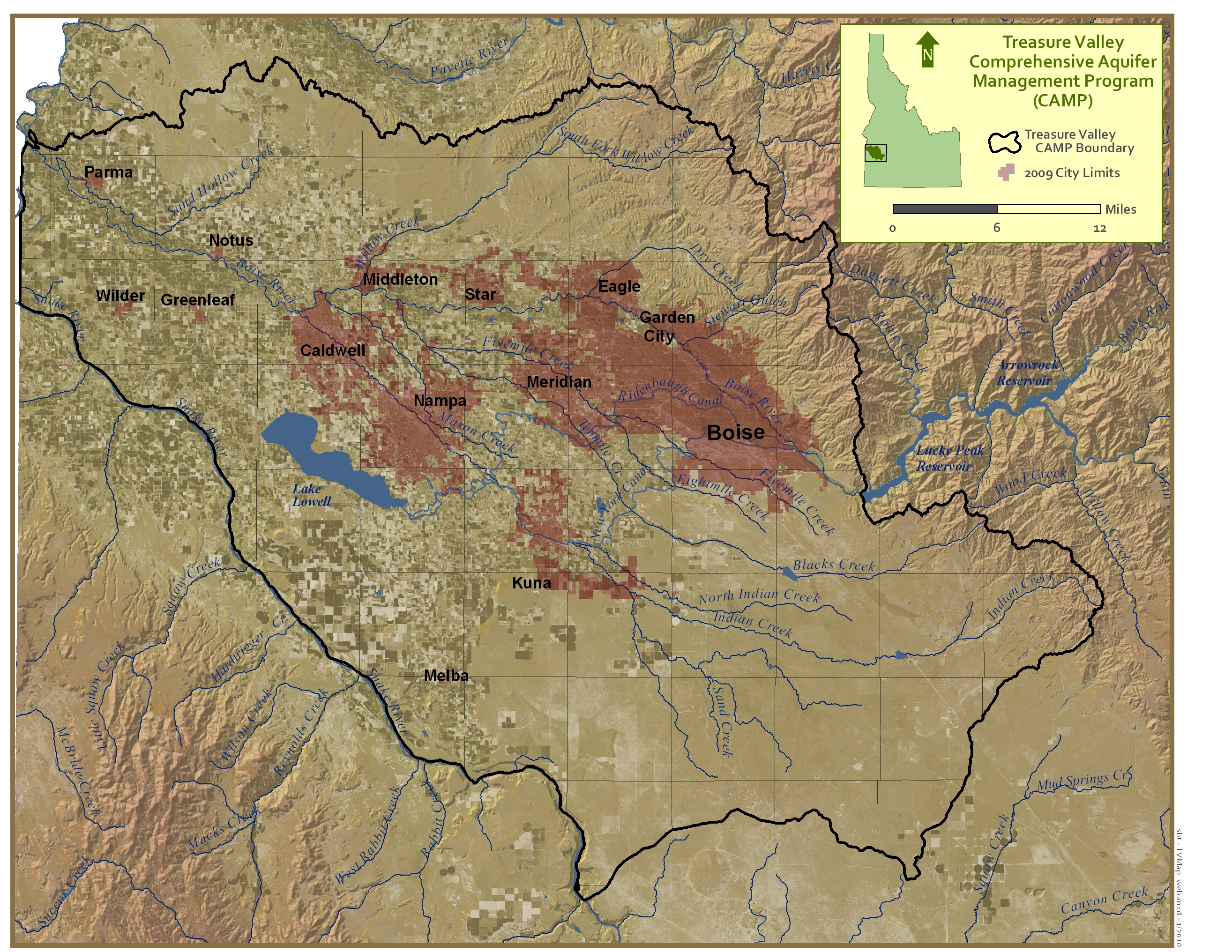
On March 26, 2010, IWRB appointed the Treasure Valley CAMP Advisory Committee which was comprised of representatives from water providers, local governments, utilities, business interests, and conservation groups. Between April 2010 and June 2011, the committee held regular meetings, and through those meetings developed the proposed Treasure Valley Comprehensive Aquifer Management Plan.
On May 18, 2012, IWRB accepted the proposed Treasure Valley CAMP for public review. During August and September 2012, the committee provided a public comment period and held hearings.
At the November 28, 2012 IWRB meeting, some Board members raised concerns regarding the proposed Treasure Valley Comprehensive Aquifer Management Plan. With these concerns in mind, the Board sent the plan to the Water Resource Planning Committee to determine how to proceed.
At the December 13, 2012 Water Resource Planning Committee meeting, the committee recommended that the IWRB hold the plan and not submit it to the Legislature in 2013. The committee further recommended that all comments received previously on the plan be reconsidered in a revision process during 2013 with the goal of taking a revised plan back to the IWRB for adoption in 2013, and then taking it to the Legislature in 2014.
At the January 3, 2013 IWRB meeting, the Board accepted the committee’s recommendation and directed IDWR staff to work with the committee during 2013 to develop a revised plan that could be adopted by the Board and sent to the Legislature in 2014.
Proposed Treasure Valley Comprehensive Aquifer Management Plan
Treasure Valley Aquifer CAMP Process
Framework Development
Within the context of long-range planning, IWRB studied what might influence water supply and demand during the 50 year planning time horizon. Topics studied included climate change impacts, population changes, and social needs. The study results were incorporated into strategies for adapting to change and to scale.
IWRB hired Collaborative Processes® to provide professional facilitation services and to assist in the public participation process. General guidelines for the Treasure Valley CAMP were:
- The process will be open and public.
- The plan will be comprehensive, but will have sideboards.
- The plan framework will include interim measures that might be implemented before a comprehensive plan is final.
- The plan will address aquifer management goals; the management level designed to adjust water demand, and legally and administratively define available water supply; and, funding mechanisms for implementation of management alternatives.
- The context for the plan framework includes legal constraints and precedents; technical and modeling tools; and, existing studies and plans.
Advisory Committee
On March 26, 2010, IWRB established the Treasure Valley Advisory Committee and appointed industry representatives. The facilitators completed a situation assessment which identified issues and concerns by interviewing a broad group of interests. The committee had a unique opportunity to develop solutions that were consistent with the interests of water users and local interests in the Treasure Valley region, and they were charged with collaboratively developing acceptable aquifer management proposals for public review and IWRB decision making.
| Representative | Affiliation |
|---|---|
| Megan Leatherman | Ada County |
| Lynn McKee | Ada County SWCD – Vice Chair |
| Ellen Berggren | Army Corps of Engineers |
| Brent Adamson | Boise County – Assessor |
| Jamie Anderson | Boise County – Commissioner |
| Paul Deveau | Boise Project Board of Control |
| Rex Barrie | Boise River Watermaster WD #63 |
| Matt Howard | Bureau of Reclamation |
| Gary Duspiva | Canyon County – P&Z Commission |
| Paul Woods | City of Boise – Public Works Department |
| Gary Shoemaker | City of Caldwell – Water Department |
| Mike Echeita | City of Eagle – Public Works Director |
| Doug Amick | City of Greenleaf – Public Works Director |
| Warren Stewart | City of Meridian – Public Works Department – Engineer Manager |
| Bob Schmillen | City of Middleton – Public Works Director |
| Michael Fuss | City of Nampa – Public Works Director |
| Craig Telford | City of Parma – Mayor |
| Allen Funkhouser | Drainage District # 2 |
| Greg Nelson | Farm Bureau member, former City of Kuna Mayor |
| Stephen Goodson | Governor’s Office |
| Dave Dixon | Greenleaf Farms Inc. – Owner |
| Jayson Ronk | Idaho Association of Commerce & Industry – Vice President |
| Barry Burnell | Idaho Department of Environmental Quality |
| Rick Ward | Idaho Department of Fish and Game |
| Brian Patton | Idaho Department of Water Resources |
| Jon Bowling | Idaho Power Company |
| Kevin Decker | Idaho Wildlife Federation – Treasurer |
| Russ Dane | Keller Williams Realty |
| Michelle Atkinson | Micron Technology, Inc. |
| Clinton Pline | Nampa/Meridian Irrigation District – Board |
| Ron Abramovich | Natural Resource Conservation Service |
| John Thornton | North Ada County Groundwater Users; North Ada County Foothills Association; Member of North Ada County Technical Working Group |
| Mark Zirschky | Pioneer Irrigation District |
| Lon Stewart | Sierra Club |
| John Prigge | Sorrento Lactalis – Wastewater Treatment Manager |
| Bill Larson | Treasure Valley Partnership |
| Chris Jones | Trout Unlimited – Vice President, Ted Trueblood Chapter |
| Kath Peter | Unaffiliated, former Director of USGS Idaho Water Science Program |
| Scott Rhead | United Water – Director Engineer |
| Janice Yerton | Water System Operator – Kuna |
| Gayle Batt | Wilder Irrigation District |
| Vern Case | Wilder Irrigation District |
Treasure Valley Aquifer CAMP Archived Documents & Records
Technical Publications
- Proposed Treasure Valley Comprehensive Management Plan – April 16, 2012
Brochures & Reports
- Treasure Valley CAMP brochure – 2011
- Treasure Valley CAMP Recharge Report – February 2011
- Climate Variability Impact Studies in the Rathdrum Prairie and Treasure Valley Regions – November 24, 2010
- Treasure Valley Future Water Demand – November 16, 2010
- Weather Modification Feasibility Study for Upper Boise River Basin, Idaho – October 2009
- Shaping the Future of the Treasure Valley Aquifer: A Situational Assessment and Options for Moving Forward – January 13, 2010
Ancillary Documents
The documents in this section were submitted by Advisory Committee members and the public in response to issues within the Treasure Valley CAMP.
- Sustaining California Agriculture in an Uncertain Future – July 2009
- The Ten Biggest American Cities that are Running Out of Water – October 29, 2010
- Water and Energy Toolkit: Understanding the Carbon Footprint of Your Water Use – July 2010
- California’s Next Million Acre-Feet: Saving Water, Energy, and Money – September 2010
- Rural Water Use in an Urbanizing Environment – July 8, 2010
- Los Angeles Times: Report targets waste, inefficiency in agricultural water use – January 11, 2011
Treasure Valley Aquifer CAMP Archived Meetings
Comprehensive Aquifer Management Planning Map
Use the map below to find the boundaries for the active comprehensive aquifer management areas.