
IWRB Financial Programs & Grants Overview
The Idaho Water Resource Board currently administers four grant programs: Aging Infrastructure, Flood Management, Groundwater to Surface Water Conversions, and Measuring & Monitoring. The Idaho Water Resource Board also administers a Water Project Loan program and maintains its Regional Water Sustainability Priority list of larger, region-wide projects.
These programs were developed to provide financial assistance to water users throughout Idaho, in accordance with the Idaho State Water Plan. For program specific information, see the tabs below.
FY2027 IWRB Funding Opportunities
IWRB Financial Programs & Grants Outreach Survey
Submit completed forms by either:
E-Mail: IWRBGrants@idwr.idaho.gov
Mail: IWRB Grants Team
PO Box 83720
Boise, ID 83720-0098
Questions?
Phone: (208) 287-4800
E-Mail: IWRBGrants@idwr.idaho.gov
Idaho Water Resource Board Financial Programs
IWRB Grant Programs
Aging Infrastructure Grants
Applications accepted now through August 7, 2026
(Due annually first Friday of August)
Program Information
During its 2022 session, the Idaho legislature appropriated to the Idaho Water Resource Board (IWRB) $75,000,000 to “be used for expenditures, loans, or grants for water projects, including studies, to address water sustainability, rehabilitate or improve aging water infrastructure or support flood management.”
Projects that rehabilitate or improve Idaho’s water infrastructure support the Idaho economy, provide economic value, and ensures long-term water resource stability and sustainability. The IWRB has developed these criteria to provide financial assistance on a statewide competitive basis through grants to eligible entities interested in pursuing eligible projects to rehabilitate or improve aging water infrastructure.
Program Focus/Eligible Projects
The IWRB defines an aging water infrastructure project as any new project, or new phase of an improvement project intended to repair, maintain, replace, or improve existing infrastructure that supports irrigation water delivery, storage, drainage, treatment, and use of water for irrigation. Projects that are already completed or underway by the application deadline are not eligible for this funding opportunity. Additionally, for purposes of this grant program, the term ‘aging water infrastructure’ does not include municipal drinking or wastewater systems.
- Grant Criteria & Application Instructions (Updated May 2026)
- Applicant Information Sheet
Geographic Area
Statewide
Eligible Entities
Irrigation Districts, Irrigation Boards of Control, Canal Companies, Drainage Districts, Groundwater Districts, Ditch Companies, Lateral Ditch Users Associations, Reservoir Districts, Municipal Irrigation Districts (formed per Title 50, Chapter 18, Idaho Code), Municipalities, Counties, Water Districts, and Soil and Water Conservation Districts.
Funding Limit/Grant Award Limit
Funding Details: Up to $2,000,000 per project; one project per application. IWRB grant portion cannot exceed 50% of total project costs. No more than 50% of the total budget may be spent within a single IWRB district.
Application Requirements/Project Criteria
For the grant proposal to be considered, the following must be provided:
- A cover letter that is addressed to the IWRB and with the eligible entity’s letterhead. The letter must contain a project summary and the project manager’s contact information. The summary must include the funding request dollar amount and expected total project cost, as well as all other funding sources.
- An application containing the following:
- Project sponsor (eligible entity) description (organization type, background, revenue sources, current operations)
- Project purpose and description (narrative, infrastructure description, repair, rehabilitation, improvement needs/objectives/benefits, 30% design plans, land entitlements at project location, description of any known environmental issues, urgency regarding repair or improvement)
- Photographs and description of damage, if applicable
- Project location (county, water source, PLS and/or Lat/Long), including map
- Public Benefits achieved pursuant to IC § 42-1760(2)(d) (protects existing water rights and uses, consider effects on other water uses including environmental quality, provides water for future development, improving aging water storage and infrastructure)
- Water efficiency projects that reduce incidental recharge within a groundwater management area (GWMA) or critical groundwater area (CGWA) must provide a mitigation plan or component that results in a zero net impact, and the project is not inconsistent with the State Water Plan. Project locations within the Eastern Snake Plain Aquifer (ESPA) GWMA that reduce incidental recharge must additionally show how the project will support aquifer stabilization efforts
- Project timeline, including start and completion date
- Detailed cost estimates, including all labor and materials. In-kind work must be detailed and included in cost estimates.
- Water efficiency projects that reduce incidental recharge within a GWMA or CGWA must break out costs not associated with reductions to incidental recharge separately to be considered for partial funding
- Entity’s relevant experience or contractor’s relevant experience completing stream channel repair or improvement projects
- Summary table that documents cost-share percentage for each funding source including in-kind work. If other grants are required to complete the project (USACE, NRCS, FEMA, etc.), include timelines for receiving those funds
- Required regulatory approval and permit documents; if project has not yet received permit documents, note this in the application’s project schedule.
- Proof of liability insurance for general construction, i.e., ICRMP.
- Completed Applicant Information Sheet provided by IWRB.
- Addresses all evaluation criteria described below.
Evaluation Criteria: Grant applications submitted by an eligible entity for an eligible project will be evaluated, scored (120-point scale), and ranked according to the following criteria. Applications that do not meet the eligibility requirements will not be scored and will be returned. Project scoring will be used to prioritize funding. Applications shall discuss how the project under consideration meets the evaluation criteria.
Project Details (up to 50 points)
- Eligible entity: Description of the eligible entity that includes organization type, background, revenue sources, and current operations. (10 points)
- Project proposal: Description of the project, where it will occur, and its benefits. Include pictures of the existing infrastructure (if applicable), and detailed map(s) of the project area that have a legend, county, and coordinate or PLS (Township, Range, Section) information. (10 points)
- Project schedule: The project’s timeline of important milestones, such as obtaining funds, permitting, and construction. The time to complete the project is irrelevant, grading only pertains to the quality of the schedule. (10 points)
- Plans and specifications: Relevant drawings and material specifications for construction. (10 points)
- Project team: The organization(s) and personnel involved in completing the project. Provide the roles, time commitment, and relevant experience. (10 points)
Urgency of Project (up to 20 points)
- Urgency of the project (e.g., infrastructure age, infrastructure function) (20 points)
Public Interest of Project (up to 30 points)
- Economic values supported by the existing and/or additional infrastructure. This includes consideration of the communities, irrigated acres, provision of water for future development and economic activity served by the water infrastructure. (15 points)
- Uses/benefits identified in Section 42-1760(2)(d), Idaho Code. (15 points):
-water quality
-fish and wildlife
-recreation
-hydropower
-water supply stability and sustainability
-drought resiliency
-public safety
-other benefits to the citizens of the State
-Water efficiency projects that reduce incidental recharge within a groundwater management area (GWMA) or critical groundwater area (CGWA) must provide a mitigation plan or component that results in a zero net impact, and the project is not inconsistent with the State Water Plan. Project locations within the Eastern Snake Plain Aquifer (ESPA) GWMA that reduce incidental recharge must additionally show how the project will support aquifer stabilization efforts
Budget Planning and Cost-Effectiveness (up to 20 points)
- Cost-effectiveness of the project compared to other options explored by the eligible entity. (10 points)
- Cost estimate describing all foreseen costs of materials and labor, as well as justification for those costs. Include all sources of funding for the project and their amounts. (10 points)
-Water efficiency projects that reduce incidental recharge within a GWMA or CGWA must break out costs not associated with reductions to incidental recharge separately to be considered for partial funding.
Application Submittal:
· Applications can be emailed to IWRBGrants@idwr.idaho.gov. Applications that are emailed must be received by the application due date.
· Applications that are mailed must be received on the application due date. Mailing address:
ATTENTION: IWRB GRANTS TEAM
IDAHO DEPARTMENT OF WATER RESOURCES
PO BOX 83720
BOISE, ID 83720-0098
· Applications can be dropped off in person on the 6th floor of the Idaho Water Center in Boise. Applications must be dropped off on weekdays, excluding holidays, between the hours of 8:00am and 5:00pm. The Idaho Water Center is located at:
IDAHO WATER CENTER
322 E FRONT ST STE 648
BOISE, ID 83702-7371
ESPA Groundwater to Surface Water Conversion Grants
Applications Accepted Now through July 10, 2026
(Due on the first Friday of July annually)
Program Information
The Idaho Water Resource Board (IWRB) is offering grant funding to be used for water projects targeted at converting lands irrigated from groundwater to surface water irrigation (Conversion Projects).
Program Focus/Eligible Projects
Projects located in eligible geographic areas that propose to convert from groundwater to surface water irrigation. Hard Conversions are projects that would permanently convert to the use of surface water. Soft Conversions projects would partially convert to the use of surface water but may have to use groundwater when surface water is not available.
- Grant Criteria & Application Instructions (Updated May 2026)
- Applicant Information Sheet
Geographic Area
Eastern Snake Plain Aquifer (ESPA) area of common groundwater supply.
For more information on Groundwater Management Areas see the links below:
Groundwater Management Area Information
Critical Groundwater Area Information
- CGWA
- Click here for an interactive CGWA Map
- (Note you will need to select “Critical Groundwater Area” in the Map Layers under “Groundwater Management”)
Eligible Entities
Groundwater Districts, Irrigation Districts, Irrigation Boards of Control, Canal Companies, and Municipalities. Individuals must apply through one of the eligible entities.
Funding Limit/Grant Award Limit
IWRB grant portion cannot exceed (50%) of total project costs for soft conversions. IWRB grant portion cannot exceed (75%) of total project costs for hard conversions.
- Must agree to cease pumping the proposed portion of groundwater related to project and that delivered conversion water will be used only on lands with an existing groundwater right tied to this project. Groundwater rights previously used on the conversion project lands cannot be put in the Water Bank for lease.
Application Requirements/Project Criteria
Application Requirements: For the grant proposal to be considered, the following must be provided:
- A cover letter that is addressed to the IWRB and with the eligible entity’s letterhead. The letter must contain a project summary and the project manager’s contact information. The summary must include the funding request dollar amount and expected total project cost, as well as all other funding sources.
- An application containing the following:
- Project sponsor (eligible entity) description (organization type, background, revenue sources, current operations)
- Project description (narrative, infrastructure description, repair, rehabilitation, improvement needs/objectives/benefits, 30% design plans, land entitlements at project location, description of any known environmental issues)
- Project location (county, water source, PLS and/or Lat/Long), including map
- Project timeline, including start and completion date
- Detailed cost estimates, including all labor and materials. In-kind work must be detailed and included in cost estimates.
- Summary table that documents cost-share percentage for each funding source including in-kind work. If other grants are required to complete the project (USACE, NRCS, FEMA, etc.), include timelines for receiving those funds.
- Documentation is required from Irrigation District/Canal Company of support for the project and agreement to deliver the surface water supply for the conversion project. Documentation of long-term leases, storage water, existing shares, etc. to support the proposed project if not directly diverted from a river. Documentation should address the term of the surface water delivery agreement and how often water will be available to support the project.
- Documentation from Groundwater District of support for the project and agreement to administer the pumping reduction.
- List of groundwater rights on conversion project lands
- Proof of liability insurance for general construction, i.e., ICRMP.
- Completed Applicant Information Sheet provided by IWRB.
- Addresses all evaluation criteria described below.
Evaluation Criteria: To maximize the effective and efficient use of available funds, grant applications submitted by eligible entities for eligible projects will be evaluated, scored (100-point scale), and ranked according to the following criteria. Applications that do not meet the eligibility requirements will not be scored and will be returned. Project scoring will be used to prioritize funding. Applications shall discuss how the project under consideration meets the evaluation criteria.
Benefits/Effectiveness (Up to 75 points)
- Project with a greater percentage of pumping offset will receive more points. (15 points)
- The application demonstrates a reduction in average annual groundwater pumping in acre-feet associated with this project. (10 points)
- The applicant demonstrates the dependability of the surface water supply in terms of quantity and seasonal availability. (5 points)
- The applicant demonstrates aquifer storage benefits and/or reach gain benefits associated with the project. Applicants should submit modeling results to support their claims. (20 points)
- The applicant demonstrates the project involves multiple entities, or the project is regionally focused. (5 points)
- The project includes a recharge component. (10 points)
- Conversions that are greater than 85% efficient will receive more points. (10 points)
Project Proposal Clarity and Detail (up to 15 points)
- Clarity and detail of project proposal and location: need, description, budget and benefits, detailed map(s) of project area that have a legend, county, and coordinate or PLS (Township, Range, Section) information. (5 points)
- Plans and specifications included with the grant application (5 points)
- Description of the personnel (entity’s employees, contractors and/or volunteers) that will plan, design, construct and implement the proposed project (descriptions may include the number, qualifications (resumes if applicable) and time of personnel that will be involved in the project. (5 points)
Urgency of Project (up to 10 points)
- Urgency of the project – The project is necessary to avoid curtailment or to help support a settlement (10 points)
Application Submittal:
- Applications can be emailed to IWRBGrants@idwr.idaho.gov. Applications that are emailed must be received by the application due date.
- Applications that are mailed must be received on the application due date. Mailing address:
ATTENTION: IWRB GRANTS TEAM
IDAHO DEPARTMENT OF WATER RESOURCES
PO BOX 83720
BOISE, ID 83720-0098
- Applications can be dropped off in person on the 6th floor of the Idaho Water Center in Boise. Applications must be dropped off on weekdays, excluding holidays, between the hours of 8:00am and 5:00pm. The Idaho Water Center is located at:
IDAHO WATER CENTER
322 E FRONT ST STE 648
BOISE, ID 83702-7371
Flood Management Grants
Applications Accepted Now through June 5, 2026
(due on the first Friday of June annually)
Awarded projects will be announced following a decision by the IWRB at the Regular IWRB Meeting in August.
Program Information
The IWRB is authorized to award grants for the financing of flood damaged stream channel repair, stream channel improvement, flood risk reduction, and flood prevention projects.
Program Focus/Eligible Projects
The IWRB provides financial assistance on a competitive statewide basis to flood control districts, drainage districts, irrigation districts, canal companies, municipalities, counties, and other public entities interested in pursuing flood damaged stream channel repair, stream channel improvement, flood risk reduction, and flood prevention projects.
Pursuing flood damage repair and improvement projects can help prevent or reduce flood damage in Idaho’s streams and rivers. To be considered for grant funding, entities must provide evidence of flood damage or evidence of conditions that create the risk of flooding in a stream channel, and submit a funding request document outlining the proposed repairs and/or improvements to the stream channel.
- Applicant Information Sheet
- Grant Criteria and Application Instructions
- Updated criteria published March 2026
Geographic Area
Statewide
Eligible Entities
Flood Control Districts, Drainage Districts, Irrigation Districts, Canal Companies, Municipalities, Counties, and Soil and Water Conservation Districts. Other public entities are eligible to apply.
Funding Limit/Grant Award Limit
Up to $200,000 per project; one project per application. IWRB grant portion cannot exceed 50% of total project costs. Projects that include higher cost share amounts will be prioritized during project evaluations (see evaluation criteria)
Application Requirements/Project Criteria
Application Requirements: For the grant proposal to be considered, the following documents must be provided:
- A cover letter that is addressed to the IWRB and with the eligible entity’s letterhead. The letter must contain a project summary and the project manager’s contact information. The summary must include the funding request dollar amount and expected total project cost, as well as all other funding sources.
- An application containing the following:
- Project purpose and description of urgency regarding repair or improvement
- Photographs and description of damage, if applicable
- Project location (county, water source, PLS and/or Lat/Long), including map
- Public Benefits achieved pursuant to IC § 42-1760(2)(d) (stream channel repair, stream channel improvement, flood risk reduction, water quality improvement, other ecological benefits)
- Project timeline, including start and completion date
- Detailed cost estimates, including all labor and materials. In-kind work must be detailed and included in cost estimates.
- Entity’s relevant experience or contractor’s relevant experience completing stream channel repair or improvement projects
- Summary table that documents cost-share percentage for each funding source including in-kind work. If other grants are required to complete the project (USACE, NRCS, FEMA, etc.), include timelines for receiving those funds.
- Documentation that local stakeholders have been consulted. If the project is within an active Flood Control District, the eligible entity must include a letter of support.
- Conceptual Design Documents
- Addresses all evaluation criteria described below.
- Required regulatory approval and permit documents; if project has not yet received permit documents, note this in the application’s project schedule.
- Proof of liability insurance for general construction, i.e., ICRMP.
- Completed Applicant Information Sheet provided by IWRB.
Evaluation Criteria: Projects that are determined not to be flood-related by staff will be declared ineligible and not scored. To maximize the effective and efficient use of available funds, the applications will be evaluated, scored (125-point scale), and ranked according to the following criteria:
First Time Applicant (5 points)
Application Professionalism and Clarity (up to 20 points)
- Cover letter and grant document are well-written and clearly state the goals and objectives of the project (10 points)
- Project map clearly shows the project location (10 points)
Effectiveness of Project (up to 45 points)
- Urgency of the project is explained (10 points)
- The benefits of the project are explained, and are measurable (20 points)
- Grant application considers alternatives solutions and explains why the chosen solution is most beneficial (10 points)
Readiness of Project (70 points)
- Description of applying entity and project leadership, documentation of expertise in subject matter of project (10 points)
- Documentation of project support from other stakeholders (10 points)
- The project schedule demonstrates the eligible entity has considered essential milestones (10 points)
- The cost estimate for the project budget is detailed and clearly accounts for all labor and material costs, including in-kind work (10 points)
- Projects that propose matching cost-share amounts above 50% will receive additional points in their score (1 point for each additional 1% up to 20 additional points)
Application Submission:
Applications can be emailed to IWRBGrants@idwr.idaho.gov. Applications that are emailed must be received by 11:59 pm on the application due date.
Applications that are mailed must be received by 11:59 pm on the application due date. Mailing address:
ATTENTION: GRANTS TEAM
IDAHO DEPARTMENT OF WATER RESOURCES
PO BOX 83720
BOISE, ID 83720-0098
Applications can also be dropped off in person on the 6th floor of the Idaho Water Center in Boise. Applications must be dropped off on weekdays, excluding holidays, between the hours of 8:00am and 5:00pm. The Idaho Water Center is located at:
IDAHO WATER CENTER
322 E FRONT ST STE 648
BOISE, ID 83702-7371
Measuring & Monitoring Grants
Applications accepted year-round, FY2027 funding opens July 1, 2026
Program Information
The Idaho Water Resource Board (IWRB) has allocated funding to continue to promote water conservation efforts throughout the state of Idaho, with a preference for diversions within the Eastern Snake River Plain (ESPA), through the purchase and installation of monitoring equipment, measurement devices, or other supportive infrastructure for ground and surface water diversions.
- Grant Criteria & Application Instructions (Updated May 2026)
- Applicant Information Sheet
Program Focus/Eligible Projects
Projects considered under this program are for the purchase and installation of monitoring and measurement equipment for both surface and groundwater diversions within the state of Idaho. Projects that are completed by the application deadline are not eligible for this program.
Example projects: New monitoring wells, flumes, weirs, telemetry equipment, software development, automation equipment, etc.
Geographic Area
Statewide
Eligible Entities
Irrigation Districts, Irrigation Boards of Control, Canal Companies, Drainage Districts, Groundwater Districts, Ditch Companies, Lateral Ditch Users Associations, Reservoir Districts, Municipal Irrigation Districts (formed per Title 42, chapter 18, Idaho Code), Municipalities, Counties and Water Districts
Funding Limit/Grant Award Limit
Funding under this program will be limited to 50% up to a maximum of $250,000.
Application Requirements: For the grant proposal to be considered, the following must be provided:
- A cover letter that is addressed to the IWRB and with the eligible entity’s letterhead. The letter must contain a project summary and the project manager’s contact information. The summary must include the funding request dollar amount and expected total project cost, as well as all other funding sources.
- An application containing the following:
- Project sponsor (eligible entity) description (organization type, background, revenue sources, current operations)
- Project description (narrative, conceptual plan and design, land entitlements at project location, description of any known environmental issues).
- Project location (county, water source, map with legend and PLS (Township, Range, Sections) or Lat/Long)
- Detailed cost estimate and budget, including labor and materials. In-kind work must be detailed and included in cost estimates.
- Project funding sources (IWRB grant, other state and federal grants, sponsor’s contribution)
- Project timeline and implementation schedule
- Proof of liability insurance for general construction, i.e., ICRMP.
- Completed Applicant Information Sheet provided by IWRB.
- Addresses all evaluation criteria described below.
Evaluation Criteria: To maximize the effective and efficient use of available funds, grant applications submitted by eligible entities for eligible projects will be evaluated, scored (100-point scale) according to the following criteria. Applications that do not meet the eligibility requirements will not be scored and will be returned. Project scoring may be used to prioritize funding. The application shall discuss how the project for the purchase of and/or the installation of monitoring equipment, measurement devices, or supporting infrastructure meets the following criteria:
Measurement Order (up to 10 points)
- The applicant is complying with an active measurement order issued by the IDWR Director (10 points)
2024 SWC/Ground Water District Settlement Agreement in the ESPA (up to 30 points)
- The applicant can demonstrate how this project will further agreement priorities regarding water (30 points)
Equipment Installation (up to 20 points)
- A new install of monitoring, telemetry, and/or measurement equipment on the Project diversion (20 points); or
- A retrofit of existing monitoring, telemetry and/or measurement equipment already installed on the Project diversion works. (10 points)
Project Implementation Schedule (up to 20 points)
- The Project will be completed in 1 year; (20 points) or
- The Project will be completed in 2 years; (10 points) or
- The Project will be completed in subsequent (5 points)
Project Proposal & Clarity (up to 20 points)
- Clarity and description of the Project: identifies the Project’s need, proposed budget, and public (10 points)
- Plans, timeline, and drawings for the Project. (5 points)
- Description of the equipment being installed. (5 points)
Application Submittal:
Completed applications can be emailed to the Idaho Water Resource Board’s Grants Team at IWRBGrants@IDWR.Idaho.gov and must be received by the application date.
Applications that are mailed must be postmarked by the application date. Mailing Address:
ATTN: IWRB GRANTS TEAM – MEASURING & MONITORING SUPPORT GRANT TEAM
IDAHO DEPARTMENT OF WATER RESOURCES
PO BOX 83720
BOISE, ID 83720
Applications can also be dropped off in person on the 6th floor of the Idaho Water Center in Boise, ID, and must be received by 5:00 pm on the application date. The Idaho Water Center is located at:
IDAHO WATER CENTER
322 E. Front Street, Suite 648
Boise, ID 83702-7371
Regional Water Sustainability Priority List Projects
Projects, including studies, to be undertaken by eligible entities that provide water sustainability on a regional, basin-wide, or statewide scale are eligible to be included on the List. An eligible entity that requests inclusion of the project on the list is a “Project Sponsor.” For projects that are included on the List, the IWRB may 1) help advocate for Federal funding opportunities for these projects, 2) facilitate state funding consideration, and 3) help with letters of support related to necessary funding and/or permitting authorizations. Inclusion on the List is not a funding commitment, but rather a recognition that the project has the potential to help achieve water sustainability. To obtain funding from an existing grant, loan or other funding program, the Project Sponsor will be required to submit the requisite application(s), and the project will be considered for funding pursuant to the procedures and criteria of the program.
Requests to have a project added to the IWRB’s Regional Water Sustainability List are due annually by December 1. Requests shall be submitted to: IWRB-Info@idwr.idaho.gov
More information on how to submit a request IWRB RWS Criteria & Application (Updated May 2026)
Water Project Loans
The Idaho Water Resource Board’s Water Project Loan Program assists in the development of the state’s water resources through the construction of water projects.
Current Loan Rate: 3.5%
- Loan Program Guidelines
- Sample Loan Application
- Application for Financial Assistance for Potable Water System Construction Project
- Application for Financial Assistance for Non-Potable Water System Construction Project
- Financial Ratios Worksheet (non-calculating)
- Financial Ratios Worksheet (calculating)
- W-9 Request for Taxpayer Identification Number and Certification
How does the loan process work?
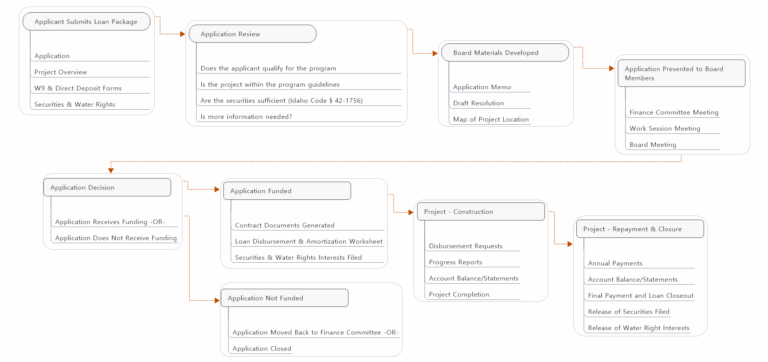
The loan process has several steps before loans are submitted to the board for approval.
- Contact the Loan Program team to discuss the project.
- If the project falls under the guidelines, the team asks you to complete a loan form and submit it with the required documents.
- The team reviews your application and verifies your assets for securing the loan.
- The team calculates estimated cost assessments to the borrower at different terms.
- The team presents this information in a memo to the Board at their meeting.
- The board reviews the application and either approves or denies the application.
What is the term of the loan?
The loan term can range from 5 to 60 years. Currently, the average loan term is 10 to 15 years.
What is the interest rate?
The board sets the interest rate at their first meeting each year. Generally, they set two rates: one for irrigation-related projects and one for municipal water systems.
Current Loan Rate: 3.5%
Should the applicant attend the board meeting when the loan application is reviewed?
Yes, we recommended that the applicant or a representative attend the board meeting during the loan application review. Doing so aids the Board should they have any questions which fall outside the scope of the Loan Program team’s memo to the Board.
How do I obtain a loan application?
You can download the application as well as related guidelines and worksheets from the Forms page.
What if I do not use all the loan funds?
You are not required to use all funds appropriated for the loan. Funds that are not used remain in the revolving loan account. However, loan repayment is based on the funds appropriated.
What are the minimum and maximum amounts that can be borrowed?
The minimum amount is $5,000. With changes enacted by the 2007 legislature, there is no longer a maximum cap for loans.
How is repayment scheduled when the overall project was split into smaller projects?
According to Idaho Code § 42-1756, each loan must be repaid upon completion of the project. If one project is completed before the other, repayment for the completed project begins no later than one year from date of completion.
Can additional funds be obtained if the project runs into unforeseeable costs?
In the event that your project runs over budget and additional funds are required, the Board can authorize a loan increase. You must complete an additional application and follow the same funding process. Upon approval, the Board amends and restructures the original loan.
Is there an “early payoff” penalty?
You are responsible to repay the loan’s principle and accrued interest according to the repayment agreement. If you choose to repay the loan earlier than agreed, there is no “early payoff” penalty.
Surface Water Coalition Operational Efficiencies Program
Accepting Applications Year-round
Program Information
The Idaho Water Resource Board (IWRB) has allocated funding to help Surface Water Coalition members in the Eastern Snake River Plain Aquifer (ESPA) area implement innovative operational efficiencies in an effort to improve the demand for surface water. Applications for funding for this program will be accepted year- round.
Program Focus
Projects considered under this program include purchasing and installing equipment, conducting efficiency studies, and/or other activities designed to improve operational efficiencies that result in reduction in the demand for surface water by Surface Water Coalition members.
SWC Operational Efficiencies Criteria & Application Instructions (Updated March 2026)
Geographic Area
Limited to surface water diversions of the Surface Water Coalition
Eligible Entities
Members of the Surface Water Coalition
Funding Limit
Projects funded under this project are eligible for up to 100% funding per project
Application Requirements
Efficiency Results Likely to Be Achieved
- What are the proposed project goals and how will the project improve operational Please provide sufficient details supporting how the efficiency results were determined.
- How this project will have no impact to incidental recharge in the ESPA
- Water savings due to operational efficiencies will be evaluated on a case-by-case basis
Project Proposal Clarity & Implementation Schedule
- Project sponsor description: organization type, background, current operations,
- Project description
- Proposed project narrative, project map (county, PLS or coordinates), scope of work (and supporting documents/designs if appropriate) & any other supporting information the applicant would like to include
- Cost estimate and budget
- Project implementation schedule
Additional Project funding sources
- If other funding sources are used to support the project, please provide a list with the agency and funding amount
- Sponsor’s contributions, IWRB grants, other state and federal grants,
How Does This Project Promote State and/or Local Priorities
- Demonstrate how this project will support the 2024 stipulated approved mitigation plan (“2024 settlement agreement”) between the Surface Water Coalition and the Idaho Ground Water Appropriators, Inc.
Program Proposal Submittal
Completed applications can be emailed to the Idaho Water Resource Board’s Grants Team at IWRBGrants@IDWR.Idaho.gov.
Physical copies must be postmarked by the application date and can be mailed to:
Idaho Department of Water Resources
Attn: IWRB Grants Team
P.O Box 83720
Boise, ID 83720
Applications can also be dropped off in person on the 6th floor of the Idaho Water Center in Boise, ID. The Idaho Water Center is located at:
322 E. Front Street Suite 648
Boise, ID 83702-7371
Modernizing Idaho's Water Infrastructure Project Profiles
The following projects were completed with grant funding from the IWRB’s Aging Infrastructure Grants program.
- King Hill Irrigation District
- Water District #63
- Chester Canal & Irrigation Co.
- Bannock Feeder Canal Company
- Solenberger Ditch Company
- Hat Butte Canal Project
- Fremont-Madison Irrigation District
- Hayden Lake Irrigation District
- Enterprize Canal Company
- North Side Pumping Company
- Chesterfield Spillway
- Galloway Diversion Dam Project
- Conant Creek Canal Project
- West Indian Cove Project
- Grindstone Butte Project
- Boise City Canal Co. Project
- Last Chance Canal Flume Project
- FMID Crosscut Canal Project