
Active Legal Matters
Administrative Actions
Archived Legal Matters
Curtailment Notices & Orders
Delivery Call Actions
District Court Actions
IDWR-Issued Orders
Mitigation Plan Actions
Orders Overview
Statutes, Rules & Hearing Procedures
Supreme Court Actions

Notice
Water right changes made under the provisions of a drought declaration expire at the end of the current year unless extended or terminated by the IDWR Director.
Operational Periods
Aircraft Seeding: November 1 – March 31
Ground Seeding: November 1 – April 30
*Cloud seeding does not occur outside of these periods in Idaho.
Hot Topics
Current Project Status
Upper Snake Basin Project
Inactive
Boise Basin Project
Inactive
Wood River Basin Project
Inactive
Payette Basin Project
Inactive
State of Utah Projects
Inactive
Legend
InactiveNo cloud seeding operations are occurring in the project area.
ActiveProject operations are active. Operations include weather
forecasting and operational activities. Forecasting occurs
continuously throughout the operational period to identify storm
systems conducive for precipitation enhancement. Operations are only
performed when favorable storm systems are observed.
SuspendedProject operations are temporarily suspended.
Frequently Asked Questions
Contact
Email:
cloudseedingprogram@idwr.idaho.gov
Phone: (208) 287-4852
Other Resources
- North American Weather Modification Council
- Weather Modification Association
- COMET MetEd — How Cloud Seeding Works
- The Ranch Podcast: Idaho Cloud Seeding
- The Ranch Podcast: Cloud Seeding Authorizations & Litigation
- Informational Cloud Seeding Presentations (Committee Mtg. No. 1-25)
- EPA: Information on Contrails from Aircraft
History of Cloud Seeding
Origins of Cloud Seeding
Discovery of Cloud Seeding (1946)
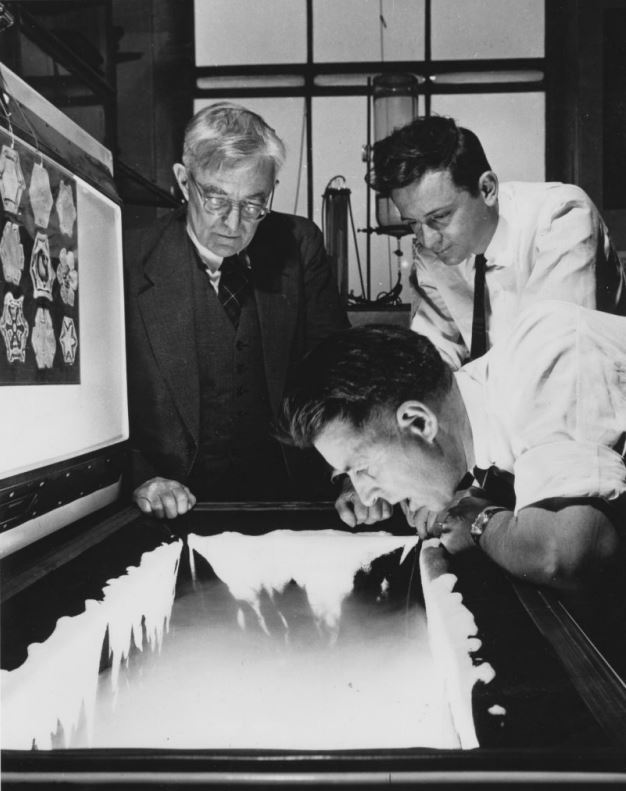
The proof of concept was first discovered by Vincent J. Schaefer, Bernard Vonnegut, and Irving Langmuir in 1946. Schaefer and Langmuir were researching icing on aircraft at the General Electric Company’s research laboratory after World War II.
By investigating the production of particles of various sizes and their behavior in the atmosphere, they discovered that tiny particles could be used to produce ice. They were able to nucleate ice by introducing small particles in a laboratory-made cloud in a freezer with dry ice to create snow. Vonnegut later discovered that silver iodide (AgI) was even more effective at generating ice formations—a breakthrough discovery for operational cloud seeding.

First Cloud Seeding Experiment (1947)
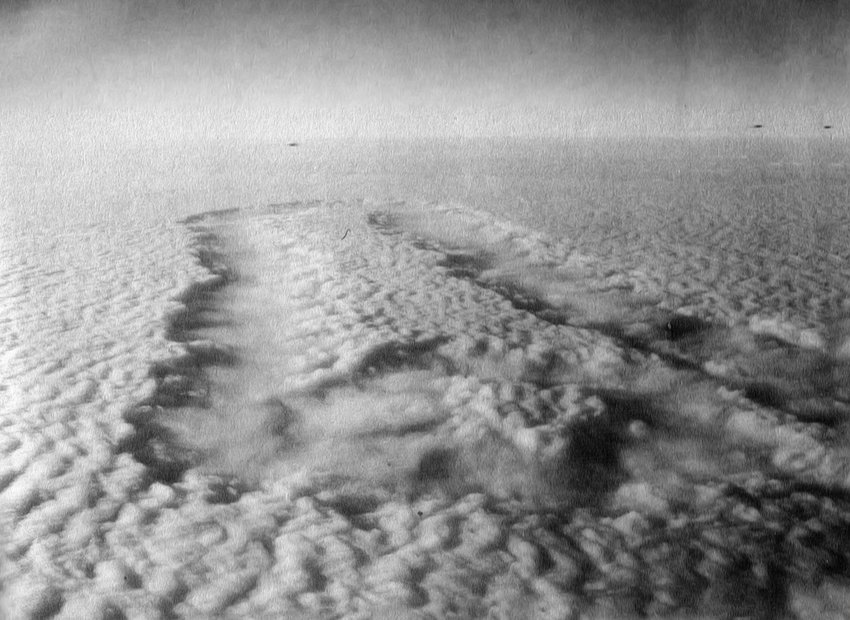
The first cloud seeding experiment called “Project Cirrus” happened in 1947. A modified B-17 bomber dropped dry ice (solid carbon dioxide) into a stratocumulus cloud. This experiment proved successful when they witnessed a “racetrack” form in the cloud deck where the plane had seeded—evidence that ice was produced and that cloud physics and precipitation could be altered.
References:
The role of induced entrainment in past stratiform cloud seeding experiments (Walcek)

History of Cloud Seeding in Idaho
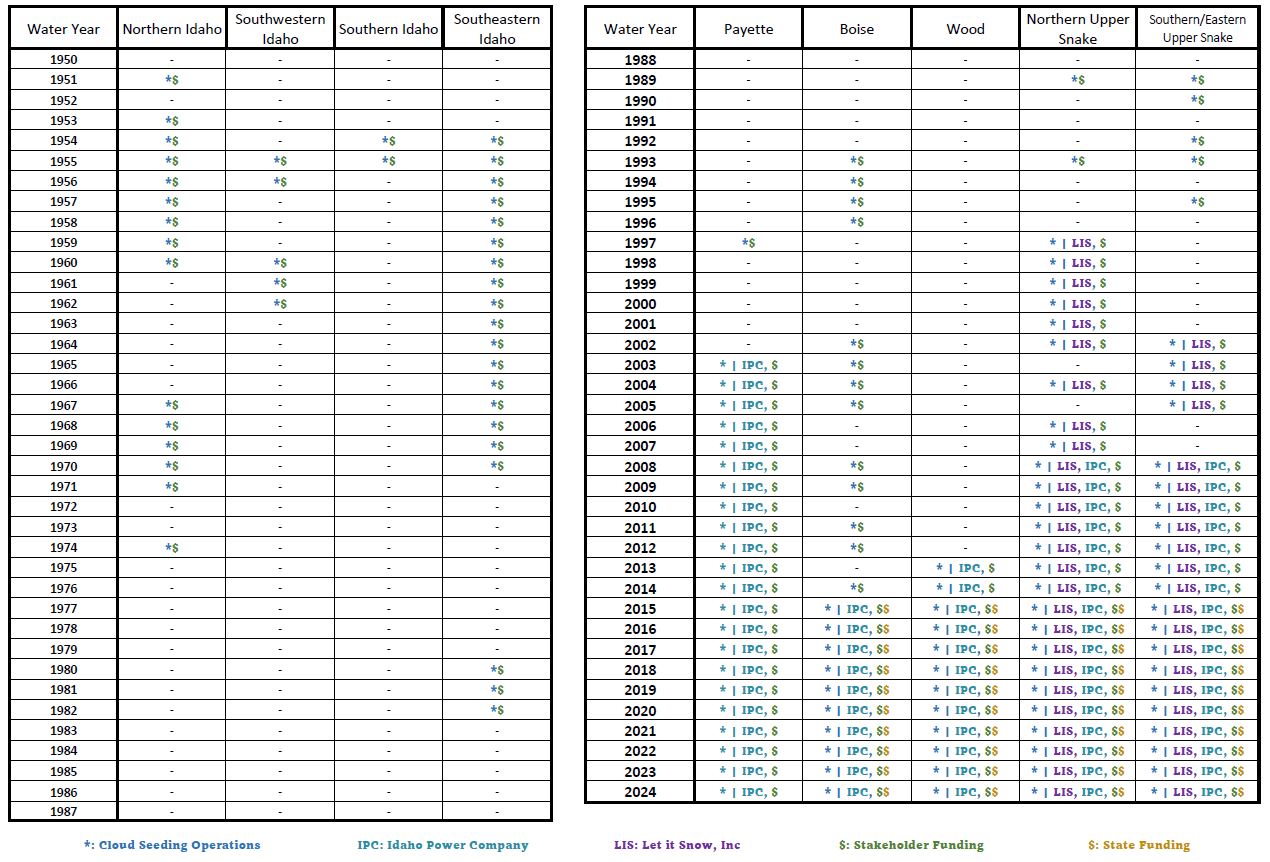
Cloud seeding operations have been occurring in various parts of Idaho since the early 1950’s. Earlier programs were locally sponsored, manually operated ground seeding projects. More consistent operations began in the late 1990’s with the development of the High Country Resource Conservation & Development’s (HCRCD) East Idaho program, operated by Let it Snow (LIS). This program is currently the longest operational program in the State of Idaho. Idaho Power Company (IPC), in response to shareholder questions, also began investigating cloud seeding in the late 1990’s to support its hydropower generation. IPC began its first operational project in the Payette River Basin in 2003. Prior to IPC’s cloud seeding efforts, the Boise Board of Control contracted with the North American Weather Modification Company (NAWC) for the operations of manual ground generators in the Boise River Basin for over a decade.

History of the Collaborative Cloud Seeding Program
The Idaho Water Resource Board (IWRB) began investigating cloud seeding in 2008 as a water management strategy to support the Eastern Snake Plain Aquifer (ESPA) Comprehensive Aquifer Management Plan (CAMP). As a part of the CAMP planning process, IPC proposed to develop and operate a 5-year pilot project in the Upper Snake River Basin, and if successful, the State and local water users would come to the table to discuss collaboration for the long-term operation of a program. Following success of the pilot project, operations were expanded to include the Boise and Wood basins at the request of water users in the basins.
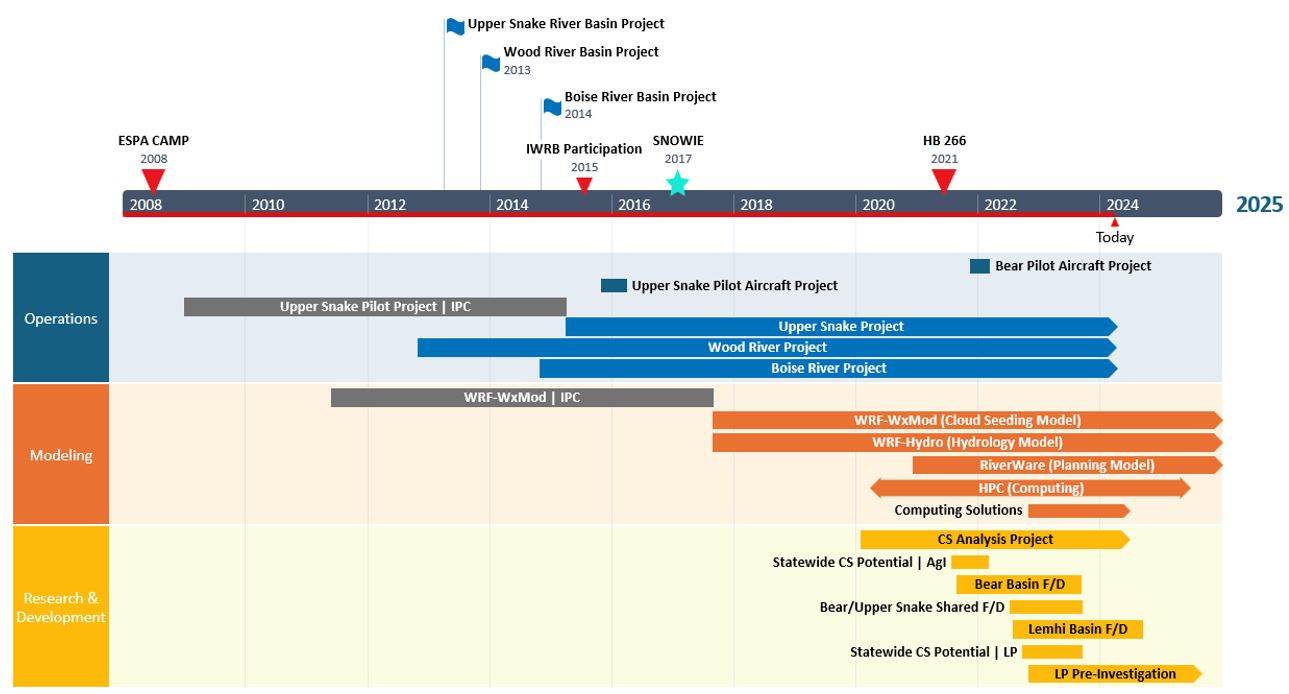
In 2015, IPC approached the IWRB about partnering for the build out of a full-scale program. The IWRB’s initial investment was for capital expenses to build out program infrastructure. Recognizing the importance of validation and long-term monitoring and analysis, the IWRB shifted its investments into cloud seeding to focus on the development of modeling and computing technologies to support cloud seeding operations, planning and design of projects, and ultimately program evaluation and long-term analysis. The Collaborative Cloud Seeding Program has continued to evolve, and currently exists as a partnership between IWRB, IPC, and local water users for the long-term operation of precipitation enhancement. A full timeline of the Collaborative Cloud Seeding Program is shown below.

- 2008 | ESPA CAMP implementation of a 5-year pilot project in the Upper Snake Basin; Operations and Funding by IPC
- 2013–2014 | Water users in the Wood and Boise River Basins approached IPC about the potential for developing new projects
- 2015 | IWRB provided cost share with IPC and began participation in program funding with capital for new infrastructure
- 2016 | IWRB began contributing towards program operations and modeling (1/3 total program cost)
- 2017 | IWRB partnered with IPC for development of Weather Research and Forecasting Cloud Seeding model (WRF-WxMod)
- 2017 | SNOWIE study field campaign in the Payette River Basin
- 2019 | Program reached existing build-out (3 aircraft, 57 remote generators, network of weather instrumentation) and initiated cloud seeding analysis
- 2019 | IWRB directed staff to conduct an analysis of cloud seeding (CS) operations (CS Analysis)
- 2020 | Initial results of the CS Analysis; IWRB directed staff to conduct a more detailed investigation, utilizing sophisticated modeling tools
- 2021 | Legislature passed House Bill 266 (HB266) on cloud seeding. Directed the IWRB to:
- Continue cloud seeding analysis
- Complete an assessment of cloud seeding opportunities statewide
- Authorize cloud seeding programs in State
- Provide authority to sponsor or develop local or statewide cloud seeding programs
- 2021 | IWRB directed staff to conduct: a more detailed cloud seeding analysis; a statewide cloud seeding assessment; and a feasibility and design study of the Bear River Basin
- 2021 | Bear River Basin Pilot Aircraft project
- 2022 | Statewide assessment results using silver iodide (AgI) presented to IWRB CS Committee
- 2022 | IWRB directed staff to conduct feasibility and design study of the Lemhi River Basin
Science Behind Cloud Seeding
What is cloud seeding?
Cloud seeding is a form of weather modification that increases the efficiency of a cloud by enhancing its natural ability to produce ice.
When an ice particle first forms, it collides with other water molecules and continues to grow until it becomes heavy enough to fall as precipitation in the form of rain or snow.
Why are clouds seeded?
Cloud seeding authorized by the Idaho Water Resource Board (IWRB) is used during the cold season to augment high elevation snowpack, a critical source of water supply for the state.
Cloud seeding is also used in other areas of the U.S. and around the world for rain enhancement, hail mitigation to reduce crop and infrastructure damage, and fog suppression.
Enhancement of winter snowpack ultimately results in increased runoff, and thus, the availability of water to support the unique needs of each basin or region.
Benefits of Increased Water Supply Include:
- Increased water availability for:
- Aquatic habitat
- Water quality
- Reservoir storage
- Flow augmentation
- Natural flow water rights
- Aquifer recharge
- Hydropower
- Recreation
- Extended seasonal flows due to increased high elevation snowpack:
- Fill of natural flow water rights
- Reduced dependency on storage water
- Increased reservoir carryover
What is a cloud?
Clouds are made up of water vapor (gas), tiny water droplets (liquid water), and ice particles (frozen water) within the atmosphere.
Water molecules can take many forms depending on the atmospheric conditions. In colder or mixed phase clouds, water molecules often become “supercooled.”
There are three types of clouds:
- All Liquid clouds: exist entirely of liquid water molecules at ~32°F
- Ice-Crystal clouds: exist entirely of ice crystals (e.g., cirrus)
- Mixed-Phase clouds: made up of both liquid and ice; temperatures 14°F to -31°F
What is supercooled liquid water (SLW)?
At standard pressure, water freezes at 32°F. However, under the right conditions, liquid water can exist below freezing—this is called
Supercooled Liquid Water (SLW).
SLW freezes instantly if disturbed or when it comes into contact with a surface, forming ice that grows as it collides with other molecules until heavy enough to fall as precipitation.
Try this at home!
How does a cloud form?
Clouds form when invisible water vapor condenses into droplets or ice crystals. As air rises, it expands, cools, and increases in
relative humidity until condensation occurs.
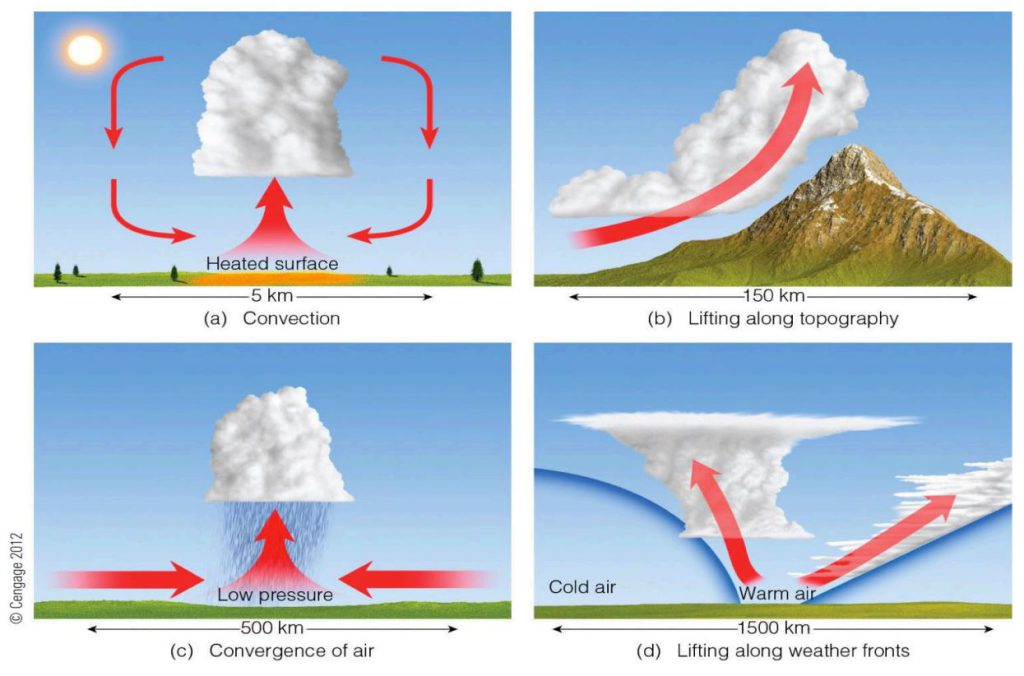
Clouds form via four main processes:
- Convection
- Orographic lifting (air rising over mountains)
- Convergence of air
- Frontal lifting

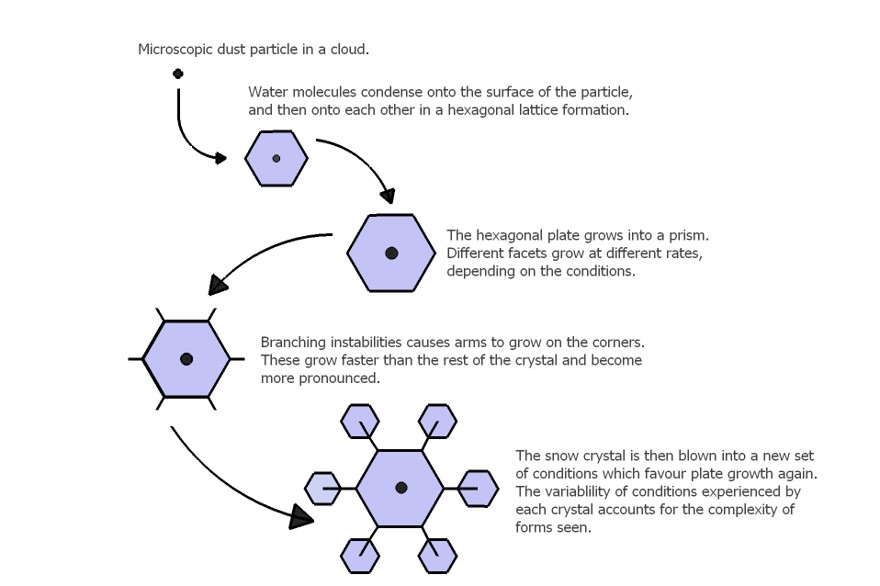
How does a snowflake develop in nature?

- A microscopic dust particle acts as a nucleus for freezing.
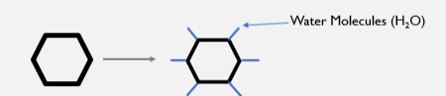
- Water molecules condense into a hexagonal lattice.
- Hexagonal platelets grow into a prism.
- Branching instabilities form arms on the corners of the structure.
- Changing conditions grow new plates repeatedly until the snowflake is heavy enough to fall—making each snowflake unique.
What kind of clouds commonly form in the winter in Idaho?
Due to Idaho’s mountain ranges, wintertime orographic clouds dominate.
These form when moist air lifts over mountains. In cold conditions, many contain Supercooled Liquid Water (SLW), but not enough ice forms naturally for precipitation.
Cloud seeding introduces particles that provide more “landing pads” for SLW to freeze upon, increasing precipitation.

How does cloud seeding work?

Cloud seeding is a physical process in which a seeding agent is released into an existing cloud containing SLW.
These particles act as nuclei, allowing SLW to freeze and grow into snowflakes until they fall as precipitation.
Seeding mimics natural precipitation processes by providing additional nuclei for freezing.
What seeding agent is used?

Silver Iodide (AgI)
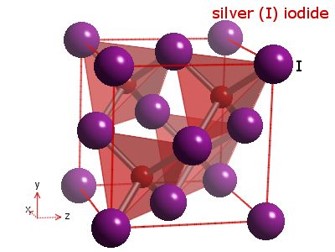
Silver iodide (AgI) is the most common seeding agent. Its molecular structure resembles ice crystals, enabling ice formation at warmer temperatures.
AgI is inert, insoluble in water, and stable, meaning it does not react or accumulate in ecosystems.
Decades of use show no evidence of adverse impacts on humans, ecosystems, or the environment.

Is AgI water soluble?

AgI is insoluble, much like quartz sand. It does not dissolve in water, meaning its minerals do not break apart or become free in the environment.
How big is a particle of AgI?

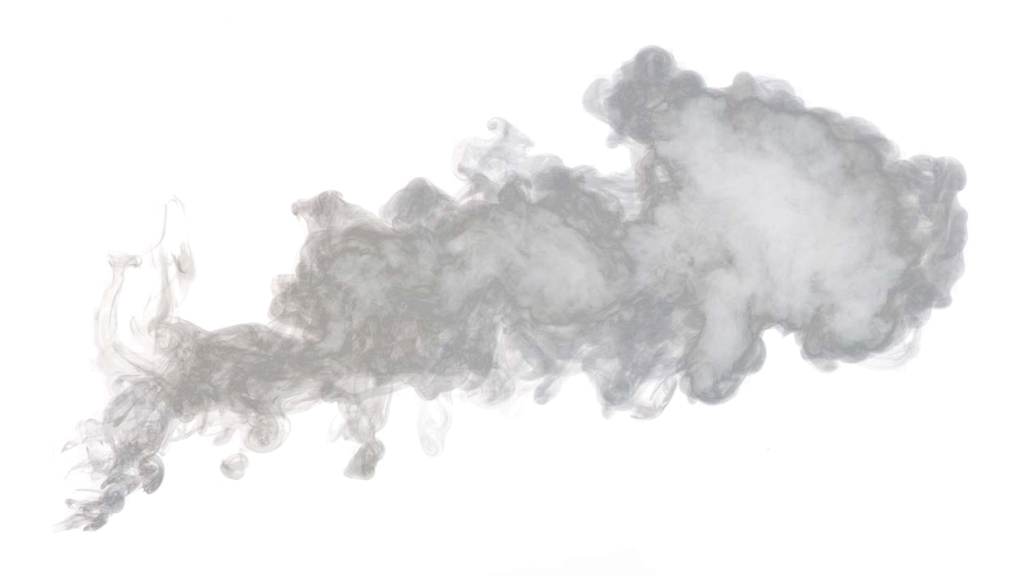
AgI is burned and released as microscopic smoke-sized particles in very small quantities.
How does the process of cloud seeding work?

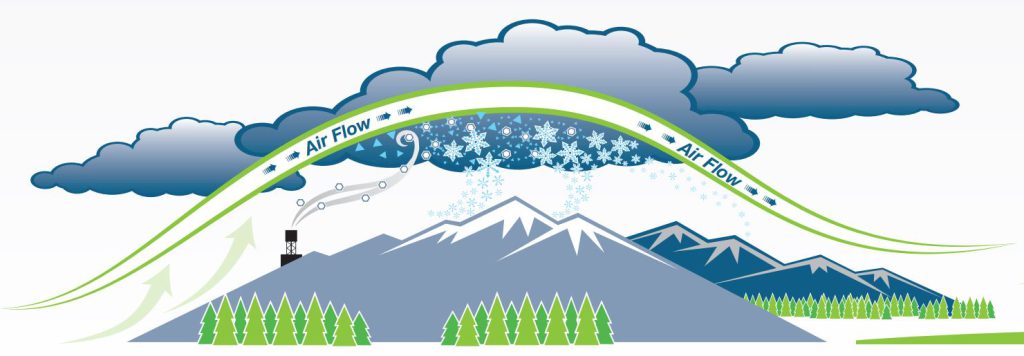
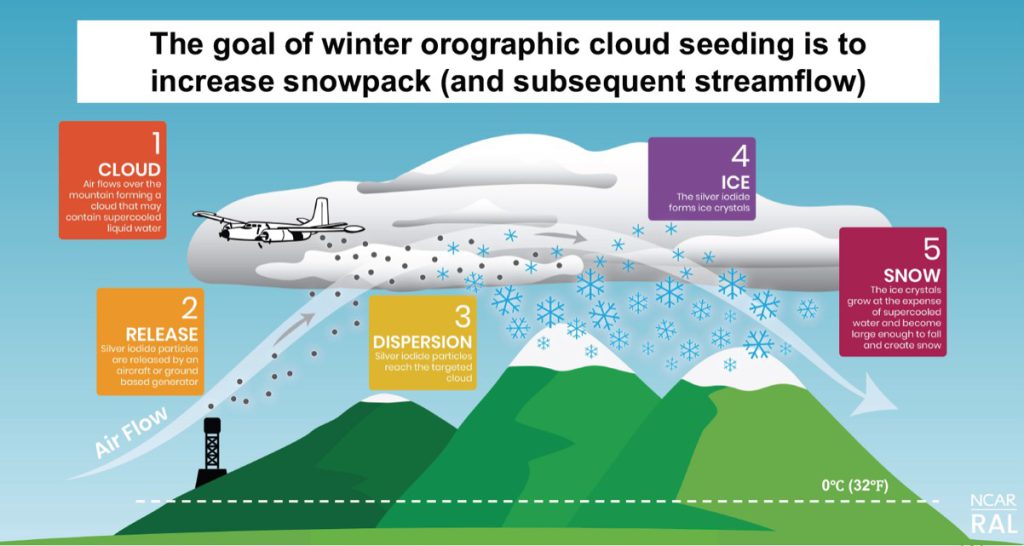
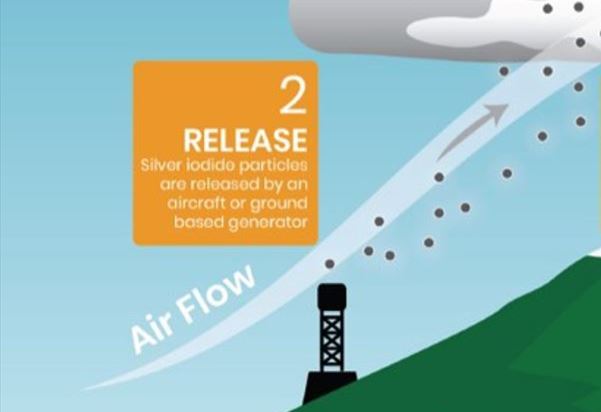
- Air flows over a mountain forming a cloud that contains supercooled liquid water. Storm systems are monitored to ensure incoming conditions are conducive for cloud seeding.
- A seeding agent, most commonly Silver Iodide (AgI), is released into the existing storm cloud by aircraft and/or ground-based generators. Seeding materials are only released during active storms with specific conditions conducive to ice formation. No existing cloud, no cloud “seeding.”
- Seeding materials disperse into the targeted cloud. This can occur by direct injection into or above the cloud via aircraft, or by ground-based dispersion carried into the cloud by winds.
- The silver iodide particles mimic the molecular shape of ice, providing “landing pads” for supercooled liquid water to freeze upon, forming ice crystals.
- Ice crystals grow at the expense of the SLW and become large enough to fall as snow, effectively “wringing out” more water from the cloud before it leaves the region.
What research has been done to demonstrate it works?
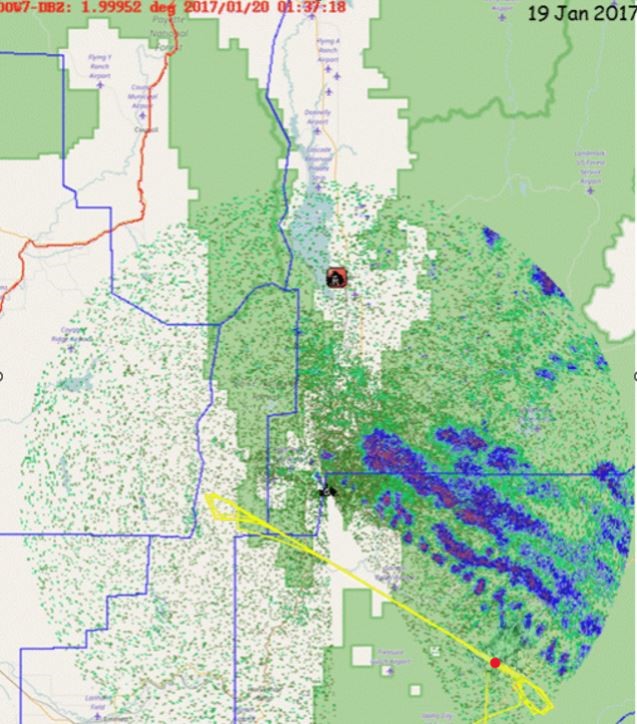
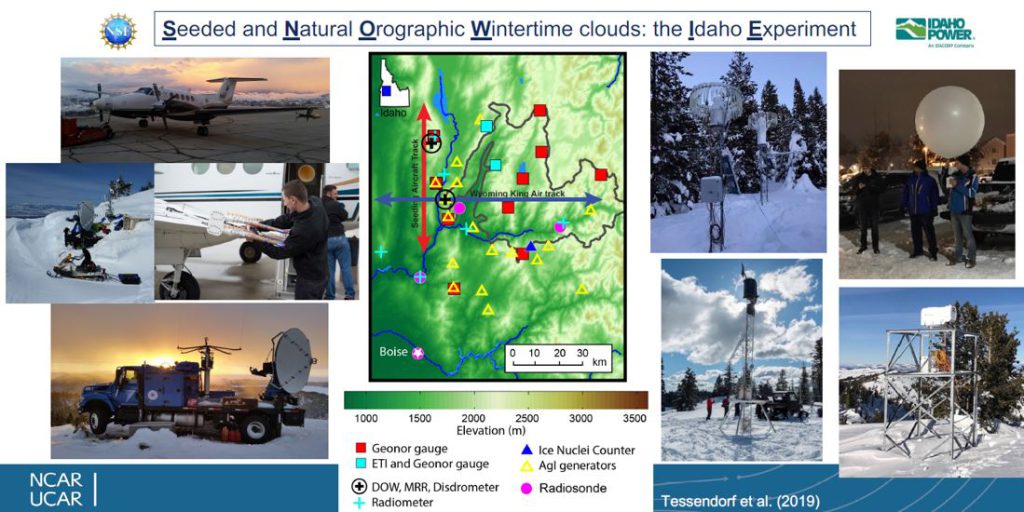
Cloud seeding was first demonstrated in a lab in 1946. In 2017, the Seeded and Natural Orographic Wintertime clouds: the Idaho Experiment (SNOWIE) provided the first unambiguous field evidence.
Researchers used a fully outfitted aircraft to release AgI plumes directly into clouds and measured the impacts with both ground-based and airborne instruments.
This created a detailed 4D picture of how seeded clouds evolved and confirmed that cloud seeding can produce winter precipitation.


The SNOWIE Project
Conducted by NCAR, Idaho Power, and universities, SNOWIE took place in Idaho’s Payette River Basin. Using over 75 instruments and research flights, it showed the “first unambiguous observations of the physical chain of events” after seeding supercooled orographic clouds
(Proceedings of the National Academy of Sciences).

How much additional precipitation is produced?
Proving that cloud seeding works took decades, but quantifying the exact amount remains complex. Research uses methods such as:
Target/Control Method
By comparing SNOTEL gage data from a “target” basin (where seeding occurs) with a climatologically similar “control” basin (where it does not), scientists can estimate additional precipitation as a percentage increase.
- Target: Area seeded with AgI
- Control: Comparable area with no seeding

Modeling
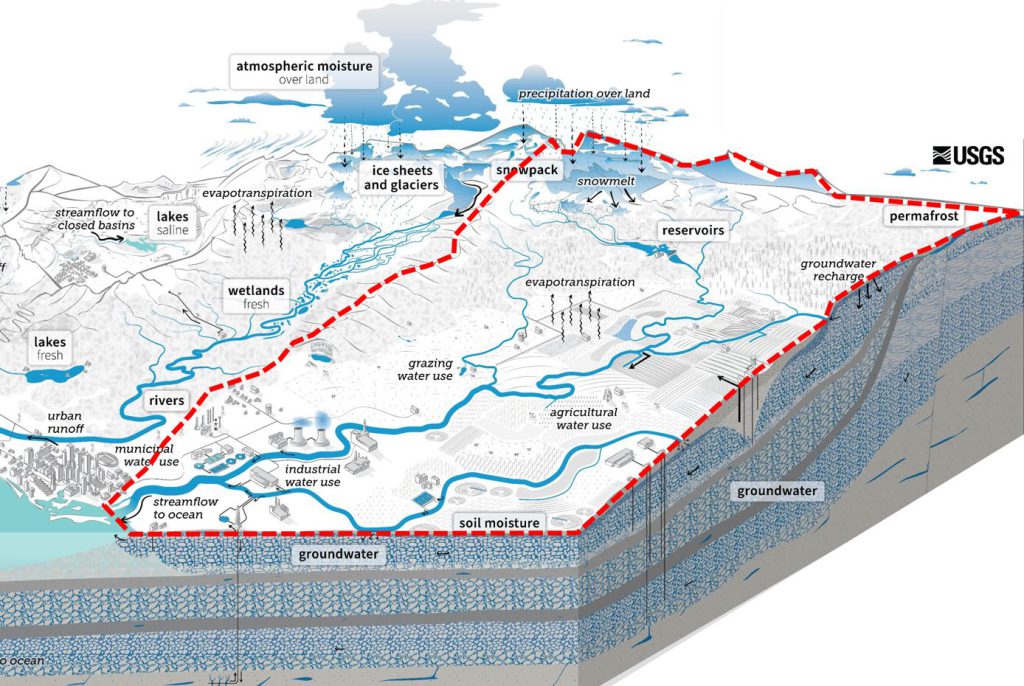
Cloud and hydrology models simulate precipitation increases and track where added water ends up in the system. Tools include:
- WRF Model
- WRF-WxMod (Cloud Seeding Model)
- WRF-Hydro (Hydrology Model)
- RiverWare (Planning Model)
More details can be found on the Research and Development page.

Downwind Effects
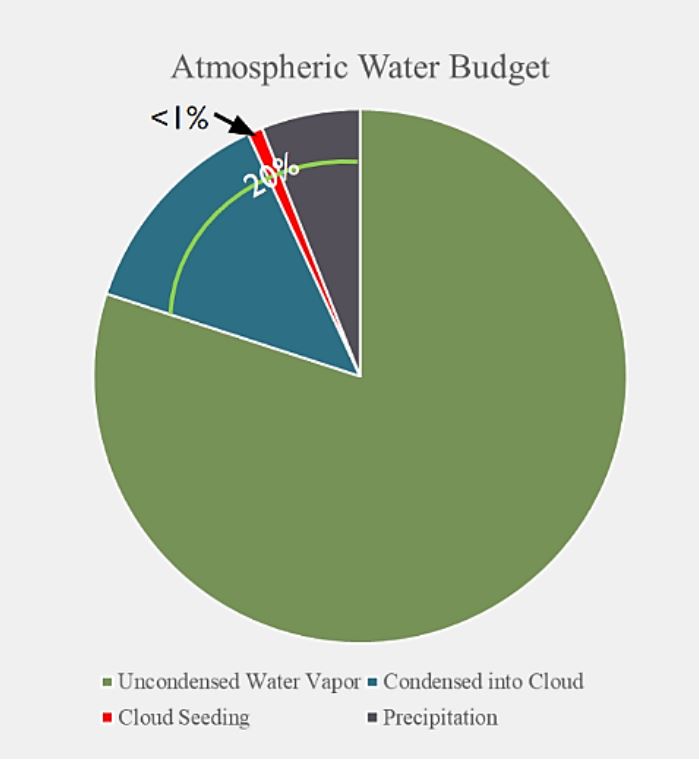
Atmospheric rivers move water like surface rivers, with natural gains and losses. Roughly 20% of atmospheric moisture condenses into clouds, and only 30% of that becomes precipitation—about 6% of the total water budget.
Cloud seeding affects less than 1% of the total budget. Evidence suggests a neutral or positive benefit for downwind users, as seeded nucleation can continue downwind, enhancing precipitation.

Methods of Seeding Clouds
Airborne Seeding

Aircraft release AgI via:
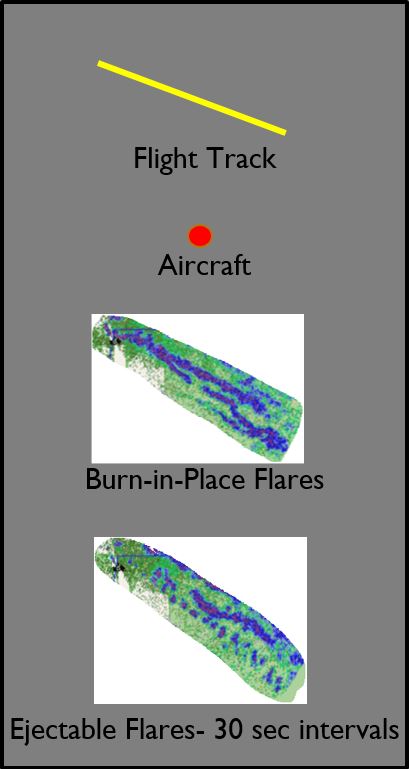
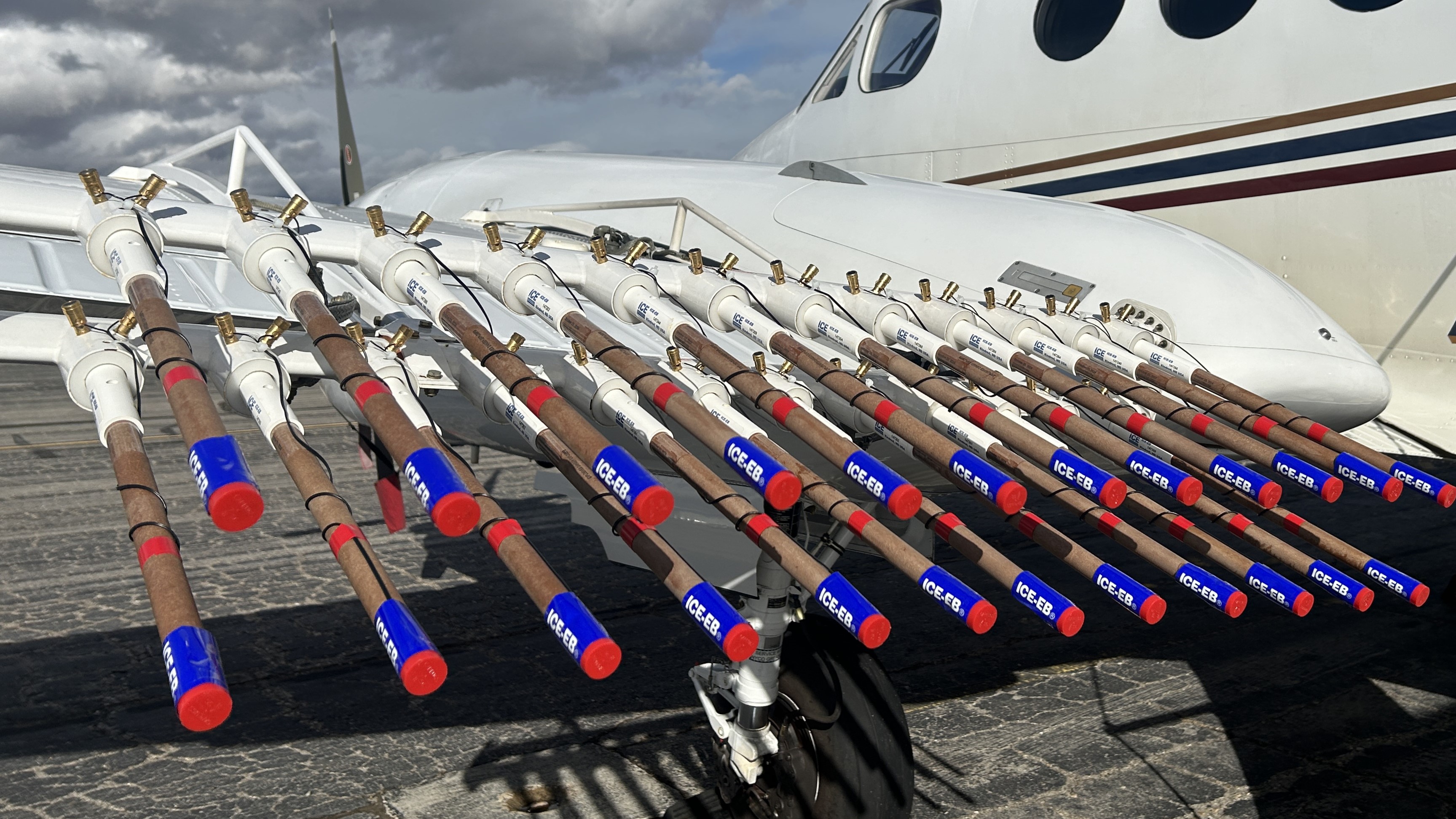
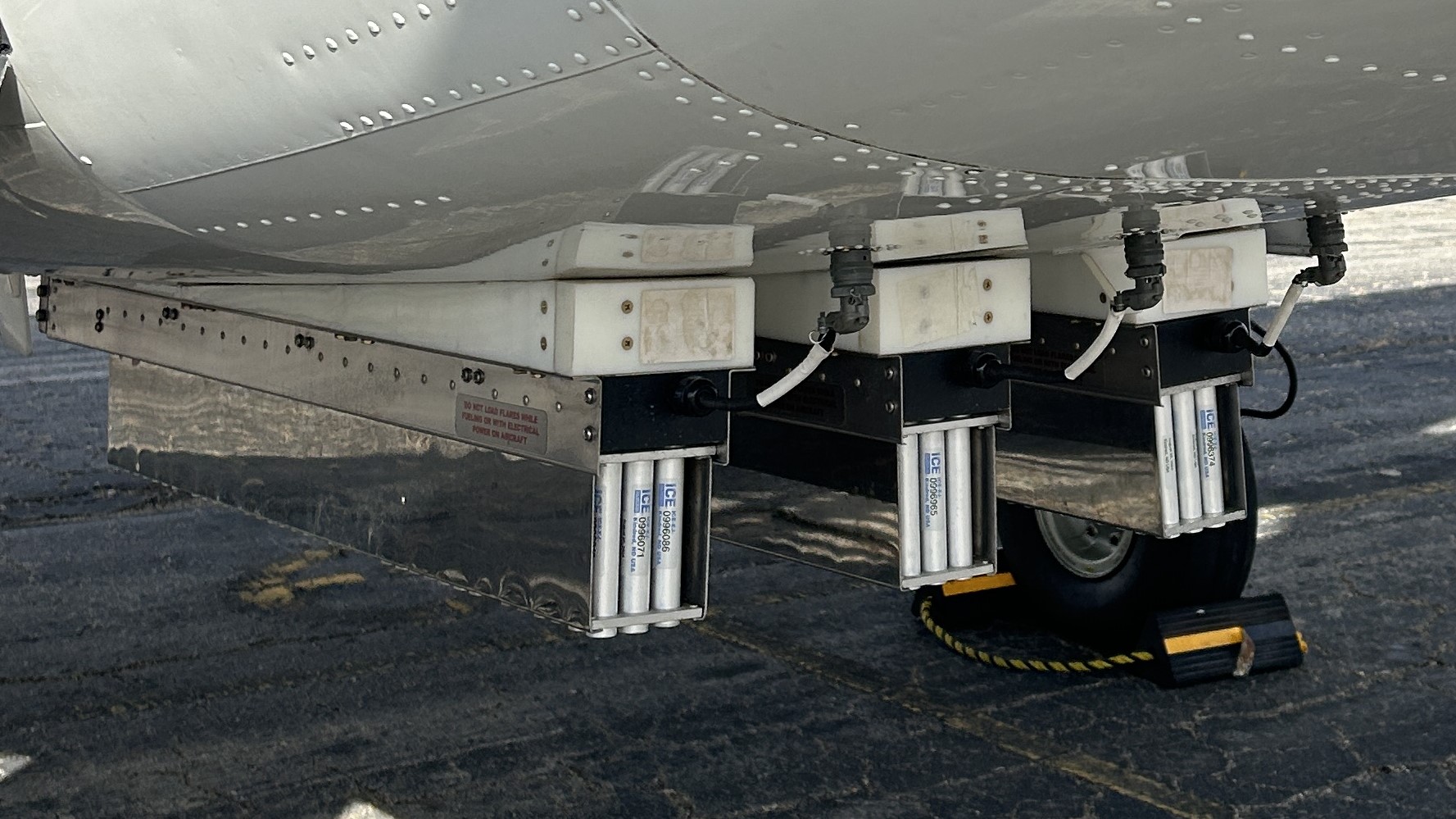
- Burn-In-Place (BIP) Flares: Mounted on wings, burned directly into clouds during flight.
- Ejectable (Ej) Flares: Dropped from the aircraft belly above clouds, used when flying through storms is unsafe.
Ground Seeding

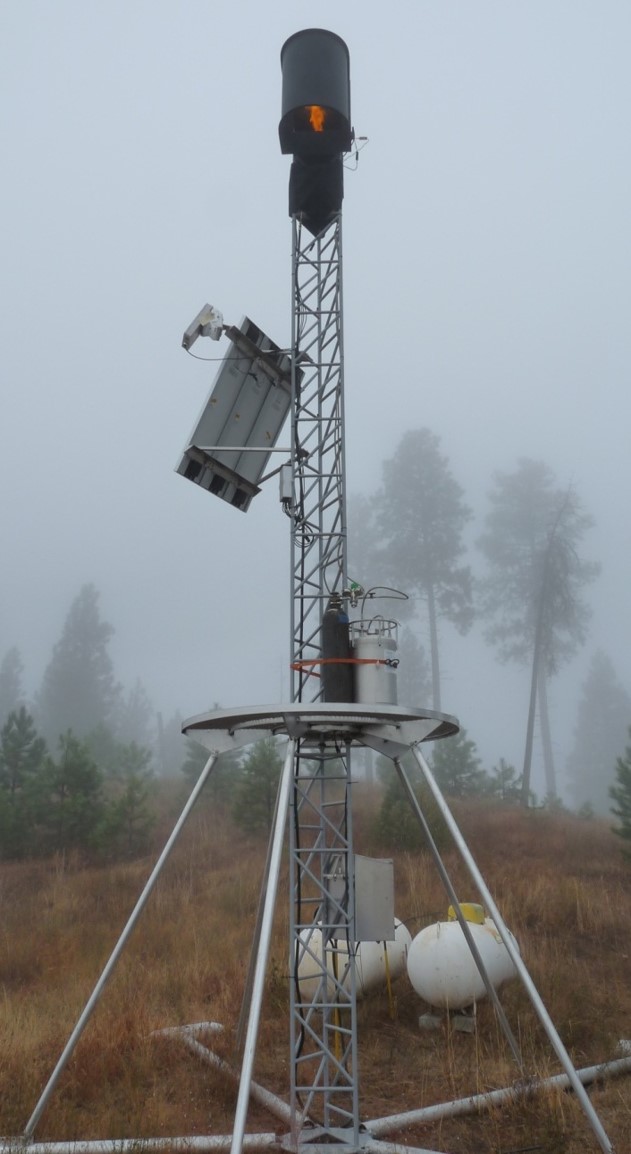
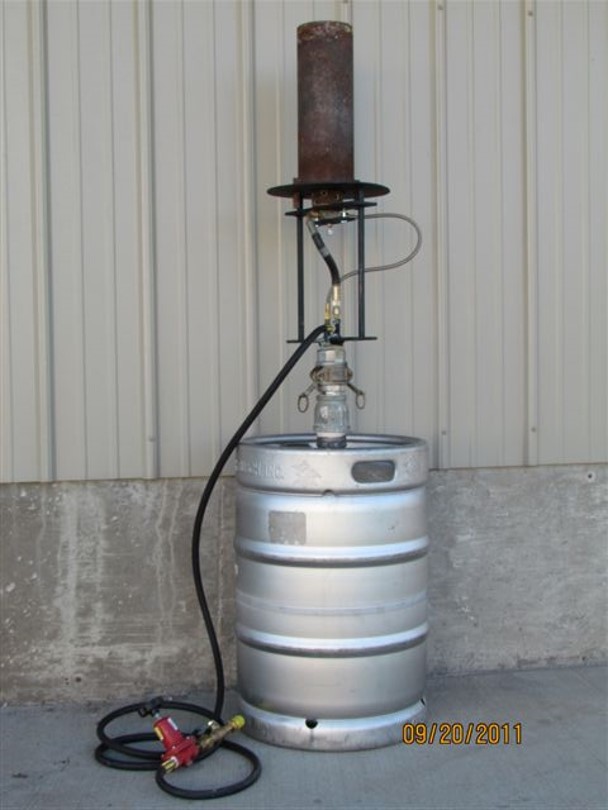
Ground-based generators burn AgI solution, releasing smoke-sized particles carried by winds into storm clouds. Operated manually or remotely, they are typically placed on windward slopes.
Cloud Seeding Equipment


Images provided by Idaho Power Company.
Weather Instrumentation
- Weather Balloon: Provides vertical profiles of temperature, moisture, and winds.
- Ice Rate Sensors: Give real-time liquid water observations.
- Radiometer: Measures atmospheric water values in real-time.
- Radar: Detects precipitation and cloud structure.
- Web Cams: Offer visual confirmation of weather conditions.
- Precipitation Gauge: Records snow and rainfall rates and totals.
- Surface Station: Collects wind, temperature, dew point, and direction values.
Images provided by Idaho Power Company.
Are condensation trails and cloud seeding the same thing?
No. Contrails form when hot aircraft exhaust mixes with cold, moist air, creating ice clouds. Cloud seeding depletes existing clouds by introducing particles (AgI) that freeze supercooled water into snow.

Contrails: Create new clouds from engine exhaust.
Cloud Seeding: Enhances precipitation from existing clouds.
See the EPA Contrails FAQ for more information.
Helpful Resources
- Cloud Seeding Committee Meeting
- Interview with Idaho Water Resource Board
- Authorization and Liability with Cynthia Bridge Clark
- NCAR Cloud Seeding Steps
Publications
See resources from the
North American Weather Modification Council and the
Weather Modification Association.
FAQ’s
Other Resources
- How Cloud Seeding Works training module (COMET)
- NAWMC Workshop Slides
- NAWMC Website
- ASCE Guidelines
- Weather Modification Association Website
Current Projects and Programs
Collaborative Cloud Seeding Program:
Wood River Basin
Boise River Basin
Upper Snake River Basin
Idaho Power Company Projects:
Payette River Basin
High Country Resource Conservation & Development Projects:
Upper Snake River Basin
State of Utah Projects:
Northern Utah Program

Who Conducts Cloud Seeding in Idaho?
Collaborative Cloud Seeding Program
The Collaborative Cloud Seeding Program (Collaborative Program) is a partnership between the Idaho Water Resource Board (IWRB), Idaho Power Company (IPC), and local water users.
IPC operates the program, while IWRB facilitates and funds it. Local water users also provide financial support. IPC also runs an independent project in the Payette River Basin, coordinated with the Collaborative Program.
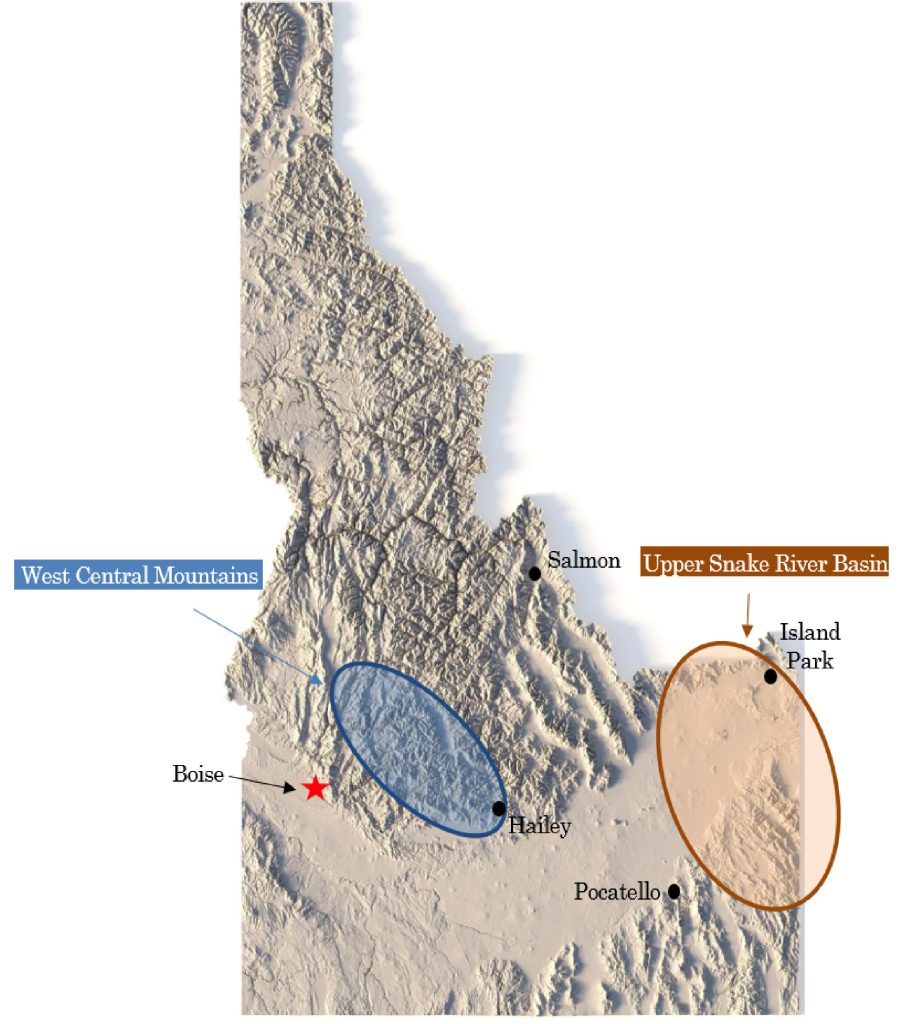
The program’s goal is to enhance snowpack and runoff. Operations are regional—West Central Mountains (Boise and Wood River Basins) and Eastern Mountains (Upper Snake Basin). Regional operations allow equipment sharing and cost-efficiency.


West Central Mountain Region:
- Boise River Basin
- Wood River Basin
- Payette River Basin
Eastern Mountain Region:
- Northern Upper Snake River Basin
- Southern Upper Snake River Basin
Idaho Power Company (IPC)
IPC independently manages the Payette River Basin project, with coordination through the Collaborative Program.
High Country Resource Conservation & Development (HCRCD) Program
HCRCD, operated by Let It Snow, has run manual generator operations in the Upper Snake River Basin for over 20 years. IPC provides forecasting support, but HCRCD runs its program independently, in coordination with the Collaborative Program.
State of Utah’s Northern Utah Program in Idaho
The Utah Division of Natural Resources (UT DNR) operates 3 ground seeding generators in southern Idaho to support the Northern Utah Cloud Seeding Program (Cache and Box Elder counties).

Projects In Idaho
Wood River Basin


Current Annual Basin: ~$769,000
- 1 Shared Aircraft (Boise)
- 3 Shared Generators
- 7 Dedicated Generators
Boise River Basin


Current Annual Basin: ~$1,025,000
- 1 Shared Aircraft (Payette)
- 1 Shared Aircraft (Wood)
- 12 Shared Generators
- 5 Dedicated Generators
Upper Snake River Basin

Northern Upper Snake River Basin
Southern Upper Snake River Basin


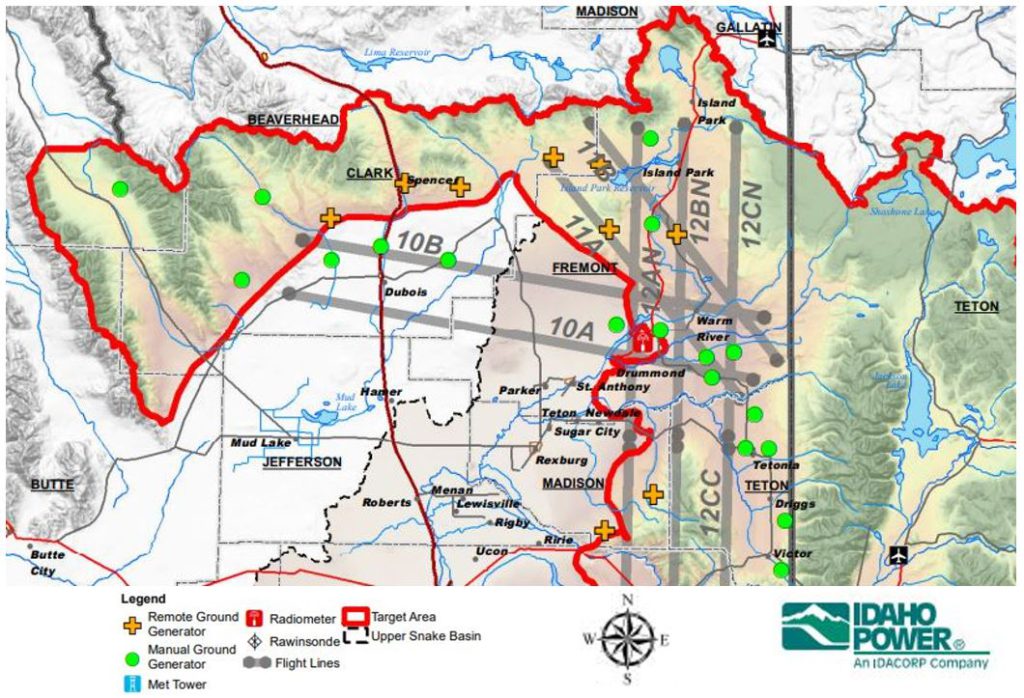
Current Annual Costs: ~$1,816,000
- 1 Dedicated Aircraft
- 25 Dedicated Remote Ground Generators
- 23 Dedicated Manual Generators (HCRCD)
Payette River Basin

Managed independently by IPC, coordinated with the Collaborative Program.
- 1 Shared Aircraft (Boise)
- 9 Shared Generators
- 7 Dedicated Liquid Propane Generators
- 8 Dedicated Generators
Basins of Interest
IWRB is studying cloud seeding in the Bear River and Lemhi River Basins.
Bear River Basin

A 2021 feasibility study found Bear River viable for cloud seeding. Not yet operational.
Lemhi River Basin

A feasibility and design study launched in 2022 is evaluating viability. Not yet operational.
Research and Development
Research is critical for designing, developing, operating, monitoring, and assessing an effective cloud seeding program. Research helps the Idaho Water Resource Board (IWRB) address policy questions and public concerns, and ensures the objectives of water supply enhancements are being met in regions where operations occur.
The SNOWIE research project served as a catalyst across the drought-stricken western United States, showing proof of a method to bring more water to basins in need. Cloud seeding has been proven to work—but “how well does it work?” Quantifying the effects is the next big evolution in the science of cloud seeding. Research provides data for developing models that ultimately help IWRB understand how much water is being generated and how it affects water supply systems.
Models are also essential for forecasting storms to inform operations, determining the feasibility of new projects, designing those projects, and assessing the broader potential for cloud seeding across a region.

Current Research Projects
- Cloud Seeding Analysis
- Statewide Assessment of Cloud Seeding Opportunities
- Bear River Basin Feasibility and Design
- Upper Snake River Basin/Bear River Basin Feasibility and Design
- Lemhi River Basin Feasibility and Design
- Statewide Cloud Seeding Potential / Liquid Propane
- Liquid Propane Investigation
Modeling Projects
- Weather Research & Forecasting (WRF) model
- WRF-WxMod (Cloud Seeding Model)
- WRF-Hydro (Hydrology Model)
- RiverWare (Upper Snake River Planning Model)
- High Performance Computing Solutions
Research Projects
Cloud Seeding Analysis

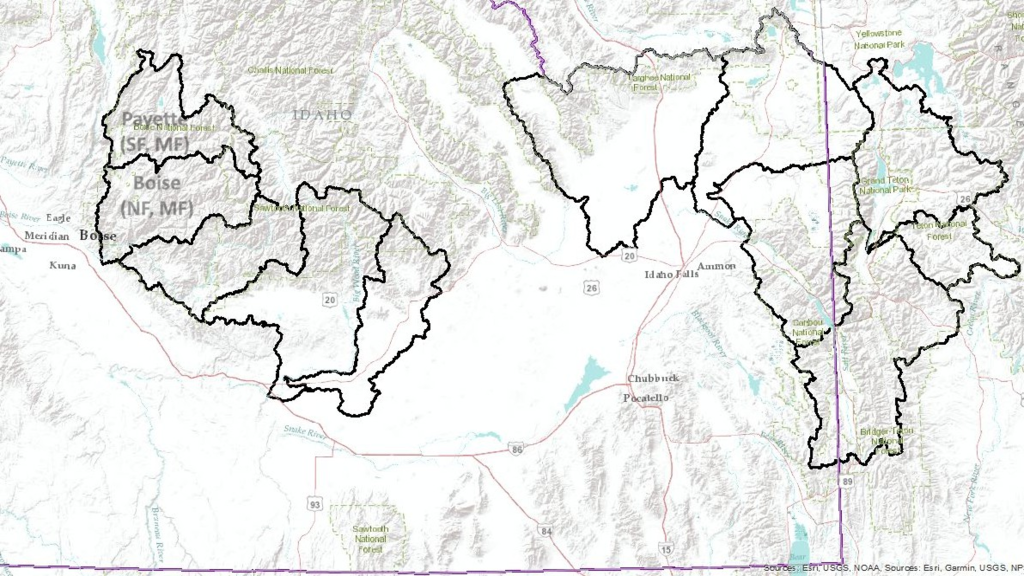
In 2019, the Idaho Water Resource Board (IWRB) directed staff to conduct an investigation of cloud seeding in the basins where collaborative cloud seeding operations are conducted. The IWRB contracted with the National Center for Atmospheric Research (NCAR) to develop modeled cloud seeding data, as well as a WRF based hydrologic model, that can be used estimate the amount of water resulting from cloud seeding. The objective of the Cloud Seeding Analysis project is to determine how increased water supply from cloud seeding (CS) effects the hydrology and use of water in the targeted basins; and to determine the cost effectiveness of cloud seeding as a water management tool for Idaho.
Resources:
Cloud Seeding Analysis Presentation
Key Analysis Components
- How much did precipitation increase?
Using statistical target/control methods and developing physically based cloud seeding models supported by observational data. - How much water did the increase add to the system?
Developing a WRF-Hydro model to estimate impacts on streamflow. - Where does the increased supply go?
Replicating dynamic hydrologic systems and testing sensitivity to changes like added water supply.
Statewide Assessment

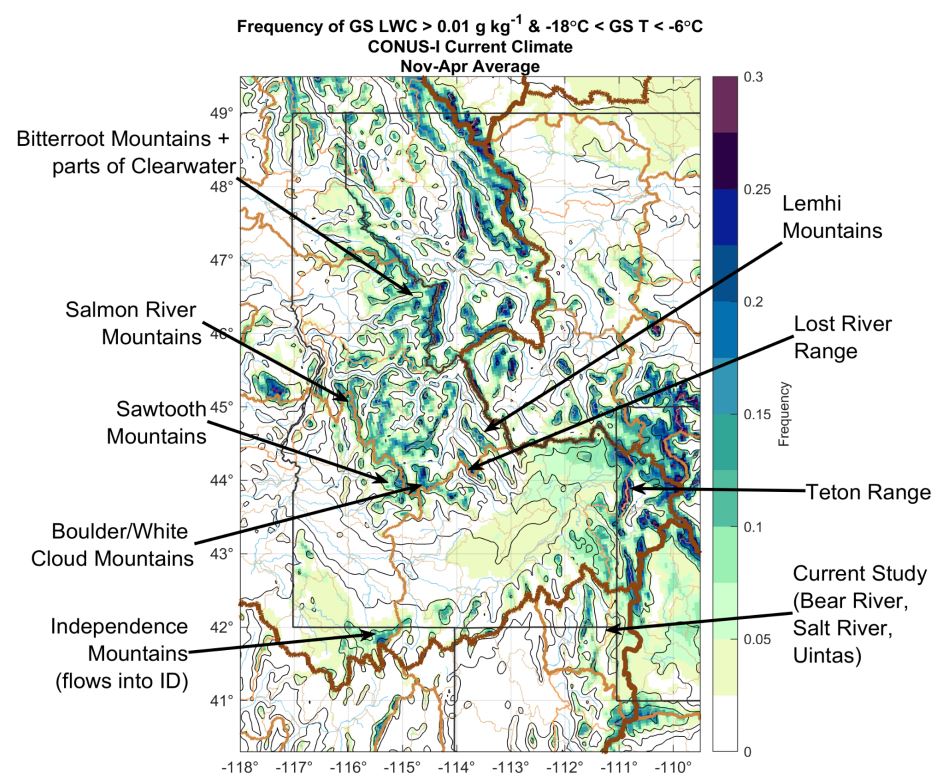
Initiated under HB266 (2021), this assessment identified regions in Idaho where cloud seeding is feasible based on historical weather data. It evaluated opportunities for both Silver Iodide (AgI) and Liquid Propane (LP). While AgI is field-proven, LP requires further study but shows promise in lab settings.
Bear River Basin Feasibility and Design
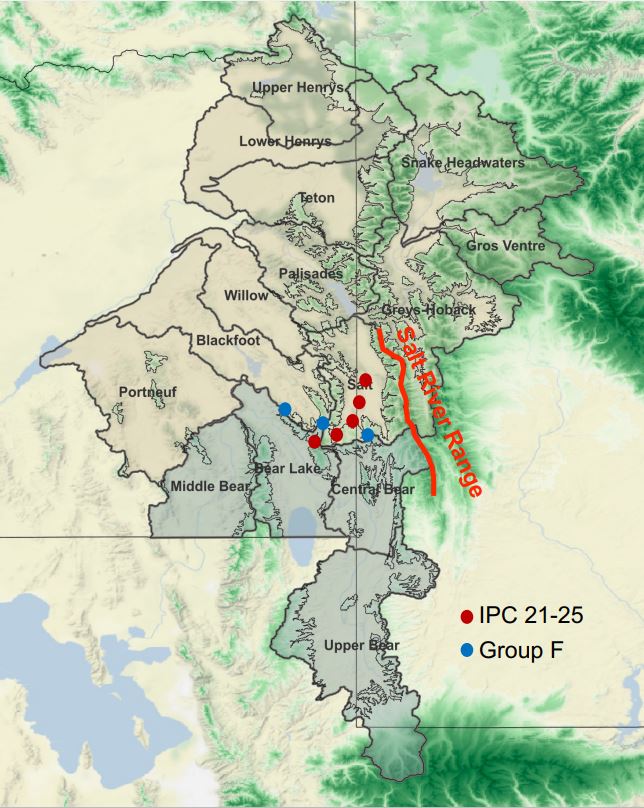
This study evaluated ground and aerial seeding opportunities targeting Bear Lake and stream reaches supplying Idaho. Findings showed considerable potential, with aerial operations being more effective due to flexibility and overcoming mountain flow blocking conditions.

Resources: Bear River Basin Feasibility and Design Slides
Upper Snake River/Bear River Basin Shared Feasibility and Design

This study explored shared infrastructure to support both basins. Some generators can serve dual purposes depending on wind conditions, enhancing cost-effectiveness.
Resources: Shared Ground Generators Impact Slides
Lemhi River Basin Feasibility and Design

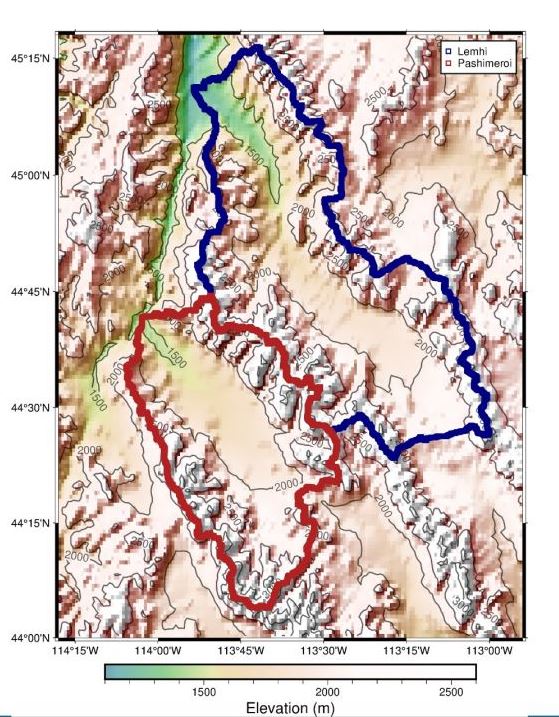
Currently underway, this investigation will determine feasibility of cloud seeding in the Lemhi River Basin. No active operations are yet in place.
Liquid Propane Pre-Investigation

LP shows promise at warmer temperatures and lower costs compared to AgI. IWRB, IPC, NCAR, and CryoToolbox launched a pre-investigation phase in 2025 to test LP as a seeding agent.
Resources: Liquid Propane Cloud Seeding Year 1 Report
Silver Iodide (AgI) Research
A literature review, funded by 28 member states and agencies, is underway to assess silver iodide impacts in weather modification. Conducted by Heritage Environmental & Wisconsin State Laboratory of Hygiene, results are expected by Fall 2025.
Scope of Work:
- Natural atmospheric silver inputs to target regions
- Summary of silver in soils and freshwater
- Estimates of silver iodide deposition from programs
- Review of silver toxicity to organisms
- Discussion of natural vs. weather modification silver deposition
Modeling Projects
WRF Model
Developed in the late 1990s for atmospheric research, the Weather Research and Forecasting (WRF) model produces simulations of atmospheric conditions. However, national models struggle with Idaho’s mountainous terrain, requiring regional adaptations.
Resources: NCAR WRF Model Page
WRF-WxMod (Cloud Seeding Model)
A modified WRF model that integrates cloud seeding parameters. It helps design projects, validate operations, and forecast seeding opportunities. Coupled with WRF-Hydro, it estimates water impacts.
- 2011 | IPC initiated model development with NCAR
- 2017 | IWRB partnered for operational support
- 2023 | Expanded to Bear and Lemhi River Basins
Resources: NCAR WRF-WxMod Page
WRF-Hydro (Hydrology Model)
Produces forecasts for precipitation, streamflow, soil moisture, snowpack, flooding, and groundwater. Used for hydroclimate assessments in Idaho basins.
- Calibration of Upper Snake River Basin
- Calibration of Boise River Basin
- Calibration of Wood River Basin
Resources: NCAR WRF-Hydro Page
RiverWare (Upper Snake River Planning Model)
A reservoir regulation and hydrology model developed by USBR, updated by IDWR and IPC to include operations, diversions, water right accounting, and recharge. Supports planning for Snake River water management.
High Performance Computing
Large-scale modeling requires high-capacity computing. IWRB, IPC, Boise State University, and INL share an HPC system. Current needs exceed capacity, and new computing solutions are being investigated.
Program Administration
Program Budget:
Funding for the Cloud Seeding Program is authorized under the Idaho Water Resource Board’s (IWRB) Secondary Aquifer Planning and Management Fund (Secondary Fund). The Cloud Seeding Committee reviews the program budget and provides a funding recommendation to the IWRB; program funding is then approved as part of the IWRB’s Fiscal Year (FY) budget resolution for the Secondary Fund.
Partnership Agreements:
Since 2014, the IWRB has participated in a collaborative cloud seeding program with Idaho Power Company (IPC) and water users in the Boise River, Wood River, and Upper Snake River Basins. IPC conducts program operations, while the IWRB and local water users provide funding support.
North American Weather Modification Council:
The NAWMC is comprised of state and local resource managers involved in cloud seeding across North America. The IWRB is a Full Member, represented by its staff. The council serves as a forum for exchanging information on weather modification science and promoting the safe and effective use of these technologies.
Statutory Authority Timeline

Legislation
Idaho House Bill 266 (2021)
Directed the IWRB to:
- Continue analysis of existing cloud seeding projects
- Complete an assessment of opportunities in other basins
- Authorize cloud seeding programs in Idaho
Provides IWRB authority to:
- Sponsor or develop local or statewide programs
- State funds may only be used in basins where supplies are insufficient for existing rights, water quality, recreation, or fish/wildlife
Establishes that:
- Water supply from cloud seeding shall be distributed according to the prior appropriation doctrine
Authorizations
§42-4301 designates the IWRB as the agency responsible for authorizing cloud seeding projects. In May 2022, the IWRB adopted criteria to ensure compliance with laws and proper documentation of activities.
Current IWRB Authorizations:
- Idaho Collaborative Cloud Seeding Program
- Partnership managed by IWRB
- Operated by IPC
- Funded by IWRB, IPC, and basin stakeholders
- Idaho Power Company | Payette River Basin
- Operated and managed by IPC
- Remote ground generators
- Aircraft operations by Weather Modification International
- IPC Authorization
- High Country Resource Conservation & Development | Upper Snake River Basin
- Operated by Let it Snow, Inc
- Manual ground generators
- HCRCD Authorization
- State of Utah | Box Elder and Cache County
- Operated by North American Weather Consultants
- Manual ground generators
- Utah Authorization
Program Documents and Reports
§42-4301 provides directive for the Idaho Water Resource Board (IWRB) to authorize cloud seeding operations in the State of Idaho. The IWRB began requiring authorized cloud seeding projects to provide reports and documentation of operations in April 2021. Records prior to this date may be incomplete.
Cloud Seeding Program Suspension Criteria
2024–2025 Season Monthly Reports
April 2025
- Idaho Collaborative Cloud Seeding Program
- High Country Resource Conservation & Development (Coming Soon)
- State of Utah, Northern Program
March 2025
- Idaho Collaborative Cloud Seeding Program
- High Country Resource Conservation & Development
- State of Utah, Northern Program
February 2025
- Idaho Collaborative Cloud Seeding Program
- High Country Resource Conservation & Development
- State of Utah, Northern Program
January 2025
- Idaho Collaborative Cloud Seeding Program
- High Country Resource Conservation & Development
- State of Utah, Northern Program
December 2024
- Idaho Collaborative Cloud Seeding Program
- High Country Resource Conservation & Development
- State of Utah, Northern Program
November 2024
- Idaho Collaborative Cloud Seeding Program
- High Country Resource Conservation & Development
- State of Utah, Northern Program
Idaho Collaborative Cloud Seeding Program Annual Reports
- 2023/2024 Cloud Seeding Season
- 2022/2023 Cloud Seeding Season
- 2021/2022 Cloud Seeding Season
- 2020/2021 Cloud Seeding Season
- 2019/2020 Cloud Seeding Season
High Country Resource Conservation & Development Annual Reports
State of Utah, Northern Program Annual Reports
Documents and Additional Reports
2019-2020 Cloud Seeding Summary
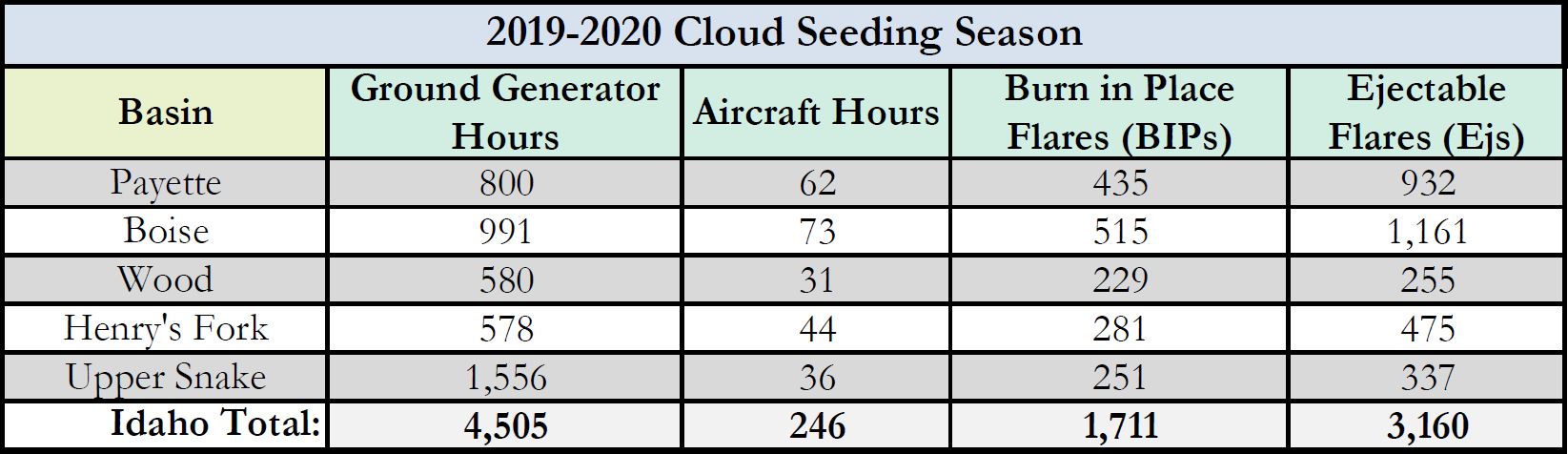
Table 1. 2019-2020 Cloud seeding season summary data from Idaho Power Company (November 1st 2019 – April 15th 2020)
2019-2020 Collaborative Cloud Seeding Annual Report
During the WY2020 cloud seeding season, IPC operated 32 remote ground-based cloud seeding generators, 2 cloud seeding aircraft (operated by WMI), 1 automated surface observing system (ASOS), 2 radiometers and 11 high resolution precipitation gauges in the Central Mountains Cloud Seeding Project focusing on the Payette, Boise and Wood River Basins. In the Upper Snake Basin, the High-Country RC&D (HC RC&D) operated 25 manual ground based cloud seeding generators (operated by Let It Snow), IPC operated 1 cloud seeding aircraft (operated by WMI) and 25 remote ground based cloud seeding generators, 1 ASOS, 2
radiometers and 2 high resolution precipitation gauges. As part of the collaborative efforts in the Upper Snake Basin, IPC provides its weather and cloud seeding operations forecasts and other scientific support to Let It Snow in support of its operation of manual ground generators.
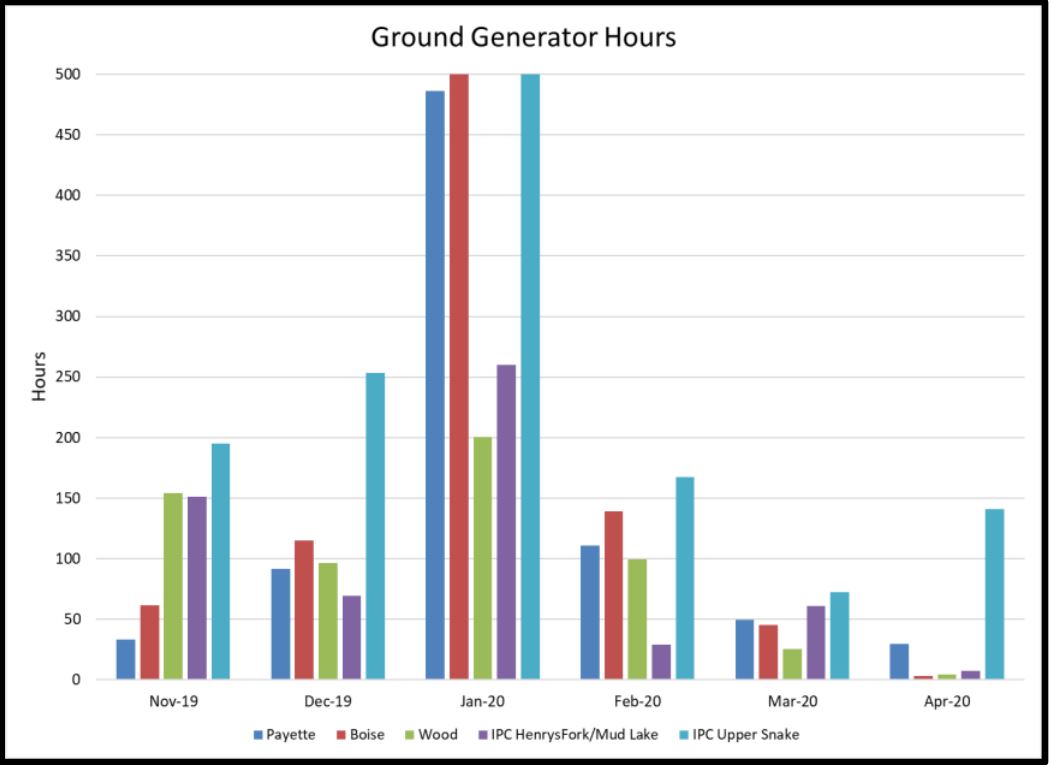
Monthly Operations Summary
Figure 1. 2019-2020 Cloud seeding ground generator operational hours by month by basin (created by Idaho Power Company)
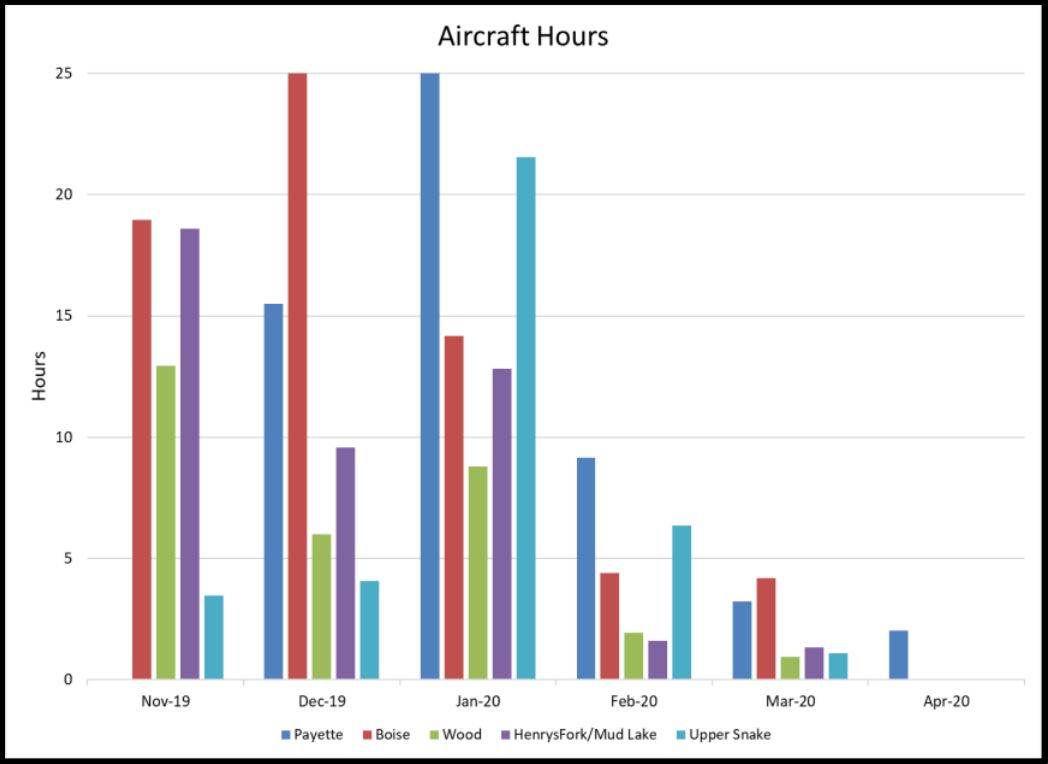
Figure 2. 2019-2020 Cloud seeding aircraft operational hours by month by basin (created by Idaho Power Company)
2020-2021 Cloud Seeding Summary

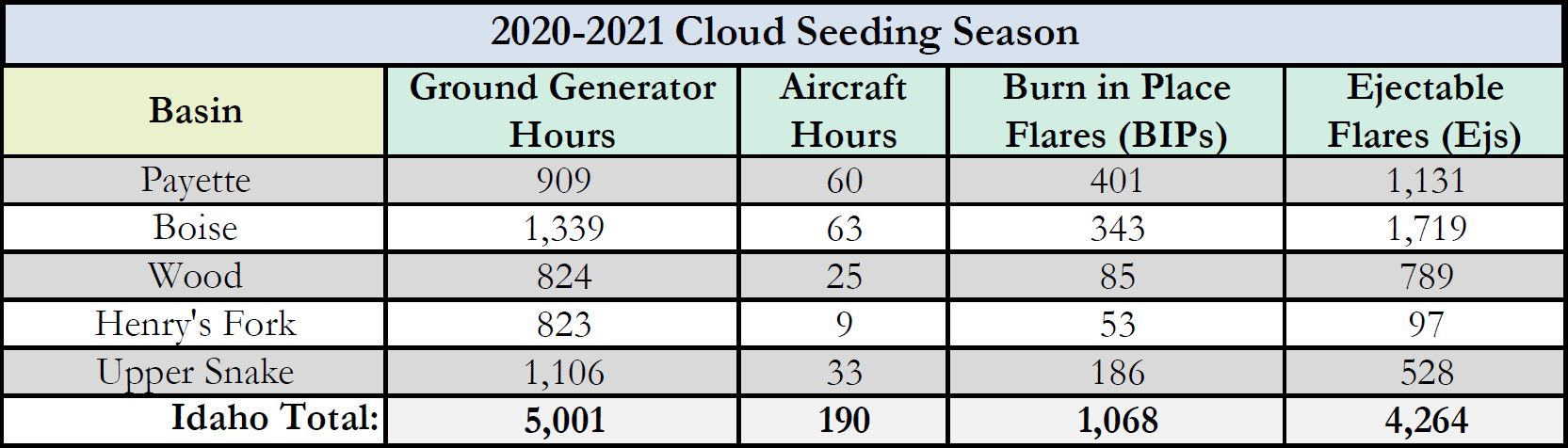
Table 1. 2020-2021 Cloud seeding season summary data from Idaho Power Company (November 1st 2020 – April 15th 2021)
2020-2021 Collaborative Cloud Seeding Annual Report
During the WY2021 cloud seeding season, in the Central Mountains IPC operated 32 remote ground-based cloud seeding generators, 2 cloud seeding aircraft (operated by WMI), 1 automated surface observing system (ASOS), 2 radiometers and 11 high resolution precipitation gauges focusing on the Payette, Boise and Wood River Basins. In the Upper Snake Basin, the High-Country RC&D (HC RC&D) operated 25 manual ground based cloud seeding generators (operated by Let It Snow), IPC operated 1 cloud seeding aircraft (operated by WMI) and 25 remote ground based cloud seeding generators, 1 ASOS, 2 radiometers and 2 high resolution precipitation gauges. As part of the collaborative efforts in the Upper Snake Basin, IPC provides its weather and cloud seeding operations forecasts and other scientific support to Let It Snow in support of its operation of manual ground generators.
Monthly Operations Summary

Figure 1. 2020-2021 Cloud seeding ground generator operational hours by month by basin (created by Idaho Power Company)

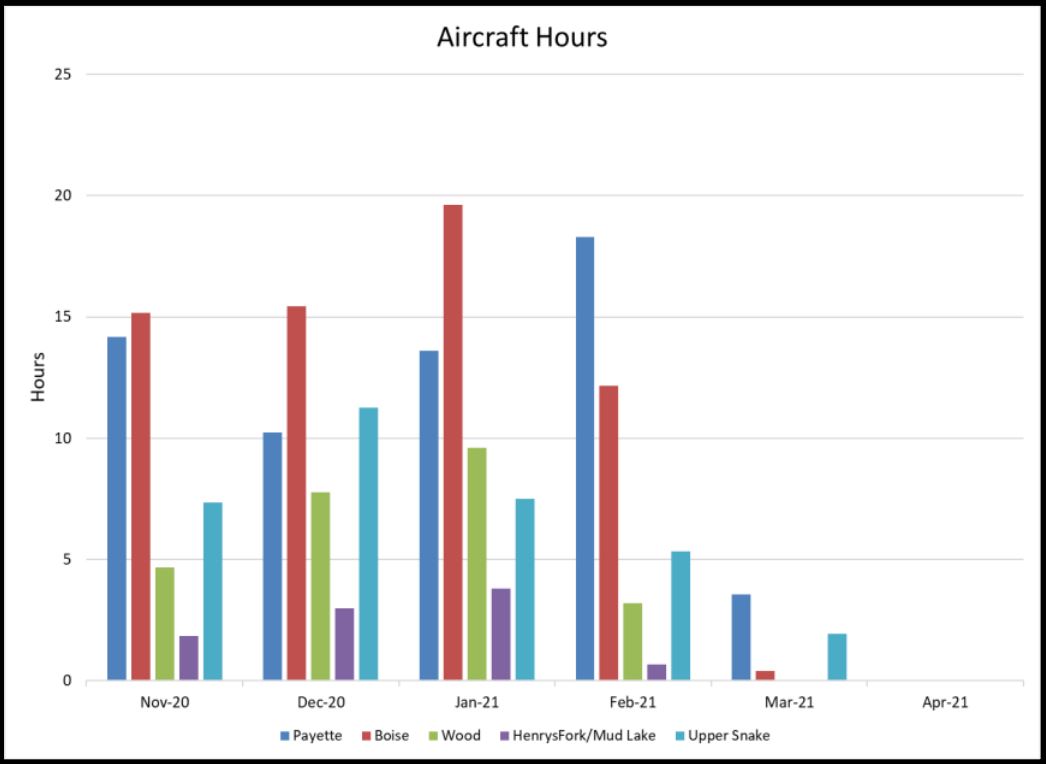
Figure 2. 2020-2021 Cloud seeding aircraft operational hours by month by basin (created by Idaho Power Company)
2021-2022 Cloud Seeding Summary

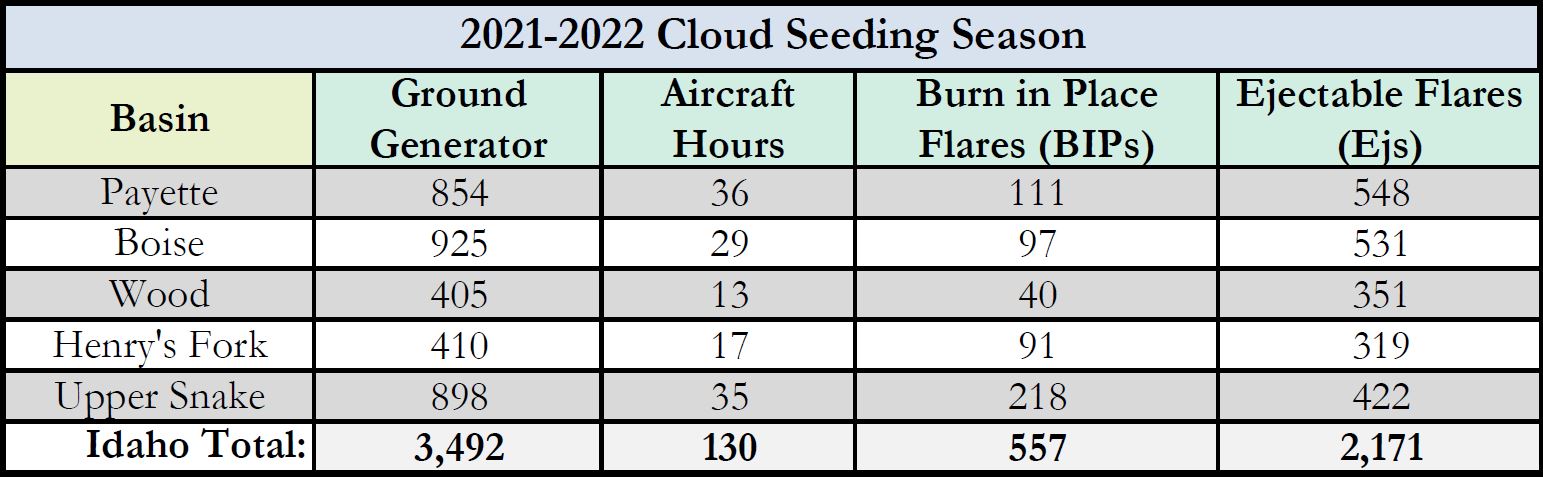
Table 1. 2021-2022 Cloud seeding season summary data provided by Idaho Power Company (November 1st 2021 – April 15th 2022)
2021-2022 Collaborative Cloud Seeding Annual Report
During the WY2022 cloud seeding season, in the Central Mountains IPC operated 32 remote ground-based cloud seeding generators, 2 cloud seeding aircraft (operated by WMI), 1 automated surface observing system (ASOS), 2 radiometers and 11 high resolution precipitation gauges focusing on the Payette, Boise and Wood River Basins. In the Upper Snake Basin, the High-Country RC&D (HC RC&D) operated 25 manual ground based cloud seeding generators (operated by Let It Snow), IPC operated 1 cloud seeding aircraft (operated by WMI) and 25 remote ground based cloud seeding generators, 1 ASOS, 2 radiometers and 2 high resolution precipitation gauges. As part of the collaborative efforts in the Upper Snake Basin, IPC provides its weather and cloud seeding operations forecasts and other scientific support to Let It Snow in support of its operation of manual ground generators.
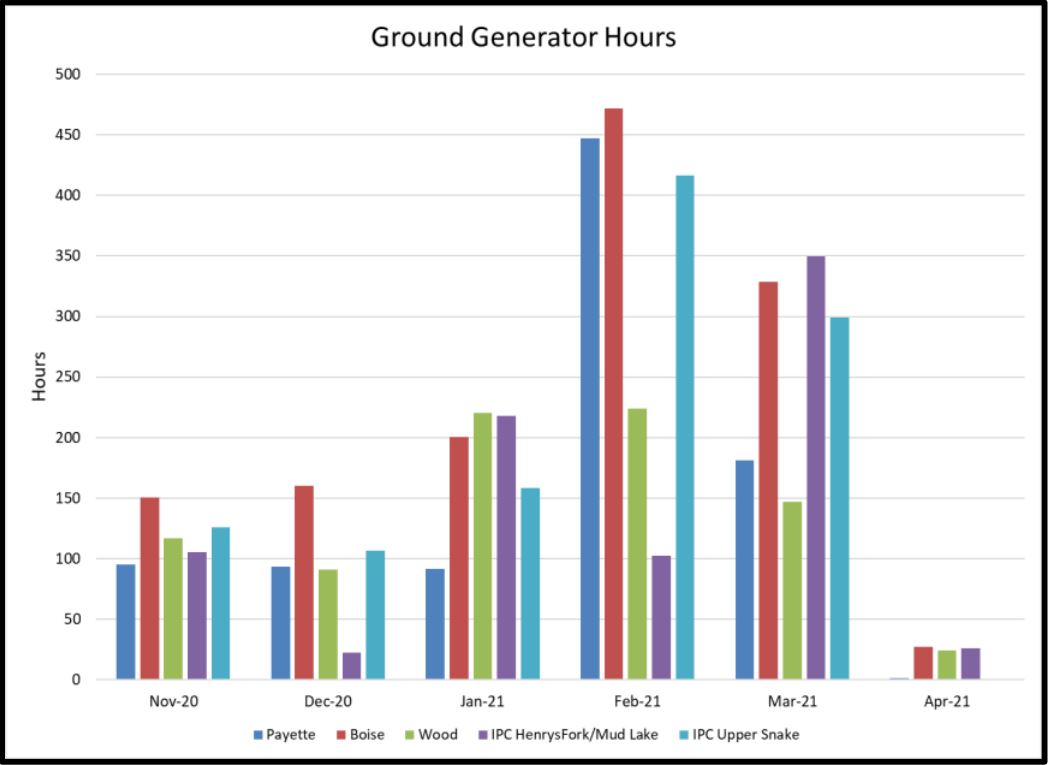
Monthly Operations Summary

Figure 1. 2021-2022 Cloud seeding ground generator operational hours by month by basin (created by Idaho Power Company)

Figure 2. 2021-2022 Cloud seeding aircraft operational hours by month by basin (created by Idaho Power Company)
2022-2023 Cloud Seeding Season Summary

Table 1. 2022-2023 Cloud seeding season summary data provided by Idaho Power Company (November 1st 2022 – April 15th 2023)
2022-2023 Collaborative Cloud Seeding Annual Report
During the WY2023 cloud seeding season, in the Central Mountains IPC operated 32 remote ground-based cloud seeding generators, 2 cloud seeding aircraft (operated by WMI), 1 automated surface observing system (ASOS), 2 radiometers and 11 high resolution precipitation gauges focusing on the Payette, Boise and Wood River Basins. In the Upper Snake Basin, the High-Country RC&D (HC RC&D) operated 25 manual ground based cloud seeding generators (operated by Let It Snow), IPC operated 1 cloud seeding aircraft (operated by WMI) and 25 remote ground based cloud seeding generators, 1 ASOS, 2 radiometers and 2 high resolution precipitation gauges. As part of the collaborative efforts in the Upper Snake Basin, IPC provides its weather and cloud seeding operations forecasts and other scientific support to Let It Snow in support of its operation of manual ground generators.
Monthly Operations Summary

Figure 1. 2022-2023 Cloud seeding ground generator operational hours by month by basin (created by Idaho Power Company)

Figure 2. 2022-2023 Cloud seeding aircraft operational hours by month by basin (created by Idaho Power Company)
2023-2024 Cloud Seeding Season Summary

Table 1. 2023-2024 Cloud seeding season summary data provided by Idaho Power Company (November 1st 2023 – April 30th 2024)
2023-2024 Collaborative Cloud Seeding Annual Report
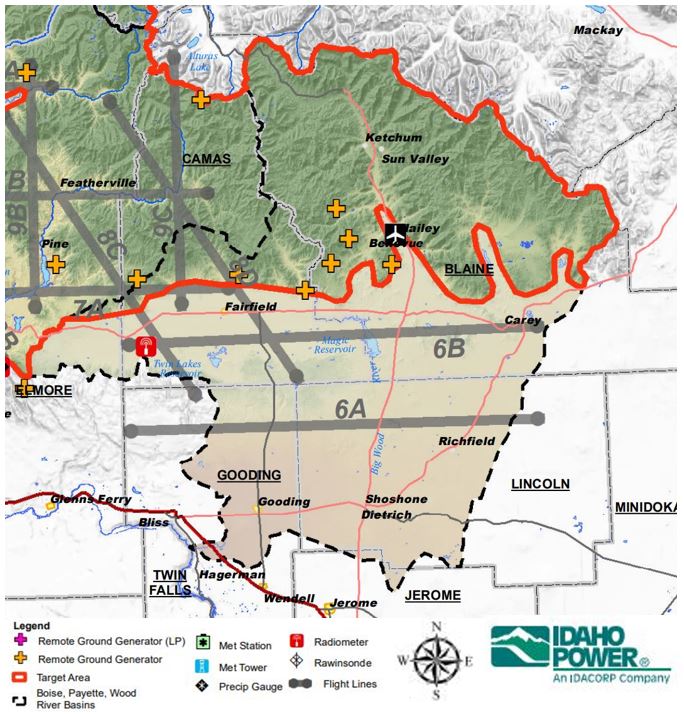
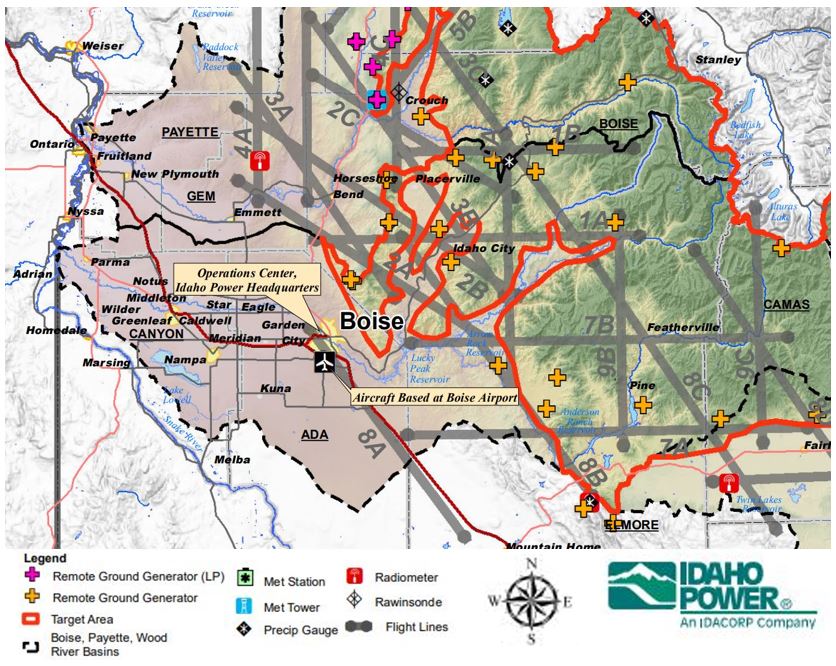
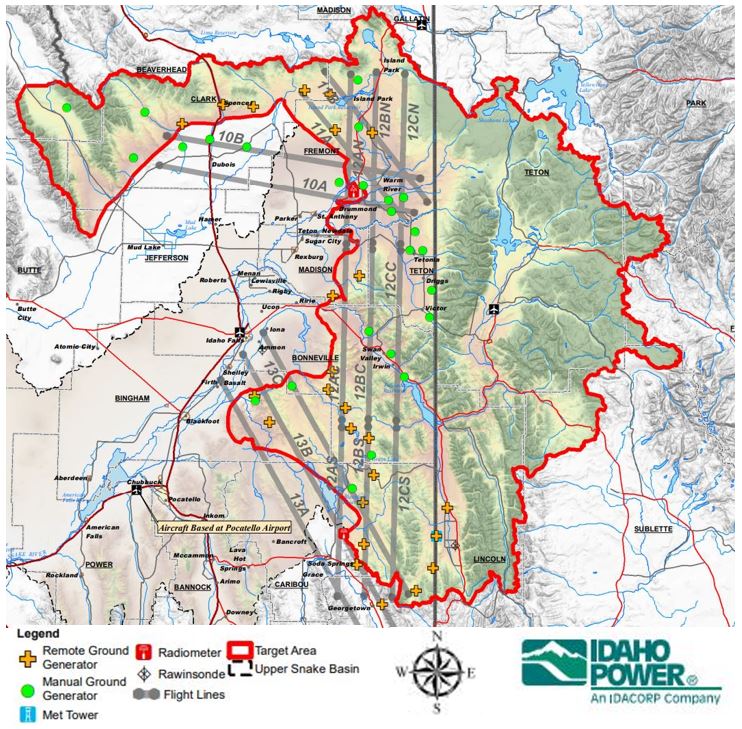
During the WY2024 cloud seeding season, in the Central Mountains IPC operated 32 remote ground-based cloud seeding generators, 2 cloud seeding aircraft (operated by WMI), 1 automated surface observing system (ASOS), 2 radiometers and 11 high resolution precipitation gauges focusing on the Payette, Boise and Wood River Basins (Figure 5). In the Upper Snake Basin, the High-Country RC&D (HC RC&D) operated 25 manual ground based cloud seeding generators (operated by Let It Snow), IPC operated 1 cloud seeding aircraft (operated by WMI) and 25 remote ground based cloud seeding generators, 1 ASOS, 2 radiometers and 2 high resolution precipitation gauges (Figure 6 and 7). As part of the collaborative efforts in the Upper Snake Basin, IPC provides its weather and cloud seeding operations forecasts and other scientific support to Let It Snow in support of its operation of manual ground generators.
Monthly Operations Summary

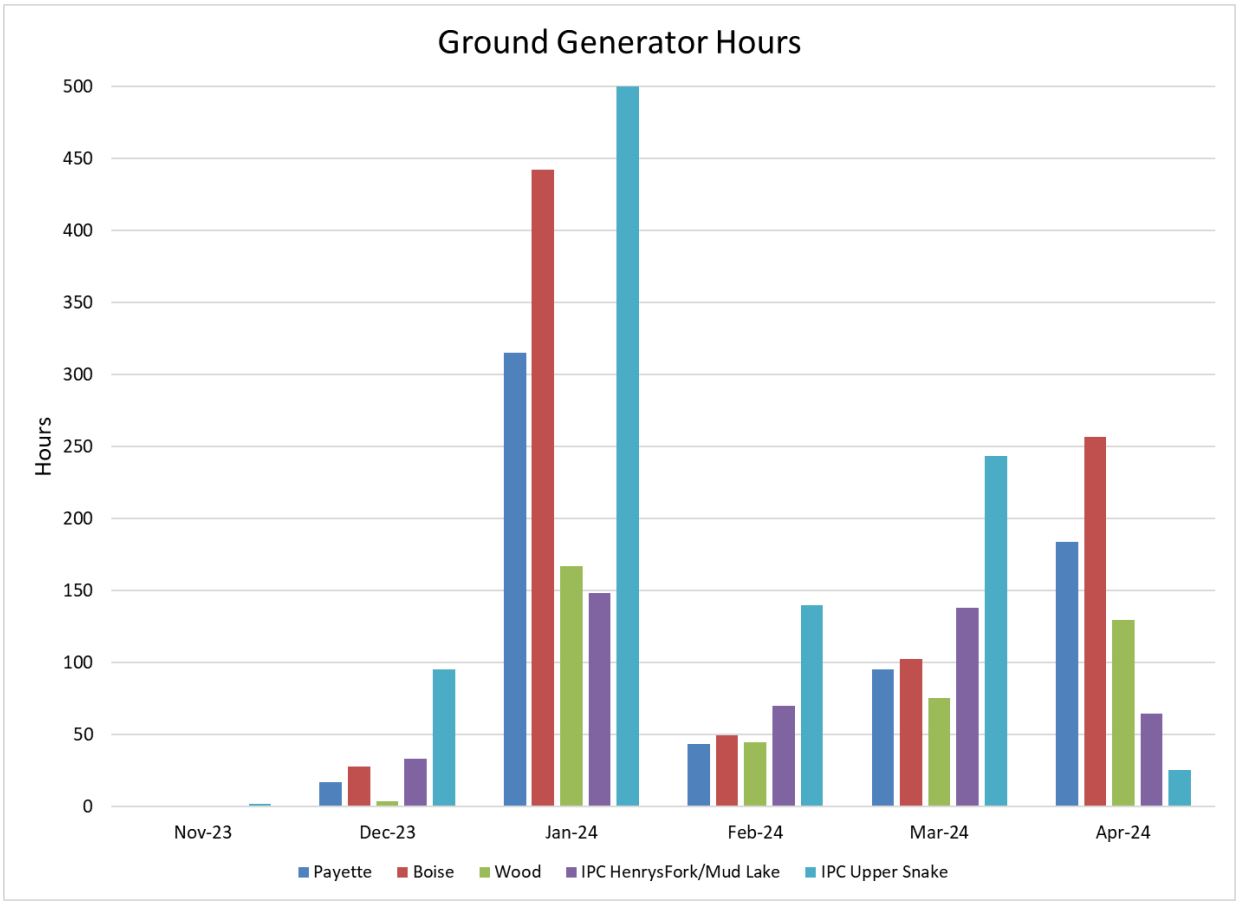
Figure 1. 2023-2024 Cloud seeding ground generator operational hours by month by basin (created by Idaho Power Company)

Figure 2. 2023-2024 Cloud seeding aircraft operational hours by month by basin (created by Idaho Power Company)
History of Cloud Seeding
Origins of Cloud Seeding
Discovery of Cloud Seeding (1946)
The proof of concept was first discovered by Vincent J. Schaefer, Bernard Vonnegut, and Irving Langmuir in 1946. Schaefer and Langmuir were researching icing on aircraft at the General Electric Company’s research laboratory after World War II.
By investigating the production of particles of various sizes and their behavior in the atmosphere, they discovered that tiny particles could be used to produce ice. They were able to nucleate ice by introducing small particles in a laboratory-made cloud in a freezer with dry ice to create snow. Vonnegut later discovered that silver iodide (AgI) was even more effective at generating ice formations—a breakthrough discovery for operational cloud seeding.

First Cloud Seeding Experiment (1947)
The first cloud seeding experiment called “Project Cirrus” happened in 1947. A modified B-17 bomber dropped dry ice (solid carbon dioxide) into a stratocumulus cloud. This experiment proved successful when they witnessed a “racetrack” form in the cloud deck where the plane had seeded—evidence that ice was produced and that cloud physics and precipitation could be altered.
References:
The role of induced entrainment in past stratiform cloud seeding experiments (Walcek)

History of Cloud Seeding in Idaho
Cloud seeding operations have been occurring in various parts of Idaho since the early 1950’s. Earlier programs were locally sponsored, manually operated ground seeding projects. More consistent operations began in the late 1990’s with the development of the High Country Resource Conservation & Development’s (HCRCD) East Idaho program, operated by Let it Snow (LIS). This program is currently the longest operational program in the State of Idaho. Idaho Power Company (IPC), in response to shareholder questions, also began investigating cloud seeding in the late 1990’s to support its hydropower generation. IPC began its first operational project in the Payette River Basin in 2003. Prior to IPC’s cloud seeding efforts, the Boise Board of Control contracted with the North American Weather Modification Company (NAWC) for the operations of manual ground generators in the Boise River Basin for over a decade.

History of the Collaborative Cloud Seeding Program
The Idaho Water Resource Board (IWRB) began investigating cloud seeding in 2008 as a water management strategy to support the Eastern Snake Plain Aquifer (ESPA) Comprehensive Aquifer Management Plan (CAMP). As a part of the CAMP planning process, IPC proposed to develop and operate a 5-year pilot project in the Upper Snake River Basin, and if successful, the State and local water users would come to the table to discuss collaboration for the long-term operation of a program. Following success of the pilot project, operations were expanded to include the Boise and Wood basins at the request of water users in the basins.
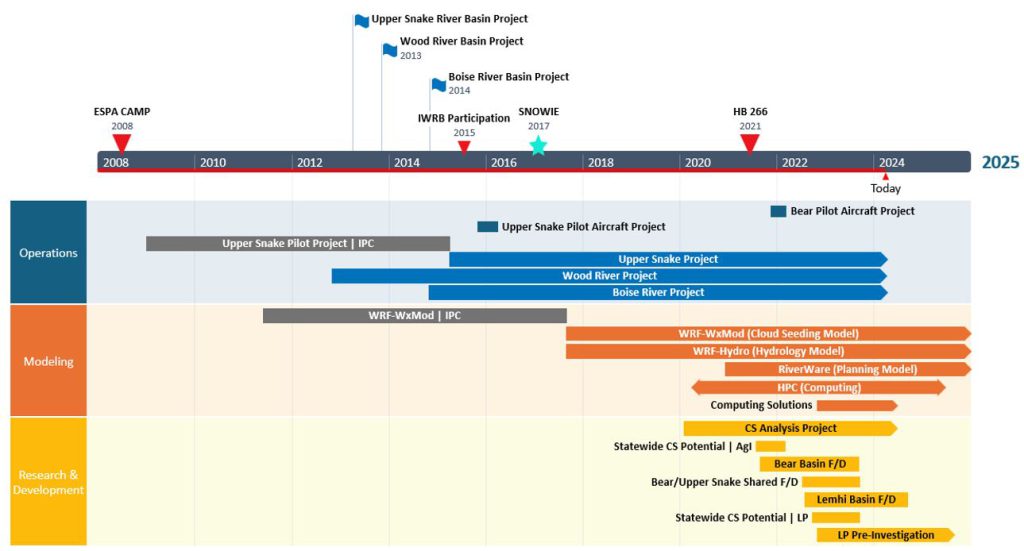
In 2015, IPC approached the IWRB about partnering for the build out of a full-scale program. The IWRB’s initial investment was for capital expenses to build out program infrastructure. Recognizing the importance of validation and long-term monitoring and analysis, the IWRB shifted its investments into cloud seeding to focus on the development of modeling and computing technologies to support cloud seeding operations, planning and design of projects, and ultimately program evaluation and long-term analysis. The Collaborative Cloud Seeding Program has continued to evolve, and currently exists as a partnership between IWRB, IPC, and local water users for the long-term operation of precipitation enhancement. A full timeline of the Collaborative Cloud Seeding Program is shown below.

- 2008 | ESPA CAMP implementation of a 5-year pilot project in the Upper Snake Basin; Operations and Funding by IPC
- 2013–2014 | Water users in the Wood and Boise River Basins approached IPC about the potential for developing new projects
- 2015 | IWRB provided cost share with IPC and began participation in program funding with capital for new infrastructure
- 2016 | IWRB began contributing towards program operations and modeling (1/3 total program cost)
- 2017 | IWRB partnered with IPC for development of Weather Research and Forecasting Cloud Seeding model (WRF-WxMod)
- 2017 | SNOWIE study field campaign in the Payette River Basin
- 2019 | Program reached existing build-out (3 aircraft, 57 remote generators, network of weather instrumentation) and initiated cloud seeding analysis
- 2019 | IWRB directed staff to conduct an analysis of cloud seeding (CS) operations (CS Analysis)
- 2020 | Initial results of the CS Analysis; IWRB directed staff to conduct a more detailed investigation, utilizing sophisticated modeling tools
- 2021 | Legislature passed House Bill 266 (HB266) on cloud seeding. Directed the IWRB to:
- Continue cloud seeding analysis
- Complete an assessment of cloud seeding opportunities statewide
- Authorize cloud seeding programs in State
- Provide authority to sponsor or develop local or statewide cloud seeding programs
- 2021 | IWRB directed staff to conduct: a more detailed cloud seeding analysis; a statewide cloud seeding assessment; and a feasibility and design study of the Bear River Basin
- 2021 | Bear River Basin Pilot Aircraft project
- 2022 | Statewide assessment results using silver iodide (AgI) presented to IWRB CS Committee
- 2022 | IWRB directed staff to conduct feasibility and design study of the Lemhi River Basin
Science Behind Cloud Seeding
What is cloud seeding?
Cloud seeding is a form of weather modification that increases the efficiency of a cloud by enhancing its natural ability to produce ice.
When an ice particle first forms, it collides with other water molecules and continues to grow until it becomes heavy enough to fall as precipitation in the form of rain or snow.
Why are clouds seeded?
Cloud seeding authorized by the Idaho Water Resource Board (IWRB) is used during the cold season to augment high elevation snowpack, a critical source of water supply for the state.
Cloud seeding is also used in other areas of the U.S. and around the world for rain enhancement, hail mitigation to reduce crop and infrastructure damage, and fog suppression.
Enhancement of winter snowpack ultimately results in increased runoff, and thus, the availability of water to support the unique needs of each basin or region.
Benefits of Increased Water Supply Include:
- Increased water availability for:
- Aquatic habitat
- Water quality
- Reservoir storage
- Flow augmentation
- Natural flow water rights
- Aquifer recharge
- Hydropower
- Recreation
- Extended seasonal flows due to increased high elevation snowpack:
- Fill of natural flow water rights
- Reduced dependency on storage water
- Increased reservoir carryover
What is a cloud?
Clouds are made up of water vapor (gas), tiny water droplets (liquid water), and ice particles (frozen water) within the atmosphere.
Water molecules can take many forms depending on the atmospheric conditions. In colder or mixed phase clouds, water molecules often become “supercooled.”
There are three types of clouds:
- All Liquid clouds: exist entirely of liquid water molecules at ~32°F
- Ice-Crystal clouds: exist entirely of ice crystals (e.g., cirrus)
- Mixed-Phase clouds: made up of both liquid and ice; temperatures 14°F to -31°F
What is supercooled liquid water (SLW)?
At standard pressure, water freezes at 32°F. However, under the right conditions, liquid water can exist below freezing—this is called
Supercooled Liquid Water (SLW).
SLW freezes instantly if disturbed or when it comes into contact with a surface, forming ice that grows as it collides with other molecules until heavy enough to fall as precipitation.
Try this at home!
How does a cloud form?
Clouds form when invisible water vapor condenses into droplets or ice crystals. As air rises, it expands, cools, and increases in
relative humidity until condensation occurs.
Clouds form via four main processes:
- Convection
- Orographic lifting (air rising over mountains)
- Convergence of air
- Frontal lifting

How does a snowflake develop in nature?

- A microscopic dust particle acts as a nucleus for freezing.
- Water molecules condense into a hexagonal lattice.
- Hexagonal platelets grow into a prism.
- Branching instabilities form arms on the corners of the structure.
- Changing conditions grow new plates repeatedly until the snowflake is heavy enough to fall—making each snowflake unique.
What kind of clouds commonly form in the winter in Idaho?
Due to Idaho’s mountain ranges, wintertime orographic clouds dominate.
These form when moist air lifts over mountains. In cold conditions, many contain Supercooled Liquid Water (SLW), but not enough ice forms naturally for precipitation.
Cloud seeding introduces particles that provide more “landing pads” for SLW to freeze upon, increasing precipitation.

How does cloud seeding work?

Cloud seeding is a physical process in which a seeding agent is released into an existing cloud containing SLW.
These particles act as nuclei, allowing SLW to freeze and grow into snowflakes until they fall as precipitation.
Seeding mimics natural precipitation processes by providing additional nuclei for freezing.
What seeding agent is used?

Silver Iodide (AgI)
Silver iodide (AgI) is the most common seeding agent. Its molecular structure resembles ice crystals, enabling ice formation at warmer temperatures.
AgI is inert, insoluble in water, and stable, meaning it does not react or accumulate in ecosystems.
Decades of use show no evidence of adverse impacts on humans, ecosystems, or the environment.

Is AgI water soluble?

AgI is insoluble, much like quartz sand. It does not dissolve in water, meaning its minerals do not break apart or become free in the environment.
How big is a particle of AgI?

AgI is burned and released as microscopic smoke-sized particles in very small quantities.
How does the process of cloud seeding work?

- Air flows over a mountain forming a cloud that contains supercooled liquid water. Storm systems are monitored to ensure incoming conditions are conducive for cloud seeding.
- A seeding agent, most commonly Silver Iodide (AgI), is released into the existing storm cloud by aircraft and/or ground-based generators. Seeding materials are only released during active storms with specific conditions conducive to ice formation. No existing cloud, no cloud “seeding.”
- Seeding materials disperse into the targeted cloud. This can occur by direct injection into or above the cloud via aircraft, or by ground-based dispersion carried into the cloud by winds.
- The silver iodide particles mimic the molecular shape of ice, providing “landing pads” for supercooled liquid water to freeze upon, forming ice crystals.
- Ice crystals grow at the expense of the SLW and become large enough to fall as snow, effectively “wringing out” more water from the cloud before it leaves the region.
What research has been done to demonstrate it works?
Cloud seeding was first demonstrated in a lab in 1946. In 2017, the Seeded and Natural Orographic Wintertime clouds: the Idaho Experiment (SNOWIE) provided the first unambiguous field evidence.
Researchers used a fully outfitted aircraft to release AgI plumes directly into clouds and measured the impacts with both ground-based and airborne instruments.
This created a detailed 4D picture of how seeded clouds evolved and confirmed that cloud seeding can produce winter precipitation.


The SNOWIE Project
Conducted by NCAR, Idaho Power, and universities, SNOWIE took place in Idaho’s Payette River Basin. Using over 75 instruments and research flights, it showed the “first unambiguous observations of the physical chain of events” after seeding supercooled orographic clouds
(Proceedings of the National Academy of Sciences).

How much additional precipitation is produced?
Proving that cloud seeding works took decades, but quantifying the exact amount remains complex. Research uses methods such as:
Target/Control Method
By comparing SNOTEL gage data from a “target” basin (where seeding occurs) with a climatologically similar “control” basin (where it does not), scientists can estimate additional precipitation as a percentage increase.
- Target: Area seeded with AgI
- Control: Comparable area with no seeding

Modeling
Cloud and hydrology models simulate precipitation increases and track where added water ends up in the system. Tools include:
- WRF Model
- WRF-WxMod (Cloud Seeding Model)
- WRF-Hydro (Hydrology Model)
- RiverWare (Planning Model)
More details can be found on the Research and Development page.

Downwind Effects
Atmospheric rivers move water like surface rivers, with natural gains and losses. Roughly 20% of atmospheric moisture condenses into clouds, and only 30% of that becomes precipitation—about 6% of the total water budget.
Cloud seeding affects less than 1% of the total budget. Evidence suggests a neutral or positive benefit for downwind users, as seeded nucleation can continue downwind, enhancing precipitation.

Methods of Seeding Clouds
Airborne Seeding

Aircraft release AgI via:
- Burn-In-Place (BIP) Flares: Mounted on wings, burned directly into clouds during flight.
- Ejectable (Ej) Flares: Dropped from the aircraft belly above clouds, used when flying through storms is unsafe.
Ground Seeding

Ground-based generators burn AgI solution, releasing smoke-sized particles carried by winds into storm clouds. Operated manually or remotely, they are typically placed on windward slopes.
Cloud Seeding Equipment


Images provided by Idaho Power Company.
Weather Instrumentation
- Weather Balloon: Provides vertical profiles of temperature, moisture, and winds.
- Ice Rate Sensors: Give real-time liquid water observations.
- Radiometer: Measures atmospheric water values in real-time.
- Radar: Detects precipitation and cloud structure.
- Web Cams: Offer visual confirmation of weather conditions.
- Precipitation Gauge: Records snow and rainfall rates and totals.
- Surface Station: Collects wind, temperature, dew point, and direction values.
Images provided by Idaho Power Company.
Are condensation trails and cloud seeding the same thing?
No. Contrails form when hot aircraft exhaust mixes with cold, moist air, creating ice clouds. Cloud seeding depletes existing clouds by introducing particles (AgI) that freeze supercooled water into snow.

Contrails: Create new clouds from engine exhaust.
Cloud Seeding: Enhances precipitation from existing clouds.
See the EPA Contrails FAQ for more information.
Helpful Resources
- Cloud Seeding Committee Meeting
- Interview with Idaho Water Resource Board
- Authorization and Liability with Cynthia Bridge Clark
- NCAR Cloud Seeding Steps
Publications
See resources from the
North American Weather Modification Council and the
Weather Modification Association.
FAQ’s
Other Resources
- How Cloud Seeding Works training module (COMET)
- NAWMC Workshop Slides
- NAWMC Website
- ASCE Guidelines
- Weather Modification Association Website
Current Projects and Programs
Collaborative Cloud Seeding Program:
Wood River Basin
Boise River Basin
Upper Snake River Basin
Idaho Power Company Projects:
Payette River Basin
High Country Resource Conservation & Development Projects:
Upper Snake River Basin
State of Utah Projects:
Northern Utah Program

Who Conducts Cloud Seeding in Idaho?
Collaborative Cloud Seeding Program
The Collaborative Cloud Seeding Program (Collaborative Program) is a partnership between the Idaho Water Resource Board (IWRB), Idaho Power Company (IPC), and local water users.
IPC operates the program, while IWRB facilitates and funds it. Local water users also provide financial support. IPC also runs an independent project in the Payette River Basin, coordinated with the Collaborative Program.
The program’s goal is to enhance snowpack and runoff. Operations are regional—West Central Mountains (Boise and Wood River Basins) and Eastern Mountains (Upper Snake Basin). Regional operations allow equipment sharing and cost-efficiency.


West Central Mountain Region:
- Boise River Basin
- Wood River Basin
- Payette River Basin
Eastern Mountain Region:
- Northern Upper Snake River Basin
- Southern Upper Snake River Basin
Idaho Power Company (IPC)
IPC independently manages the Payette River Basin project, with coordination through the Collaborative Program.
High Country Resource Conservation & Development (HCRCD) Program
HCRCD, operated by Let It Snow, has run manual generator operations in the Upper Snake River Basin for over 20 years. IPC provides forecasting support, but HCRCD runs its program independently, in coordination with the Collaborative Program.
State of Utah’s Northern Utah Program in Idaho
The Utah Division of Natural Resources (UT DNR) operates 3 ground seeding generators in southern Idaho to support the Northern Utah Cloud Seeding Program (Cache and Box Elder counties).

Projects In Idaho
Wood River Basin


Current Annual Basin: ~$769,000
- 1 Shared Aircraft (Boise)
- 3 Shared Generators
- 7 Dedicated Generators
Boise River Basin


Current Annual Basin: ~$1,025,000
- 1 Shared Aircraft (Payette)
- 1 Shared Aircraft (Wood)
- 12 Shared Generators
- 5 Dedicated Generators
Upper Snake River Basin

Northern Upper Snake River Basin

Southern Upper Snake River Basin


Current Annual Costs: ~$1,816,000
- 1 Dedicated Aircraft
- 25 Dedicated Remote Ground Generators
- 23 Dedicated Manual Generators (HCRCD)
Payette River Basin

Managed independently by IPC, coordinated with the Collaborative Program.
- 1 Shared Aircraft (Boise)
- 9 Shared Generators
- 7 Dedicated Liquid Propane Generators
- 8 Dedicated Generators
Basins of Interest
IWRB is studying cloud seeding in the Bear River and Lemhi River Basins.
Bear River Basin
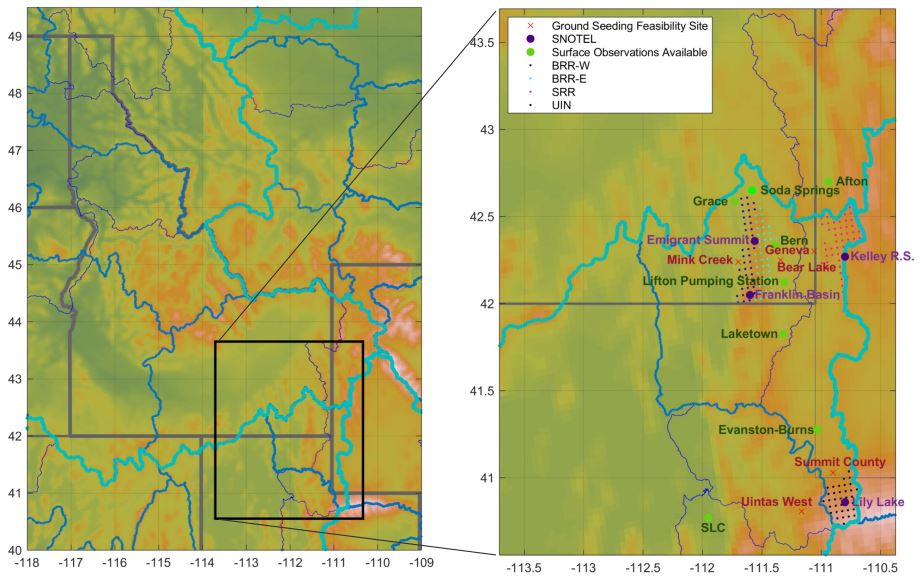
A 2021 feasibility study found Bear River viable for cloud seeding. Not yet operational.
Lemhi River Basin

A feasibility and design study launched in 2022 is evaluating viability. Not yet operational.
Research and Development
Research is critical for designing, developing, operating, monitoring, and assessing an effective cloud seeding program. Research helps the Idaho Water Resource Board (IWRB) address policy questions and public concerns, and ensures the objectives of water supply enhancements are being met in regions where operations occur.
The SNOWIE research project served as a catalyst across the drought-stricken western United States, showing proof of a method to bring more water to basins in need. Cloud seeding has been proven to work—but “how well does it work?” Quantifying the effects is the next big evolution in the science of cloud seeding. Research provides data for developing models that ultimately help IWRB understand how much water is being generated and how it affects water supply systems.
Models are also essential for forecasting storms to inform operations, determining the feasibility of new projects, designing those projects, and assessing the broader potential for cloud seeding across a region.

Current Research Projects
- Cloud Seeding Analysis
- Statewide Assessment of Cloud Seeding Opportunities
- Bear River Basin Feasibility and Design
- Upper Snake River Basin/Bear River Basin Feasibility and Design
- Lemhi River Basin Feasibility and Design
- Statewide Cloud Seeding Potential / Liquid Propane
- Liquid Propane Investigation
Modeling Projects
- Weather Research & Forecasting (WRF) model
- WRF-WxMod (Cloud Seeding Model)
- WRF-Hydro (Hydrology Model)
- RiverWare (Upper Snake River Planning Model)
- High Performance Computing Solutions
Research Projects
Cloud Seeding Analysis

In 2019, the Idaho Water Resource Board (IWRB) directed staff to conduct an investigation of cloud seeding in the basins where collaborative cloud seeding operations are conducted. The IWRB contracted with the National Center for Atmospheric Research (NCAR) to develop modeled cloud seeding data, as well as a WRF based hydrologic model, that can be used estimate the amount of water resulting from cloud seeding. The objective of the Cloud Seeding Analysis project is to determine how increased water supply from cloud seeding (CS) effects the hydrology and use of water in the targeted basins; and to determine the cost effectiveness of cloud seeding as a water management tool for Idaho.
Resources:
Cloud Seeding Analysis Presentation
Key Analysis Components
- How much did precipitation increase?
Using statistical target/control methods and developing physically based cloud seeding models supported by observational data. - How much water did the increase add to the system?
Developing a WRF-Hydro model to estimate impacts on streamflow. - Where does the increased supply go?
Replicating dynamic hydrologic systems and testing sensitivity to changes like added water supply.
Statewide Assessment

Initiated under HB266 (2021), this assessment identified regions in Idaho where cloud seeding is feasible based on historical weather data. It evaluated opportunities for both Silver Iodide (AgI) and Liquid Propane (LP). While AgI is field-proven, LP requires further study but shows promise in lab settings.
Bear River Basin Feasibility and Design
This study evaluated ground and aerial seeding opportunities targeting Bear Lake and stream reaches supplying Idaho. Findings showed considerable potential, with aerial operations being more effective due to flexibility and overcoming mountain flow blocking conditions.

Resources: Bear River Basin Feasibility and Design Slides
Upper Snake River/Bear River Basin Shared Feasibility and Design

This study explored shared infrastructure to support both basins. Some generators can serve dual purposes depending on wind conditions, enhancing cost-effectiveness.
Resources: Shared Ground Generators Impact Slides
Lemhi River Basin Feasibility and Design

Currently underway, this investigation will determine feasibility of cloud seeding in the Lemhi River Basin. No active operations are yet in place.
Liquid Propane Pre-Investigation

LP shows promise at warmer temperatures and lower costs compared to AgI. IWRB, IPC, NCAR, and CryoToolbox launched a pre-investigation phase in 2025 to test LP as a seeding agent.
Resources: Liquid Propane Cloud Seeding Year 1 Report
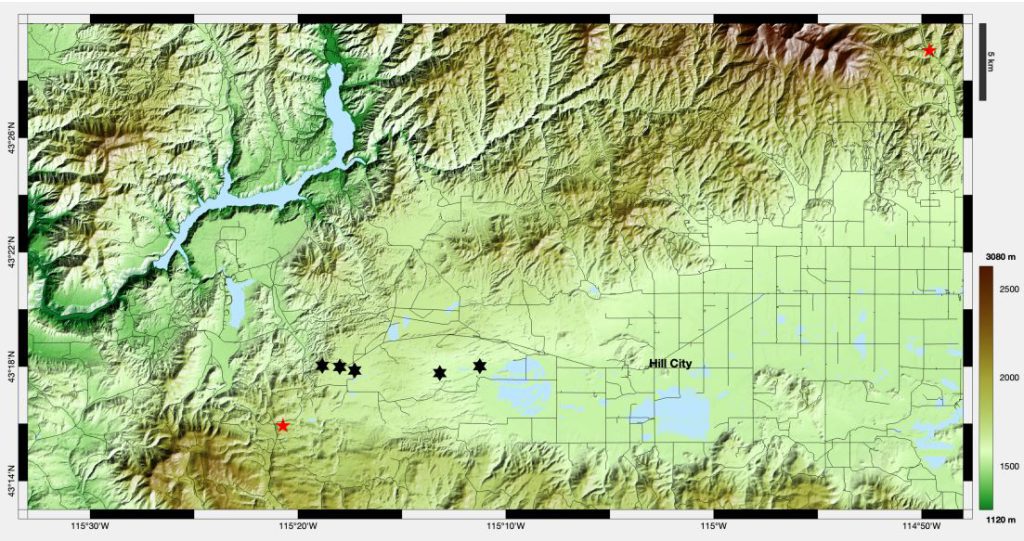
Silver Iodide (AgI) Research
A literature review, funded by 28 member states and agencies, is underway to assess silver iodide impacts in weather modification. Conducted by Heritage Environmental & Wisconsin State Laboratory of Hygiene, results are expected by Fall 2025.
Scope of Work:
- Natural atmospheric silver inputs to target regions
- Summary of silver in soils and freshwater
- Estimates of silver iodide deposition from programs
- Review of silver toxicity to organisms
- Discussion of natural vs. weather modification silver deposition
Modeling Projects
WRF Model
Developed in the late 1990s for atmospheric research, the Weather Research and Forecasting (WRF) model produces simulations of atmospheric conditions. However, national models struggle with Idaho’s mountainous terrain, requiring regional adaptations.
Resources: NCAR WRF Model Page
WRF-WxMod (Cloud Seeding Model)
A modified WRF model that integrates cloud seeding parameters. It helps design projects, validate operations, and forecast seeding opportunities. Coupled with WRF-Hydro, it estimates water impacts.
- 2011 | IPC initiated model development with NCAR
- 2017 | IWRB partnered for operational support
- 2023 | Expanded to Bear and Lemhi River Basins
Resources: NCAR WRF-WxMod Page
WRF-Hydro (Hydrology Model)
Produces forecasts for precipitation, streamflow, soil moisture, snowpack, flooding, and groundwater. Used for hydroclimate assessments in Idaho basins.
- Calibration of Upper Snake River Basin
- Calibration of Boise River Basin
- Calibration of Wood River Basin
Resources: NCAR WRF-Hydro Page
RiverWare (Upper Snake River Planning Model)
A reservoir regulation and hydrology model developed by USBR, updated by IDWR and IPC to include operations, diversions, water right accounting, and recharge. Supports planning for Snake River water management.
High Performance Computing
Large-scale modeling requires high-capacity computing. IWRB, IPC, Boise State University, and INL share an HPC system. Current needs exceed capacity, and new computing solutions are being investigated.
Program Administration
Program Budget:
Funding for the Cloud Seeding Program is authorized under the Idaho Water Resource Board’s (IWRB) Secondary Aquifer Planning and Management Fund (Secondary Fund). The Cloud Seeding Committee reviews the program budget and provides a funding recommendation to the IWRB; program funding is then approved as part of the IWRB’s Fiscal Year (FY) budget resolution for the Secondary Fund.
Partnership Agreements:
Since 2014, the IWRB has participated in a collaborative cloud seeding program with Idaho Power Company (IPC) and water users in the Boise River, Wood River, and Upper Snake River Basins. IPC conducts program operations, while the IWRB and local water users provide funding support.
North American Weather Modification Council:
The NAWMC is comprised of state and local resource managers involved in cloud seeding across North America. The IWRB is a Full Member, represented by its staff. The council serves as a forum for exchanging information on weather modification science and promoting the safe and effective use of these technologies.
Statutory Authority Timeline

Legislation
Idaho House Bill 266 (2021)
Directed the IWRB to:
- Continue analysis of existing cloud seeding projects
- Complete an assessment of opportunities in other basins
- Authorize cloud seeding programs in Idaho
Provides IWRB authority to:
- Sponsor or develop local or statewide programs
- State funds may only be used in basins where supplies are insufficient for existing rights, water quality, recreation, or fish/wildlife
Establishes that:
- Water supply from cloud seeding shall be distributed according to the prior appropriation doctrine
Authorizations
§42-4301 designates the IWRB as the agency responsible for authorizing cloud seeding projects. In May 2022, the IWRB adopted criteria to ensure compliance with laws and proper documentation of activities.
Current IWRB Authorizations:
- Idaho Collaborative Cloud Seeding Program
- Partnership managed by IWRB
- Operated by IPC
- Funded by IWRB, IPC, and basin stakeholders
- Idaho Power Company | Payette River Basin
- Operated and managed by IPC
- Remote ground generators
- Aircraft operations by Weather Modification International
- IPC Authorization
- High Country Resource Conservation & Development | Upper Snake River Basin
- Operated by Let it Snow, Inc
- Manual ground generators
- HCRCD Authorization
- State of Utah | Box Elder and Cache County
- Operated by North American Weather Consultants
- Manual ground generators
- Utah Authorization
Program Documents and Reports
§42-4301 provides directive for the Idaho Water Resource Board (IWRB) to authorize cloud seeding operations in the State of Idaho. The IWRB began requiring authorized cloud seeding projects to provide reports and documentation of operations in April 2021. Records prior to this date may be incomplete.
Cloud Seeding Program Suspension Criteria
2024–2025 Season Monthly Reports
April 2025
- Idaho Collaborative Cloud Seeding Program
- High Country Resource Conservation & Development (Coming Soon)
- State of Utah, Northern Program
March 2025
- Idaho Collaborative Cloud Seeding Program
- High Country Resource Conservation & Development
- State of Utah, Northern Program
February 2025
- Idaho Collaborative Cloud Seeding Program
- High Country Resource Conservation & Development
- State of Utah, Northern Program
January 2025
- Idaho Collaborative Cloud Seeding Program
- High Country Resource Conservation & Development
- State of Utah, Northern Program
December 2024
- Idaho Collaborative Cloud Seeding Program
- High Country Resource Conservation & Development
- State of Utah, Northern Program
November 2024
- Idaho Collaborative Cloud Seeding Program
- High Country Resource Conservation & Development
- State of Utah, Northern Program
Idaho Collaborative Cloud Seeding Program Annual Reports
- 2023/2024 Cloud Seeding Season
- 2022/2023 Cloud Seeding Season
- 2021/2022 Cloud Seeding Season
- 2020/2021 Cloud Seeding Season
- 2019/2020 Cloud Seeding Season
High Country Resource Conservation & Development Annual Reports
State of Utah, Northern Program Annual Reports
Documents and Additional Reports
2019-2020 Cloud Seeding Summary
Table 1. 2019-2020 Cloud seeding season summary data from Idaho Power Company (November 1st 2019 – April 15th 2020)
2019-2020 Collaborative Cloud Seeding Annual Report
During the WY2020 cloud seeding season, IPC operated 32 remote ground-based cloud seeding generators, 2 cloud seeding aircraft (operated by WMI), 1 automated surface observing system (ASOS), 2 radiometers and 11 high resolution precipitation gauges in the Central Mountains Cloud Seeding Project focusing on the Payette, Boise and Wood River Basins. In the Upper Snake Basin, the High-Country RC&D (HC RC&D) operated 25 manual ground based cloud seeding generators (operated by Let It Snow), IPC operated 1 cloud seeding aircraft (operated by WMI) and 25 remote ground based cloud seeding generators, 1 ASOS, 2
radiometers and 2 high resolution precipitation gauges. As part of the collaborative efforts in the Upper Snake Basin, IPC provides its weather and cloud seeding operations forecasts and other scientific support to Let It Snow in support of its operation of manual ground generators.
Monthly Operations Summary
Figure 1. 2019-2020 Cloud seeding ground generator operational hours by month by basin (created by Idaho Power Company)
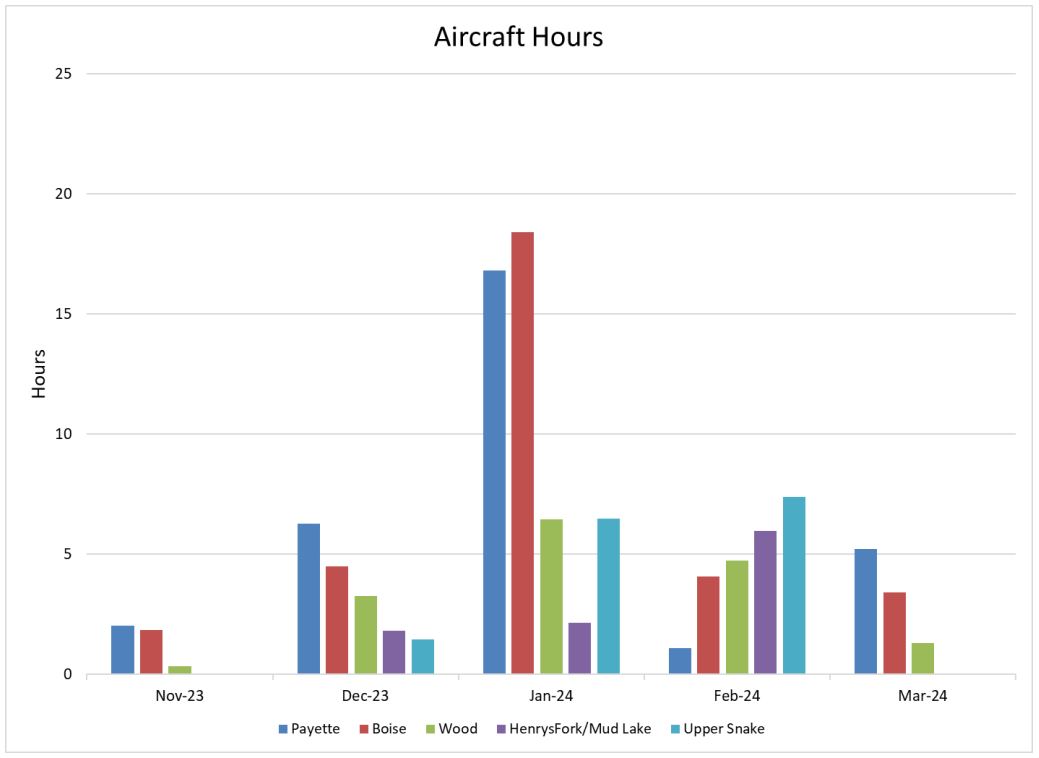
Figure 2. 2019-2020 Cloud seeding aircraft operational hours by month by basin (created by Idaho Power Company)
2020-2021 Cloud Seeding Summary

Table 1. 2020-2021 Cloud seeding season summary data from Idaho Power Company (November 1st 2020 – April 15th 2021)
2020-2021 Collaborative Cloud Seeding Annual Report
During the WY2021 cloud seeding season, in the Central Mountains IPC operated 32 remote ground-based cloud seeding generators, 2 cloud seeding aircraft (operated by WMI), 1 automated surface observing system (ASOS), 2 radiometers and 11 high resolution precipitation gauges focusing on the Payette, Boise and Wood River Basins. In the Upper Snake Basin, the High-Country RC&D (HC RC&D) operated 25 manual ground based cloud seeding generators (operated by Let It Snow), IPC operated 1 cloud seeding aircraft (operated by WMI) and 25 remote ground based cloud seeding generators, 1 ASOS, 2 radiometers and 2 high resolution precipitation gauges. As part of the collaborative efforts in the Upper Snake Basin, IPC provides its weather and cloud seeding operations forecasts and other scientific support to Let It Snow in support of its operation of manual ground generators.
Monthly Operations Summary

Figure 1. 2020-2021 Cloud seeding ground generator operational hours by month by basin (created by Idaho Power Company)

Figure 2. 2020-2021 Cloud seeding aircraft operational hours by month by basin (created by Idaho Power Company)
2021-2022 Cloud Seeding Summary

Table 1. 2021-2022 Cloud seeding season summary data provided by Idaho Power Company (November 1st 2021 – April 15th 2022)
2021-2022 Collaborative Cloud Seeding Annual Report
During the WY2022 cloud seeding season, in the Central Mountains IPC operated 32 remote ground-based cloud seeding generators, 2 cloud seeding aircraft (operated by WMI), 1 automated surface observing system (ASOS), 2 radiometers and 11 high resolution precipitation gauges focusing on the Payette, Boise and Wood River Basins. In the Upper Snake Basin, the High-Country RC&D (HC RC&D) operated 25 manual ground based cloud seeding generators (operated by Let It Snow), IPC operated 1 cloud seeding aircraft (operated by WMI) and 25 remote ground based cloud seeding generators, 1 ASOS, 2 radiometers and 2 high resolution precipitation gauges. As part of the collaborative efforts in the Upper Snake Basin, IPC provides its weather and cloud seeding operations forecasts and other scientific support to Let It Snow in support of its operation of manual ground generators.
Monthly Operations Summary

Figure 1. 2021-2022 Cloud seeding ground generator operational hours by month by basin (created by Idaho Power Company)

Figure 2. 2021-2022 Cloud seeding aircraft operational hours by month by basin (created by Idaho Power Company)
2022-2023 Cloud Seeding Season Summary
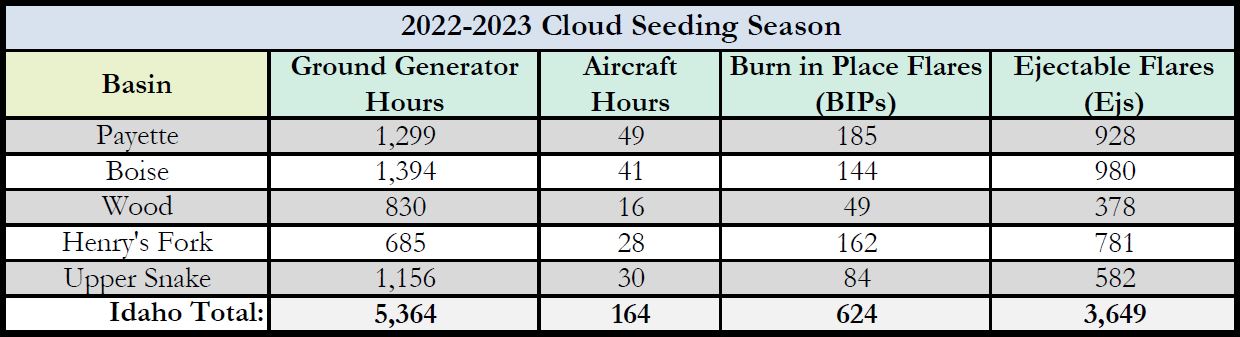
Table 1. 2022-2023 Cloud seeding season summary data provided by Idaho Power Company (November 1st 2022 – April 15th 2023)
2022-2023 Collaborative Cloud Seeding Annual Report
During the WY2023 cloud seeding season, in the Central Mountains IPC operated 32 remote ground-based cloud seeding generators, 2 cloud seeding aircraft (operated by WMI), 1 automated surface observing system (ASOS), 2 radiometers and 11 high resolution precipitation gauges focusing on the Payette, Boise and Wood River Basins. In the Upper Snake Basin, the High-Country RC&D (HC RC&D) operated 25 manual ground based cloud seeding generators (operated by Let It Snow), IPC operated 1 cloud seeding aircraft (operated by WMI) and 25 remote ground based cloud seeding generators, 1 ASOS, 2 radiometers and 2 high resolution precipitation gauges. As part of the collaborative efforts in the Upper Snake Basin, IPC provides its weather and cloud seeding operations forecasts and other scientific support to Let It Snow in support of its operation of manual ground generators.
Monthly Operations Summary
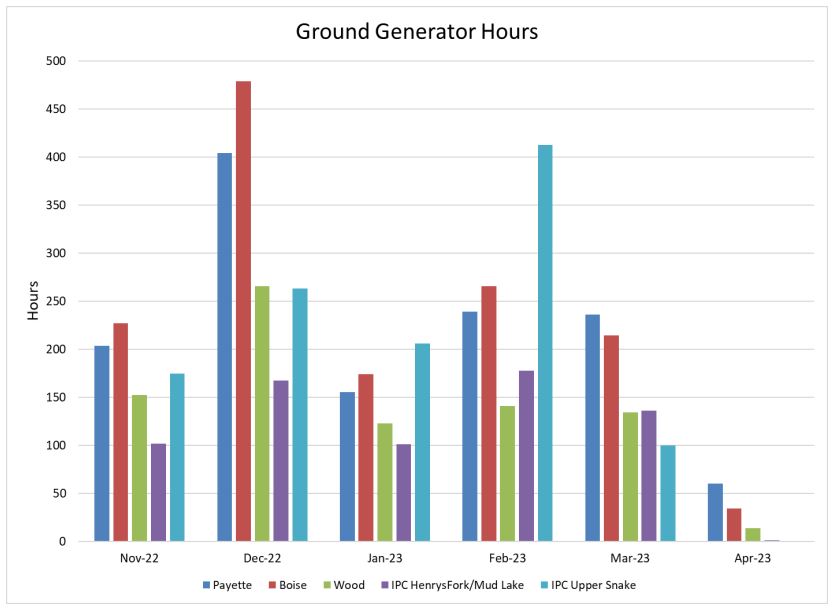
Figure 1. 2022-2023 Cloud seeding ground generator operational hours by month by basin (created by Idaho Power Company)
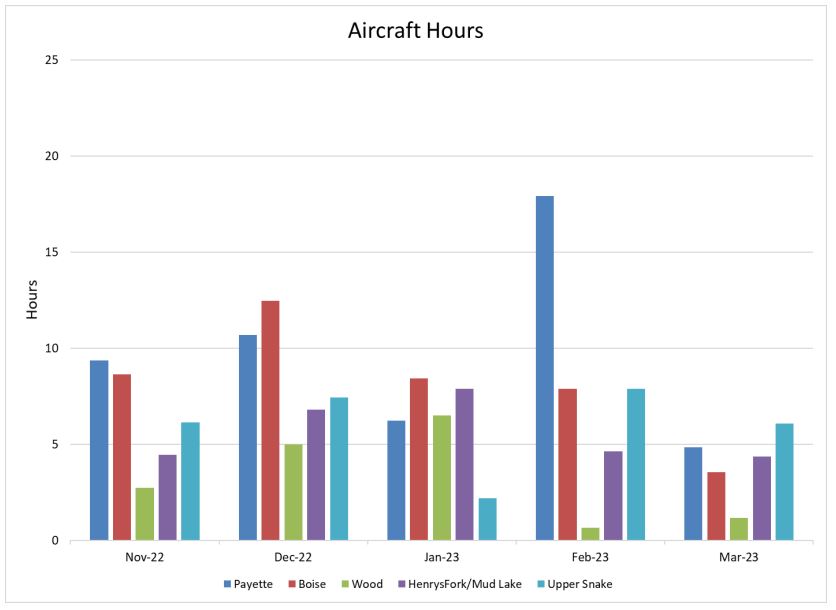
Figure 2. 2022-2023 Cloud seeding aircraft operational hours by month by basin (created by Idaho Power Company)
2023-2024 Cloud Seeding Season Summary

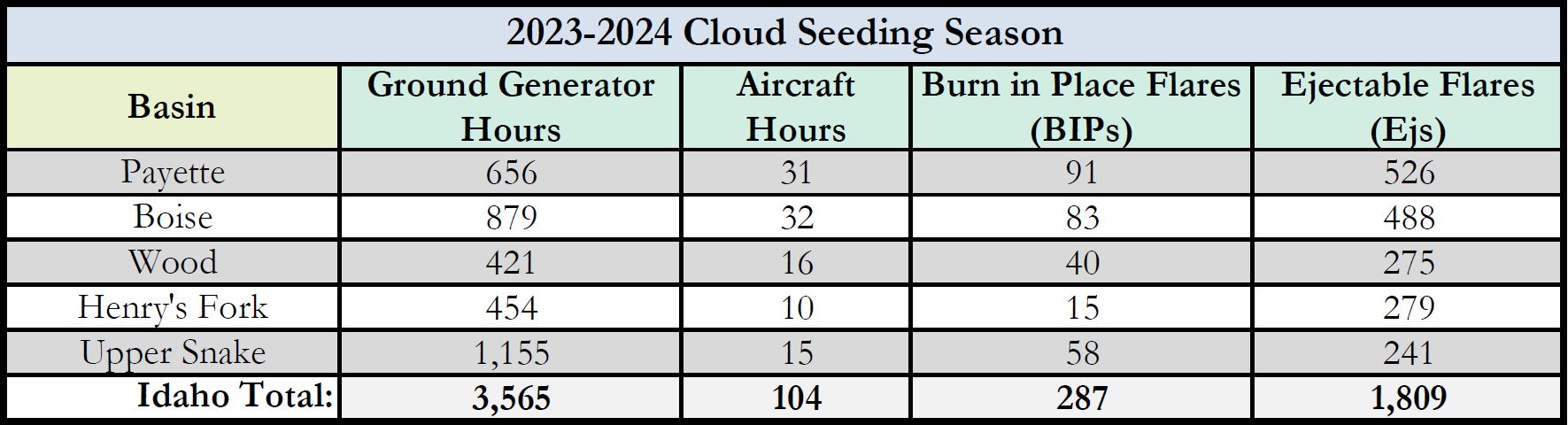
Table 1. 2023-2024 Cloud seeding season summary data provided by Idaho Power Company (November 1st 2023 – April 30th 2024)
2023-2024 Collaborative Cloud Seeding Annual Report
During the WY2024 cloud seeding season, in the Central Mountains IPC operated 32 remote ground-based cloud seeding generators, 2 cloud seeding aircraft (operated by WMI), 1 automated surface observing system (ASOS), 2 radiometers and 11 high resolution precipitation gauges focusing on the Payette, Boise and Wood River Basins (Figure 5). In the Upper Snake Basin, the High-Country RC&D (HC RC&D) operated 25 manual ground based cloud seeding generators (operated by Let It Snow), IPC operated 1 cloud seeding aircraft (operated by WMI) and 25 remote ground based cloud seeding generators, 1 ASOS, 2 radiometers and 2 high resolution precipitation gauges (Figure 6 and 7). As part of the collaborative efforts in the Upper Snake Basin, IPC provides its weather and cloud seeding operations forecasts and other scientific support to Let It Snow in support of its operation of manual ground generators.
Monthly Operations Summary

Figure 1. 2023-2024 Cloud seeding ground generator operational hours by month by basin (created by Idaho Power Company)
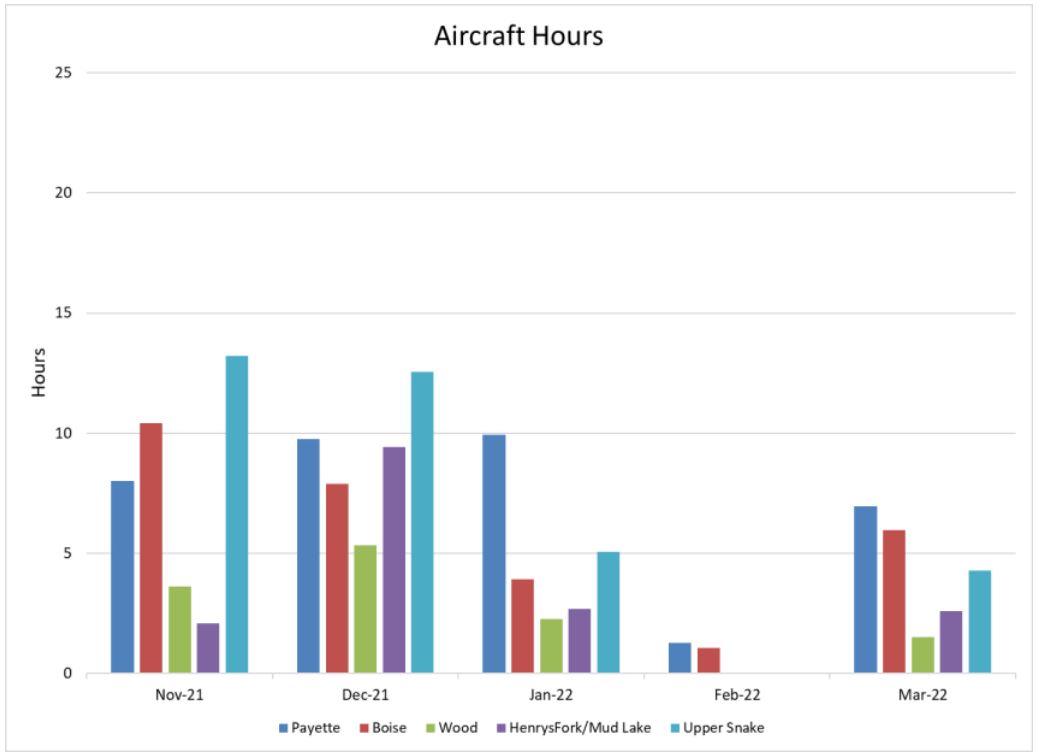
Figure 2. 2023-2024 Cloud seeding aircraft operational hours by month by basin (created by Idaho Power Company)