Statewide Groundwater Quality Monitoring Program Overview
Background
Background
The Groundwater Quality Protection Act, passed by the Idaho State Legislature in 1989, authorized a comprehensive approach for maintaining and improving Idaho’s groundwater quality. The Act resulted in the formation of the Groundwater Quality Council, which developed the Idaho Groundwater Quality Plan in 1992. The monitoring component of the plan outlined the need for statewide, regional, and local groundwater quality monitoring.
In 1990, the Idaho Department of Water Resources (IDWR), with help from other state and federal agencies, began the Statewide Groundwater Quality Monitoring Program. The Statewide Program provides valuable information about Idaho’s groundwater quality to private citizens, consulting companies, and governmental entities—as well as provides data for the Environmental Data Management System (EDMS) database.
Objectives
The objectives of the Statewide Program are to:
- characterize the groundwater quality of the state’s major aquifers,
- identify trends and changes in groundwater quality within the state’s major aquifers, and
- identify potential groundwater quality problem areas.
Responsibilities
The Statewide Groundwater Quality Monitoring Program (Statewide Program) began in 1990 with a limited prototype network of 97 monitoring sites. In 1991, the funding was increased significantly both from the State of Idaho and the Federal government (USGS). This funding enabled the State to sample about 400 sites to the network each year from 1991 through 1994. By the fall of 1994, the Statewide Program network included over 1,500 monitoring sites.
Every year, about 250 monitoring sites are sampled. Most sites are sampled once every five years. Water quality results include: nutrients, common ions (e.g. calcium, magnesium), trace elements (e.g. iron, arsenic, uranium), pesticides, and emerging contaminants.
Groundwater Quality Results
Overall, the groundwater in Idaho has mostly been found safe for human consumption and other beneficial uses at most of the Statewide Program sites. However, some sites have concentrations of one or more constituents that exceed the safe levels (known as Maximum Contaminant Levels [MCLs]) that have been established by the U.S. Environmental Protection Agency (EPA) for public water systems. Southern Idaho has a higher percentage of these sites than central and northern Idaho. Nitrate, arsenic, uranium, and fluoride are the main constituents found to exceed MCLs.
Nitrate
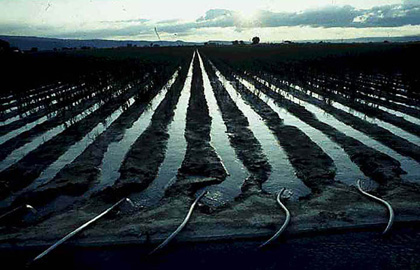
Nitrate in Idaho’s groundwater is considered to be caused by activities on the land surface (agriculture, wastewater applications, and septic systems). Five percent of the Statewide sites have had nitrate concentrations over the MCL of 10 milligrams per Liter (mg/L), and 33% of the sites have had impacted levels of nitrate (2 to 10 mg/L). Nitrate trends have been studied using three approaches:
- Hydrogeologic Subareas (as defined by the IDWR)
- Nitrate Priority Areas (as defined by the Idaho Department of Environmental Quality)
- Annual Sites
Nitrate has increased in a number of areas—mostly in southern area. The most significant increasing trends have been documented in four Nitrate Priority Areas: Twin Falls, Ada/Canyon, NE Star, and Marsing.

Arsenic
Arsenic has also been studied for patterns and trends. The MCL for arsenic in groundwater is 10 parts per billion. Arsenic has exceeded the MCL at 15% of the Statewide Program sites. Arsenic concentrations in Idaho’s groundwater are considered to be naturally-occurring. In Idaho, arsenic occurs commonly in groundwater in certain areas in the southern part of the state, such as the Weiser area (southern Washington County), the Treasure Valley (Ada and Canyon Counties), and Twin Falls County.
Uranium
Uranium has more recently been studied for patterns and trends, particularly in the Treasure Valley. The MCL for uranium is 30 parts per billion and approximately 20% of wells sampled for the Statewide Program in Ada and Canyon Counties have exceeded this MCL. Uranium concentrations in Idaho’s groundwater are considered to be naturally-occurring. See the publications page for reports on uranium.
Fluoride and Gross Alpha
Other constituents that have results that exceeded the MCLs are fluoride and gross alpha.
Pesticides
Pesticides have also been detected at some Statewide sites, with Atrazine being the most commonly detected compound. Fortunately, the concentrations of the detected pesticides have been well below any MCLs or Health Advisories.
Publications
The publications listed below are Archived records of the Department.
Groundwater Quality Information & Resources
Groundwater Quality Links
- Idaho Department of Environmental Quality (DEQ)
- Environmental Protection Agency (EPA) – Information on drinking water and groundwater.
- Idaho State Department of Agriculture – A surface water and ground quality program relating to pesticides, nutrients, and animal waste impacts.
- USGS – Data on water quality, surface water, and groundwater throughout Idaho and the United States.
- NSF – Information on drinking water including treatment options and contaminant guides.
- Idaho Department of Health & Welfare – Information pertaining to drinking water and environmental health.
- Environmental Information Exchange Network – The Exchange Network is a partnership among States, Territories, Tribes, and the U.S. Environmental Protection Agency that is improving and expanding the exchange of environmental information.
Drinking Water Testing and Certification
Visit the Health & Welfare website for a list of labs certified to analyze drinking water in Idaho and for helpful resources for testing.
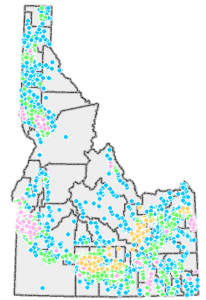
Groundwater Quality Map
Environmental Data Management System (EDMS)
The Environmental Data Management System (EDMS) is a central database designed to house Idaho groundwater quality data and well characteristics from several state agencies and provide for easy access and retrieval via the internet. This data can be used for trend monitoring, parameter-specific studies, remediation studies, or to define environmental characteristics in an area.
EDMS History
The Groundwater Quality Protection Act of 1989 provided for development of this comprehensive system to manage groundwater data. The Idaho Groundwater Protection Interagency Cooperative Agreement of 2008 establishes EDMS as the repository for groundwater quality data to facilitate cooperative groundwater protection programs among multiple state agencies.
EDMS presently contains more than 870,000 analytical results records from laboratory tests for contaminants and water measurement parameters. These were produced from more than 35,000 groundwater samples taken at over 6,000 sites throughout Idaho by many agencies, including IDWR, IDEQ, ISDA, State Health Districts, and also USGS, USBR, and USACE.
Click the Groundwater Quality Map to view the data stored in the Environmental Data Management System (EDMS).
Groundwater Quality Contacts
For more information about Idaho’s groundwater quality, send an email to our Water Quality team.
Interested in joining the team?
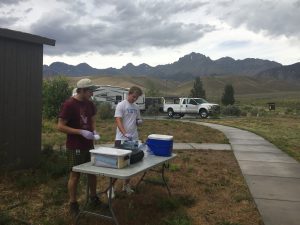
Every summer, the Statewide Program hires hydrologic technicians to collect groundwater samples across the state of Idaho. If you are interested in learning more about these positions, please reach out to our Water Quality team at any point of time.