
IDWR will hold claims taking workshops September 22-24, 2026 at the Exhibit Hall (previous room was the Valley Event Center) located at the Boundary County Fairgrounds in Bonners Ferry, Idaho. IDWR staff will be on-site 8a-6p to assist the public with filing KRBA claims.
Kootenai River Basin Adjudication (KRBA) Overview
Idaho Code § 42-1406D, effective July 1, 2024, authorized the Idaho Department of Water Resources to petition the district court to commence an adjudication of the water rights from surface water and ground water sources in the Kootenai River basin. The statute concludes that
“Effective management of the waters of the Kootenai River basin requires that a comprehensive determination of the nature, extent, and priority of the rights of all users of surface and ground water be determined.“
On November 13, 2024, the Idaho Supreme Court issued a Provisional Order appointing the Presiding Judge of the Idaho Water Adjudications in the Fifth Judicial District of the State of Idaho as the Presiding Judge over Kootenai River Basin Adjudication (KRBA). The Presiding Judge of the Idaho Water Adjudications is currently Judge Eric Wildman.
A Petition to Commence the KRBA was filed on January 3, 2025. On January 9, 2025, the Idaho Water Adjudications issued an order setting a hearing on the commencement order for April 15, 2025.
On March 6, 2026, the Idaho Water Adjudications court issued a Commencement Order for the Kootenai River Basin Adjudication.
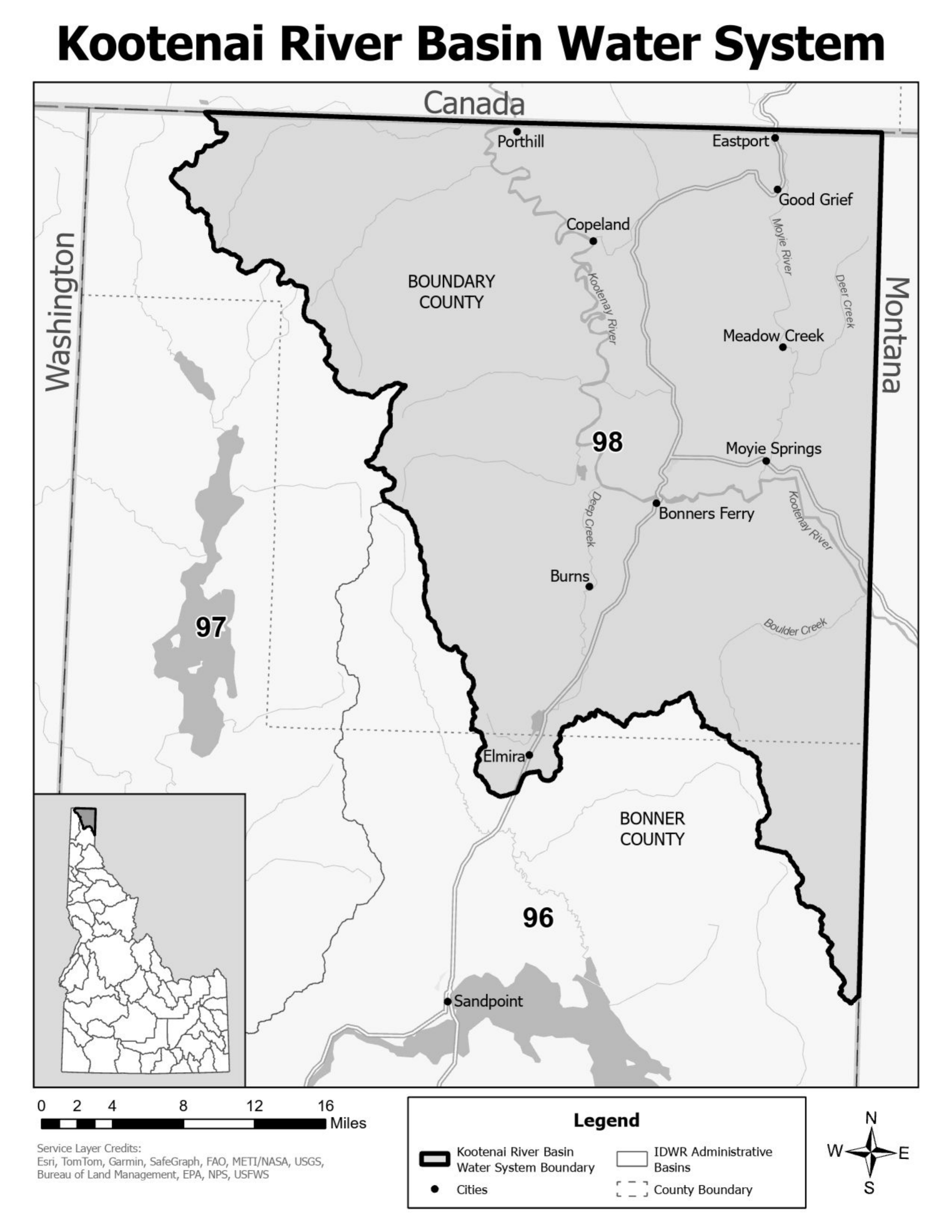
August 14, 2026: IDWR mailed the Kootenai River Basin Adjudication (KRBA) Commencement Notice to property owners in Administrative Basin 98. The deadline for filing a Notice of Claim to a Water Right is June 4, 2027.
Documents in the Mailing:
If you need filing assistance or have questions, please contact the Northern Regional Office at (208) 762-2800 or northerninfo@idwr.idaho.gov or the Adjudication Hotline at (800) 451-4129 or NIA.Help@idwr.idaho.gov.
Archived Commencement Documents, Notices, Mailings, & Filing Deadlines
Commencement Documents
- Commencement Order for the Kootenai River Basin Adjudication– March 6, 2026
- Memorandum Decision of Petition to Commence Kootenai River Basin Adjudication – March 6, 2026
- Memorandum Decision on Optional Deferral Process – March 6, 2026
- Order Establishing Procedures for the Adjudication of De Minimis Domestic and Stockwater Claims – March 6, 2026
- Affidavit of Publication – October 8, 2025
- Order Denying Motion to Adopt Proposed De Minimis Procedures – September 16, 2025
- Notice Setting Status Conference – August 20, 2025
- Order Continuing Commencement Hearing – July 16, 2025
- Order Granting Joint Motion for Extension – March 27, 2025
- Order Setting Commencement Hearing and Procedures for Hearing – January 9, 2025
- Petition to Commence Kootenai River Basin Adjudication – January 3, 2025
Idaho Supreme Court appoints Fifth Judicial District as the Presiding Judge over the KRBA- November 13, 2024
Legislative authorization to adjudicate the waters of the Kootenai River Basin – July 1, 2024
Room change at location:
IDWR will hold claims taking workshops September 22-24, 2026 at the Exhibit Hall (previous room was the Valley Event Center) located at the Boundary County Fairgrounds in Bonners Ferry, Idaho. IDWR staff will be on-site 8a-6p to assist the public with filing KRBA claims.
Helpful Links
IDAPA 37.03.01 – Adjudication Rules
Title 42, Chapter 14: Adjudication Statutes
Videos to Help You File Online
Submit and Pay Online-Online Claim and Permit Help
Submit and Pay By Mail – Online Claim and Permit Help
Placing a POD using PLS- Online Claim and Permit Help
Placing a POD using Water Right-Online Claim and Permit Help
Placing a POD using GPS-Online Claim and Permit Help
Placing a POD using Map Online Claim & Permit Help
Claim Filing FAQs
How do I know if I should file a claim?
A Notice of Claim should be filed for all water rights including unrecorded water rights (established through historic use by the diversion and application of water to a beneficial use), previously decreed or licensed rights, or water right permits if proof of beneficial use was filed on or before the commencement of the Adjudication.
Water users of a small domestic and/or stockwater (“D&S”) right, as defined by Idaho Code §§ 42-111 & 42-1401A, may elect to file a Notice of Claim now or defer (postpone) the filing until a later time in this proceeding.
What to file Flowchart: Adjudication Claim-or-Application for Permit
How do I know if I have a water right?
In Idaho, establishing a water right requires that water is diverted and put to beneficial use. If there is no history of diversion and use, then a water right has not been established.
Prior to March 25, 1963, for ground water, and May 20, 1971, for surface water, a water right could be established by simply diverting water and putting it to beneficial use. The permit system for establishing a water right became mandatory for uses developed from ground water after March 25, 1963 (except for domestic purposes as defined by Section 42-111, Idaho Code), and for uses developed from surface water after May 20, 1971 (except for watering stock directly from streams).
Can I complete the claim form myself?
Yes, most claimants complete the Notice of Claim forms without requiring additional assistance. The online, claim-filing procedure steps you through the process. To get started, review the “Before You Start” information on the Online Claims Taking page. If you prefer to submit a paper form, visit the Adjudication Forms page.
What happens if I do not file a claim?
If an adjudication claim is required for your water use, failure to file that claim before the final decree will result in a determination that the water right no longer exists. However, water users with small domestic and/or stockwater rights, as defined in Idaho Code §§ 42-111 & 42-1401A, may defer (postpone) filing a claim until a later time in the adjudication proceeding. Although a deadline for filing claims for these “deferrable” domestic and stockwater rights has not been set, the opportunity to defer filing is not indefinite. At some future time, the court will establish a filing deadline for small domestic and stockwater rights. IDWR recommends filing a claim for a small domestic or stockwater right now and not deferring.
If I have undeveloped property and water has never been used on it, do I need to file a claim?
No. An adjudication is a court action for the determination of existing water rights. When you want to begin using water, contact the Idaho Department of Water Resources to file an application for permit.
If I receive my water from a city system or water district, do I need to file, and will my water bill increase because of the adjudication?
If you are supplied water by a city, water district, or other water delivery organization, that entity should file a claim for your use.
You can verify that your water delivery organization has filed a claim by using the Water Right & Adjudication Search or by contacting your water delivery organization.
There is a one-time fee associated with filing an adjudication claim. However, the amount of those fees should not result in the need for water providers to increase bills for their customers.
How will the adjudication be funded?
A combination of water right claim filing fees and Idaho General Tax Fund appropriations will pay for the adjudication. Current estimates place the ratio at approximately 1/10 fees and 9/10 general fund dollars.
Will there be an annual tax on private wells?
The Idaho Legislature would need to pass new legislation in order to impose a tax on private wells.
Will IDWR require meters on private domestic wells as part of the adjudication?
No. An adjudication determines the priority and other elements of existing water rights. It does not address the day-to-day administration of water rights. This is not to say IDWR would never require a well to be metered. For example, if a dispute arose between water users over the impact of ground water pumping on the supply of water available to water right owners, IDWR may require metering of the wells involved in the dispute. However, IDWR does not have the directive, need, or resources to require meters on all private domestic wells.
Priority Date FAQs
What is a priority date?
The priority date is one of the elements of the water right required on your notice of claim. The priority date is the basis upon which water is distributed in times of shortage. When there is not enough water to satisfy all existing water rights, then water is distributed first to those with the oldest priority date.
Generally, the priority date of a beneficial use right is the date the water was first put to beneficial use. This date is not necessarily when you acquired the property, or when you first made beneficial use. A previous owner could have established beneficial use, which you continued.
.
I am only claiming domestic and/or stockwater use. Do I really have to provide evidence of my priority date?
No. Small domestic and/or stockwater claims where quantity used is less than 13,000 gallons per day do not require evidence of the priority date.
What is a beneficial use water right?
A claim is a beneficial use claim if it is not based on a permit or license issued by IDWR or a decree issued by a court.
A beneficial use water right is established by putting the water to beneficial use, such as for irrigation, hydropower, commercial or industrial use.
Generally, the priority date of a beneficial use right is the date the water was first put to beneficial use. This date is not necessarily when you acquired the property, or when you first made beneficial use. A previous owner could have established beneficial use, which you continued. ‘Posted notice’ water rights are considered a type of beneficial use water right because they are not confirmed by a permit, license or decree. See the frequently asked question “What if I have a ‘posted notice’ water right?” for more information on posted notice water rights.
When is evidence of priority required?
The claim is based on beneficial use.
What kind of evidence is required?
Some evidence of the year of the priority date claimed is sufficient. Evidence of the month and day is not required, but should be included if available.
Documentation of the priority date can take many forms. Generally, the document will be sufficient if it shows water was used:
- For the purpose(s) claimed,
- In the year claimed as the priority date, and
- On the land claimed as the place of use or by the owner of that land.
It is possible for a water right to have been established on one parcel of land and then transferred for use on another. In such cases, the evidence should show water was used on the original place of use or by the owner of the original place of use to meet the third part of the requirement.
What are some examples of acceptable evidence?
Note: Proof of ownership of land by a title or warranty deed usually does not, by itself, constitute proof of a priority date since the priority is based on use of water.
Here are a few examples of what may constitute acceptable evidence:
- Affidavits – a notarized statement of someone with personal knowledge of when beneficial use was first made. Personal knowledge means someone who observed the use, such as a neighbor or previous owner, not someone who was told of the use by someone else. Click here for a printable affidavit form.
- For irrigation claims – crop reports, income tax documents showing income from sale of crops, or property tax documents showing property was historically taxed as irrigated agriculture
- For ground water rights – the report of the well driller who drilled the well, if a report was filed with IDWR. Click here to search for a well log on file with IDWR.
- Pump test records
- Sales receipts for equipment of materials used in the water system
- Records of the person or business who sold, installed or constructed the diversion works
- Electric bills for electric powered diversion equipment
- Homestead documents for water patents, patent documentation for mining claims or other documentation indicating use of water during the acquisition of government land. These may be of record at the county recorder’s office for the county in which the land is located. These should also be of record with the National Archives at www.archives.gov.
- Aerial photography showing the property being used for the purpose claimed. This is most commonly used to provide proof of historic irrigation. Information on available aerial photography can be obtained from the United States Geological Survey (USGS) at the following website: https://earthexplorer.usgs.gov.
What if I am unable to obtain any of the traditional sources of evidence?
The list under the frequently asked question “What are some examples of acceptable evidence?” is only a sampling of available kinds of information. If you cannot furnish some proof such as the examples listed in the frequently asked question “What are some examples of acceptable evidence?”, you may also submit your own testimony, in the form of an affidavit, which explains the basis for the year of priority claimed. The letter should include a statement of the claimant’s personal knowledge of the water use, but may also include information the claimant obtained from others. Click here for a printable affidavit form.
What documents are not accepted?
- Statutory claims. In the late 1970s, legislation (Idaho Code 42-243) was enacted that required persons with beneficial use rights to register them with IDWR. These “claims” were declarations of the water users, and were not investigated or verified. The statutory claim may be evidence of beneficial use only as the date the statutory claim was filed, not as of the priority date claimed either in the statutory claim or the notice of claim filed in the SRBA or the NIA.
- Posted Notices. See the frequently asked question “What if I have a ‘posted notice’ water right?” for more information on posted notice water rights.
What happens if evidence of the priority date is not submitted?
IDWR will recommend the claim be disallowed to the court. If proof is submitted but it supports a priority date later than the year claimed, then a later year will be recommended.
What if I have a posted notice?
There is a special category of beneficial use rights called posted notice rights, to which special rules apply. Prior to 1903, Idaho had a ‘posted notice’ statute which provided for, among other things, posting of a notice including specified information at the point of diversion, recording the notice at the county recorder’s office, and diversion and beneficial use within a reasonable time after posting. If the requirements were met, then the priority date was the date of posting the notice. These posted notice water rights are considered a type of beneficial use water right because they are not confirmed by a permit, license or decree.
The posted notice may be evidence of a priority date as of the date the notice was posted, but only if some evidence is also submitted showing completion of the appropriation within a reasonable time after posting of the notice.
Where do I send my evidence of priority?
You can submit evidence of priority in person or by mail to the following offices. If you’re coming in person, call ahead to make an appointment. If you do not have an appointment, we may be serving other claimants and unable to meet with you. Write the claim number on all documents submitted. You will receive your claim number on the Finalize and Submit page after all elements of the claim are entered. Kootenai River Basin Adjudication (KRBA) address:
North Idaho Adjudication address:
IDWR Northern Regional Office
Adjudication Bureau
7600 Mineral Dr Suite 100
Coeur d’Alene, ID 83815
(208) 762-2800 northerninfo@idwr.idaho.gov
IDWR State Office:
Adjudication Bureau
322 East Front Street
Boise, ID 83720
(208) 287-4800